
Shoulder Innovations’ Specialty Focus Drives Growth Amid Supply Chain and Profitability Challenges
Latest quarterly results highlight expanding implant sales and procedural adoption amidst ongoing losses and supply risks.
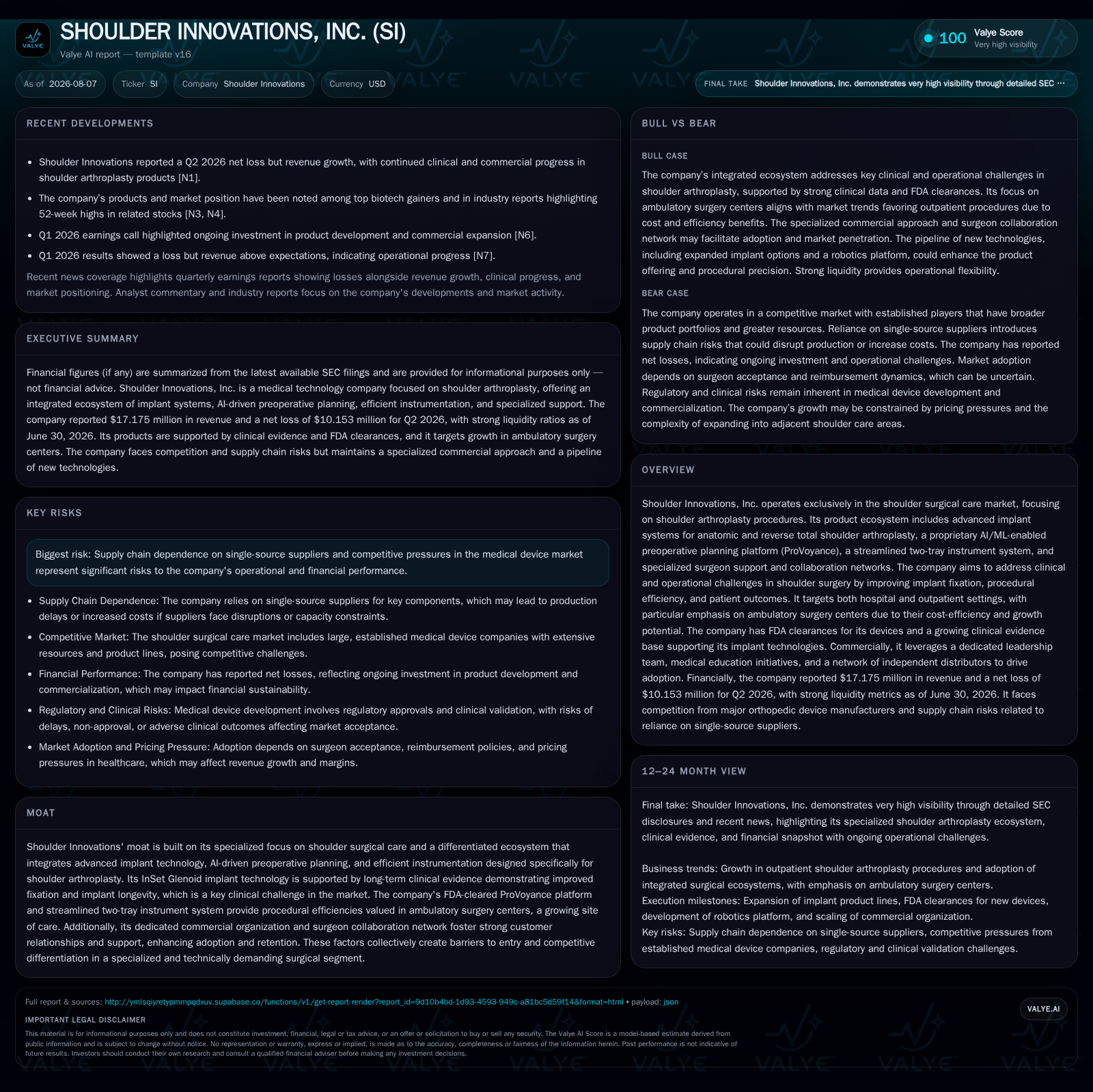
Shoulder Innovations, Inc. continues to build on its specialized shoulder arthroplasty ecosystem with advancing implant sales and strong clinical backing, particularly benefiting from the shift to ambulatory surgery centers. The company’s AI-enabled preoperative planning and streamlined instrumentation support procedural efficiency favored by high-volume surgeons. However, persistent operating losses and supplier concentration risks underscore execution hurdles. Execution in scaling commercial support and managing supply chain reliability will be critical to sustaining growth momentum in this rapidly evolving orthopedic implant niche.
Recent Operating Update
In its Q2 2026 filing dated August 6, 2026, Shoulder Innovations reported continued growth in procedure volume with corresponding increases in implant system sales, driving revenue upward even as the company incurred net losses consistent with prior periods [S2], [N1]. This expansion of implant usage reflects ongoing adoption traction primarily in anatomic total shoulder arthroplasty (aTSA) and reverse total shoulder arthroplasty (rTSA) procedures. Management emphasized the dual-site focus of product deployment in both inpatient hospitals and ambulatory surgery centers (ASCs), with notable momentum from the latter due to cost-efficiency advantages favored by payors and providers alike.
Maintenance of FDA clearances for core implant systems and the early commercialization progress of proprietary software tools like the ProVoyance AI-enabled preoperative planning platform underscore the company’s commitment to innovation-driven differentiation within a specialized shoulder surgical care niche [S3]. However, operating losses remain significant due to elevated investment in sales infrastructure, medical education initiatives targeted at high-volume surgeons, and ongoing research and development expenses critical for maintaining pipeline advancement [F1]. These expenditures have constrained operating income but are aligned with the company’s strategic emphasis on clinical validation and commercial footprint expansion.
Business Model
Shoulder Innovations operates exclusively within the shoulder arthroplasty segment of orthopedic implants, focusing on delivering an integrated ecosystem that includes advanced implantable devices designed for both anatomic total shoulder arthroplasty (aTSA) and reverse total shoulder arthroplasty (rTSA) indications. The business monetizes primarily through direct sales of these implant systems to hospitals and ASCs where orthopedic surgeons perform reconstructive shoulder procedures. Revenue is driven by volume of implants sold as well as supplementary procedural support services.
A notable element of their offering is the proprietary AI/ML-enabled ProVoyance platform that facilitates enhanced preoperative planning—optimizing implant selection and positioning—which improves surgical outcomes while reducing intraoperative complexities. Alongside this platform is a streamlined surgical instrumentation setup featuring a two-tray system that minimizes procedural time and logistical overhead. This combination serves as a key procedural efficiency differentiator especially appreciated in ASCs where throughput maximization is valued.
The company's commercial model is specialized: it segments its customer outreach towards high-volume surgeons who perform the majority of shoulder arthroplasties annually. A dedicated commercial leadership team works in conjunction with Clinical Education Medical Experts (CEMEs) and independent distributor networks to foster surgeon education, adoption acceleration, and long-term retention. This focused organization underpins the company’s strategy to dominate a premium niche by serving specialist needs more precisely than generalist orthopedic device manufacturers.
Manufacturing is fully outsourced to third-party specialists allowing scalability without heavy capital investment but also exposing the firm to supply chain dependencies on single-source suppliers — a potential risk vector given the precision demands of orthopedic components manufacturing [S1], [S2].
Industry Structure & Competitive Position
Shoulder Innovations competes within a well-established yet fiercely competitive orthopedic implant market coalesced around dominant orthopedic firms like Stryker (post-acquisition Wright Medical), Zimmer Biomet, Exactech, among others. Unlike diversified majors offering broad anatomical portfolios, Shoulder Innovations has carved out a defensible specialist position focused exclusively on shoulder arthroplasty solutions.
Within this segmentation lies a growing emphasis on outpatient care via ambulatory surgery centers driven by value-based reimbursement pressures across U.S. healthcare payors. This transition favors companies like Shoulder Innovations offering streamlined procedure workflows optimized for ASC environments — notably through efficient instrument trays and AI-assisted planning platforms that reduce OR time.
Shoulder Innovations’ moat is significantly sustained by its growing clinical evidence base around its flagship InSet Glenoid technology which addresses chronic implant fixation challenges—one of the largest drivers of surgeon preference in this category. Peer firms with similar evidence-backed implants command premium pricing power; thus evidentiary support fosters durable competitive advantages beyond basic product features [S1]
The multi-modal sales approach incorporating dedicated commercial leaders complemented by surgeon collaboration networks further differentiates it versus peers relying solely on distributor channels. This creates higher switching costs through embedded procedural know-how and user engagement.
Growth Drivers
Key structural growth drivers include demographic tailwinds with aging populations increasingly requiring joint reconstruction; rising awareness of surgical treatment efficacy for shoulder conditions such as osteoarthritis; technological advancements improving implant longevity; rising preference for outpatient surgery settings that demand efficient instrumentation; expansion of AI-driven surgical planning enhancing accuracy; plus intensified focus on surgeon education pushing adoption curves.
The ASC shift is particularly notable as insurers incentivize cost containment strategies prompting redistribution from inpatient hospital volumes. Shoulder Innovations is positioned to harness this wave due to product design tailored for ASC procedural simplicity combined with usage analytics enabled by its digital tools.
Furthermore, clinical trial data supporting improved long-term outcomes positions their products favorably relative to incumbent systems slow to innovate or lacking robust post-market surveillance data.
Incremental regulatory approvals extending implant indications or gaining clearances for additional complementary products can also unlock new market segments or procedure variants.
Risks & Watchpoints
Operational risks pivot heavily on supply chain resilience given reliance on limited contract manufacturers; disruptions could delay order fulfillment or inflate costs adversely impacting margins [S1], [S2]. Competitive pressures from large diversified orthopedics firms maintaining extensive product breadth may limit market share gains or force pricing concessions.
Regulatory compliance intricacies pose ongoing challenges—with rigorous FDA scrutiny encompassing pre-market review plus extensive post-market surveillance including adverse event reporting creating potential financial liabilities or sales interruptions [S5], [S7]. Legal landscapes governing health care provider inducements necessitate stringent internal controls lest allegations incur penalties or reputational harm.
Financially, persistent net losses reflect elevated resource commitments required for commercialization scale-up; failure to improve operational leverage could precipitate liquidity constraints requiring additional capital raises diluting shareholders or increasing leverage risk despite current adequate cash balances relative to debt [F1]
Surgeon adoption rates remain critical—any clinical setbacks undermining confidence would stall volume ramp-ups while payment reforms restricting procedure reimbursements or altering site-of-care economics could suppress demand growth.
Lastly, macroeconomic factors influencing elective surgery volumes such as economic downturns represent exogenous headwinds impacting top-line trajectory.
What To Watch Next
Upcoming milestones include tracking quarterly procedure volume growth broken down by hospital vs ASC sites reflecting progress capturing outpatient migration; monitoring FDA clearance updates especially expansions of surgical indication or new device launches;
evaluation of supply chain diversification efforts mitigating concentration risks;
gross margin trends signalling operational scale benefits;
evolving R&D pipeline announcements;
digital platform enhancements leveraging AI/ML potentially driving incremental provider value; commercial hiring pace within geographically prioritized regions; plus any regulatory compliance developments impacting go-to-market activities.
Overall execution against these vectors will crystallize whether Shoulder Innovations can translate its differentiated shoulder-specific technology ecosystem into sustained profitable growth amid a challenging competitive environment.
Financial Profile Discussion
As of June 30, 2026, Shoulder Innovations maintained $24.46 million in cash and equivalents against approximately $14.81 million of total debt—primarily term loans secured under its Trinity Loan Agreement—yielding a net cash position around $9.65 million with a very strong current ratio near 10.7x indicating substantial short-term liquidity cushion according to their latest balance sheet data [F1]
Despite revenue rising above $47 million in 2025 reflecting solid top-line expansion tied mostly to implant system sales growth from increased procedure volumes and market penetration efforts, operating income remains negative at roughly -$26 million while net loss widened beyond -$40 million during fiscal 2025 due largely to heavy investment across general administrative functions, growing sales & marketing spend aimed at commercial organization scaling, medical education programs targeted at accelerating surgeon adoption, combined with robust R&D expenses supporting product innovation strategies [F1], [S1].
Interest expense linked primarily to existing loan facilities adds another layer of financial obligation but remains manageable given overall liquidity parameters currently disclosed [F1]. The company expects its capital resources—including available credit under lending arrangements—to be sufficient at least into the near future barring unforeseen operational disruptions or accelerated cash burn from strategic pivots requiring incremental spend commitments [S18], [S24].
In sum, while reflecting typical commercialization stage profile involving reinvestment-induced losses offsetting nascent revenues from specialty orthopedic implants innovations focused on shoulder arthroplasty procedures served predominantly through hospital and ASC channels.
This analysis is based exclusively on publicly disclosed SEC filings dated through August 6, 2026, supplemented by recent news reports cited within. All data references correspond directly to source documents without extrapolation or speculation beyond supported evidence.
Disclaimer: This is research-only, informational analysis and not investment advice. It may include AI-generated interpretation and general industry context. Always verify important details using primary sources.

Comments