
Concentra Group Seizes Opportunity with Robust Contract Growth and Expanding Employer Footprint
The company’s Q2 2026 results reveal accelerating revenue driven by increased employer contracts and utilization in occupational health services amid strategic service expansions.
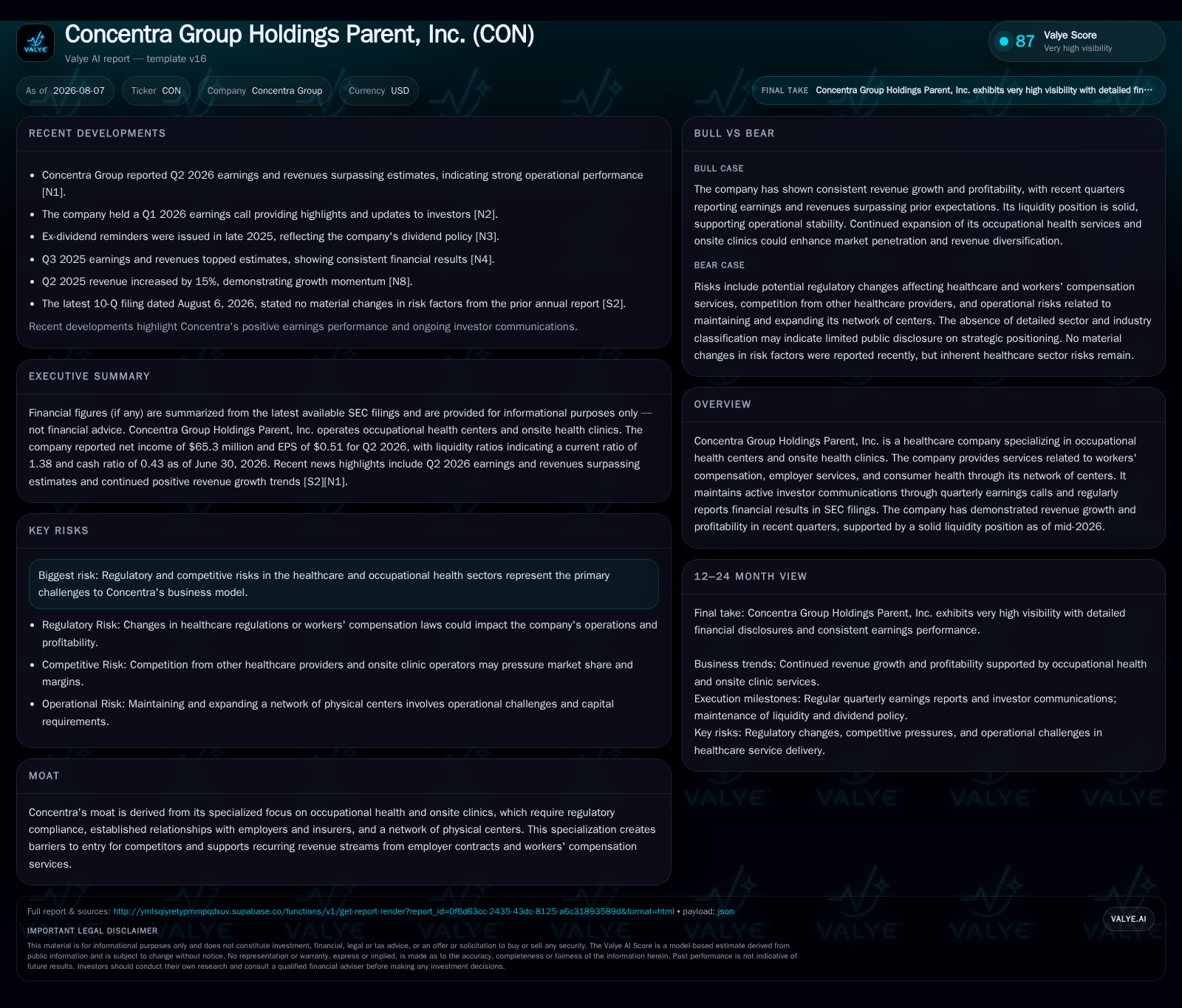
Concentra Group Holdings Parent, Inc. reported strong operational performance for Q2 2026, highlighted by growth in its employer contract base surpassing 200,000 customers and improved utilization of its occupational health centers. The company continues to leverage its scale and regulatory expertise to enhance service delivery, expanding into behavioral health and telehealth services. Despite a leveraged balance sheet, Concentra maintains sufficient liquidity to fund growth initiatives. Regulatory dynamics, reimbursement pressures, and labor market conditions remain key watchpoints for sustaining momentum.
Q2 2026 Operational Momentum Highlights Contract Expansion
Concentra Group's Q2 results filed August 6, 2026, illustrate accelerating growth driven primarily by the expansion of their employer contract base and utilization improvements across their occupational health network [S2], [S3]. The company serves over 200,000 employer customers nationwide, a figure that has increased more than 40% since 2015 along with the number of employer locations served reaching approximately 375,000 by end-2025 [S5], exemplifying durable scale expansion. This growing footprint contributes to heightened patient throughput at their 628 standalone occupational health centers and over 400 onsite clinics spread across more than 40 states [S16]. Utilization rate gains—how frequently clinics are used relative to capacity—signify efficient leverage of fixed infrastructure against rising demand.
The ability to grow both the number of employers served and the geographic reach enhances recurring revenue opportunities through long-term contractual arrangements. It also deepens network effects with payors including workers' compensation insurers and third-party administrators who often prefer partnering with providers having extensive multi-state coverage and consistent service standards. Consequently, this broadening employer footprint is a key contributor to Concentra’s revenue momentum and represents a leading indicator for sustainable top-line gains.
Evolving Business Model: From Employer Contracts to Behavioral Health Integration
Concentra’s core business generates revenues predominantly from workers’ compensation-related occupational health services delivered via their proprietary physical center network and onsite clinics at employer locations. Their payer mix notably includes direct employer contracts (which account for substantial revenue), insurance carriers, and third-party administrators managing claims and reimbursements [S5], [S7]. These contracts typically provide steady volumes subject to utilization patterns driven by workplace injury frequency—a relatively inelastic baseline—offering defensible recurring income.
In recent years the company has evolved strategically by integrating behavioral health services accessible through telehealth platforms under Concentra Telemed. This adjunct service addresses critical gaps given industry-wide provider shortages in mental health care for injured workers while complementing traditional physical injury management offerings. By investing in these adjacent mission-aligned services, Concentra not only diversifies its care portfolio but aims to improve customer retention through broader value-added solutions tailored to evolving employer health needs [S5], [S7].
This service diversification dovetails with technological advances such as their Concentra HUB portal—a digital platform enabling employers and partners to easily authorize care episodes, access medical reports, manage accounts, and streamline billing processes. Approximately two-thirds of employers utilize this self-service tool increasing operational efficiency while enhancing customer stickiness [S26]. Together these initiatives indicate an adaptive business model balancing volume-driven occupational services with higher-margin behavioral health offerings facilitated through digital channels.
Navigating Competitive Pressures: Positioning Within Occupational Health Services
Within the competitive landscape of occupational health providers—including large peers like Select Medical Holdings—Concentra distinguishes itself through unparalleled scale (largest number of U.S. occupational health locations) combined with extensive multi-state market penetration [S16]. This scale advantages enable attractive proximity economics; notably, about 64% of employer locations are within roughly twelve miles of a Concentra center creating convenience-driven patient flow advantages.
Additionally, the regulatory complexity inherent in workers’ compensation programs creates high barriers for new entrants due to stringent clinical compliance requirements and entrenched relationships with insurers and third-party administrators cultivated over decades by senior operational leadership teams [S26]. Such factors underpin a moat based on trustworthiness in clinical quality and administrative excellence rather than solely price competition.
However, competitive pressures persist as alternative onsite clinic operators expand footprint and digital-first telehealth providers target the same employer-sponsored healthcare budgets. Sustained clinic utilization improvements reflect operational discipline but must be balanced against these external threats as well as regional variations in reimbursement rates negotiated with state workers' compensation boards or insurance payors.
Market-Driven Growth Drivers: Employer Focus, Utilization Trends, Telehealth Uptake
Several secular trends validate Concentra’s growth trajectory: First is Employers’ rising commitment to workplace safety programs aimed at reducing injury frequency which spur demand for integrated injury management services including immediate onsite care that minimizes downtime. Second is continued outsourcing by companies of their employee health programs—including wellness and prevention—which catalyzes demand for comprehensive onsite clinics that deliver cost-effective injury triage but also wellness interventions.
Telehealth adoption accelerated during recent years remains a critical lever enabling broader patient access especially for behavioral health conditions associated with workplace injuries where access challenges traditionally existed. As telemedicine capabilities mature within Concentra Telemed offerings—providing care seven days per week—patient throughput can increase without proportional increment in physical clinic overheads enhancing margin profile potential [N2], [S7].
Finally, demographic shifts towards labor-intensive industries requiring robust occupational health support combined with ongoing regulatory mandates maintain a structural addressable market. These elements collectively suggest durable tailwinds supporting volume growth paired with prudent pricing power anchored on reimbursement rate negotiations with primary payors including workers' compensation insurers.
Caution Ahead: Regulatory, Labor Market, and Reimbursement Risks
Concentra identifies several risks relevant to sustaining growth at current pace: Foremost are regulatory risks arising from evolving state fee schedules governing workers' compensation reimbursements which could compress average reimbursement rates thus pressuring operating margins if cost inflation exceeds recovery mechanisms [S1], [S2].
Labor shortages within clinical personnel pose a further challenge potentially limiting patient throughput despite demand increases; this could heighten employee turnover rates elevating recruitment/training expenses impacting overall cost structure.
Competitive intensity from both existing occupational health firms expanding onsite clinics as well as digitally native telehealth operators targeting similar client segments could erode market share or necessitate increased sales/marketing spend reducing profitability margins long term. Monitoring these risks requires vigilance around contract renewal rates among top customers—the largest ~1,000 employers represent roughly 37% of occupational health revenue—and changes in payer mix dynamics influencing net revenue per visit metrics.
Performance Indicators To Track Next Quarter
Key canonical indicators signaling ongoing execution success will include quarterly renewal rates on large multi-location employer contracts confirming relationship durability amid competitive pressures; shifts in payer mix proportions indicating stability or expansion within high-margin direct-employer versus insurance-based payments; trends in utilization rate metrics reflecting effective demand capture relative to capacity investments; plus progress integrating behavioral health offerings measured by new patient enrollments or visit volumes via telehealth platforms.
Investor attention should also track operational efficiency through metrics such as patient visits per day per clinic coupled with revenue per visit changes potentially influenced by state-level reimbursement adjustments or service mix shifts.
Financial Profile Discussion: Balancing Growth with Leverage Considerations
As of June 30, 2026, Concentra held $158 million in cash against total debt approximating $1.56 billion leading to net debt near $1.4 billion and a current ratio of about 1.38 reflecting adequate immediate liquidity coverage though substantial leverage remains [F1]. This capital structure supports ongoing investment into technology enhancements like Concentra HUB platform upgrades as well as acquisitions expanding onsite clinic count evidenced by recent deals such as Nova Medical Centers acquisition completed earlier this decade.
The announced CEO transition effective November 1, 2026—where President/ CFO Matthew DiCanio succeeds Keith Newton—adds a layer of leadership change that will test strategic continuity though thorough succession planning is underway mitigating execution risk factors described above [S25]
This analysis is based solely on publicly available sources including recent SEC filings dated August 6, 2026 ([S2],[S3],[S25]) supplemented by historical annual disclosures ([S1],[S5],[S7],[S16],[S26]) and latest financial snapshot metrics ([F1]). It reflects an industry-informed perspective without investment research views or forecasts.
Disclaimer: This is research-only, informational analysis and not investment advice. It may include AI-generated interpretation and general industry context. Always verify important details using primary sources.

Comments