
Strawberry Fields REIT’s Skilled Nursing Portfolio Faces Regulatory and Tenant Risks Amid Moderate Financial Leverage
Latest quarterly update confirms stable operations in a complex healthcare real estate niche, with regulatory compliance and tenant performance as key risk factors.
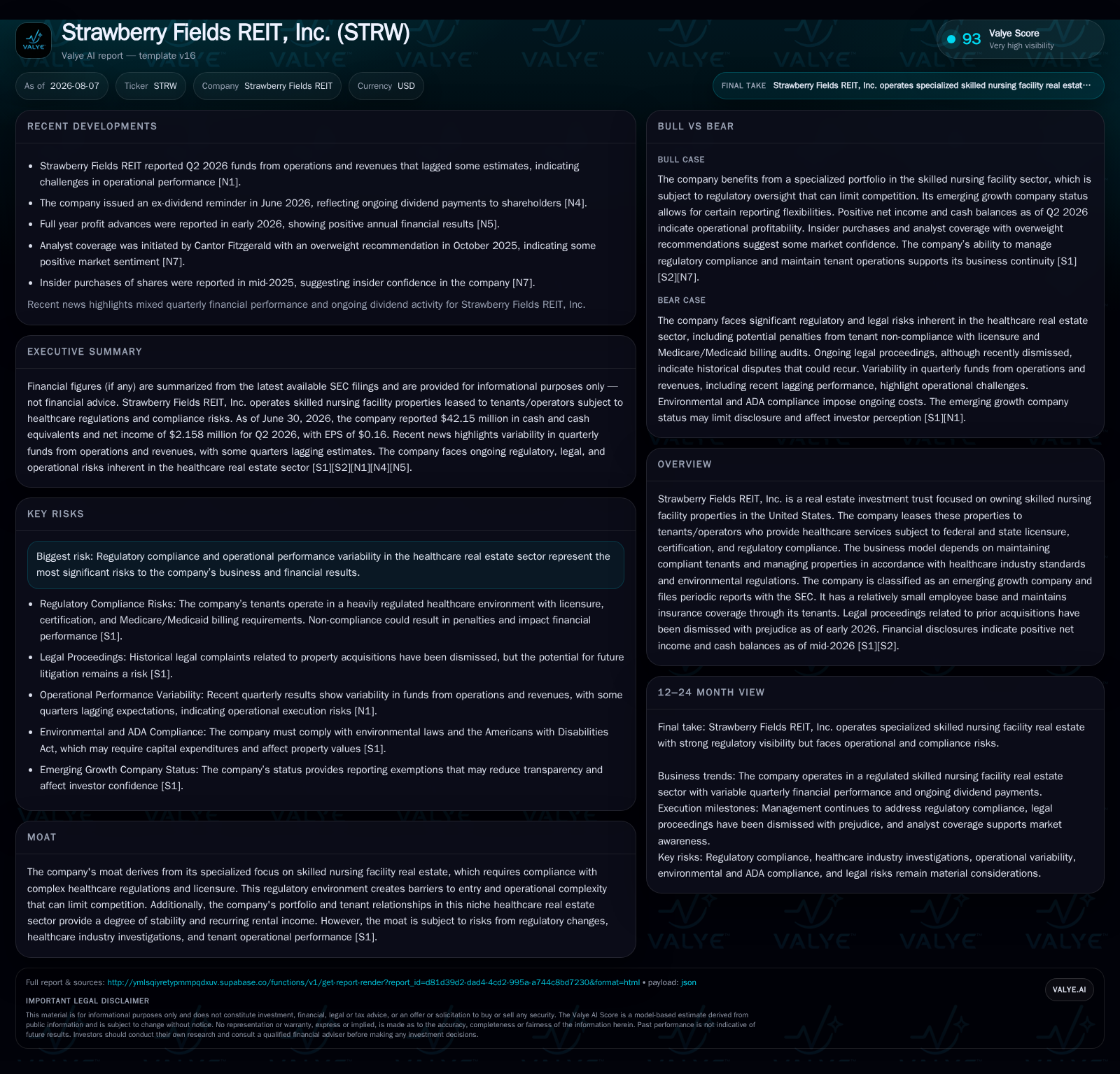
Strawberry Fields REIT, Inc. continues its specialized focus on skilled nursing facility properties leased to healthcare operators, delivering stable rental income supported by tenant compliance with healthcare regulations. The company reported positive net income and maintained cash reserves by mid-2026, although its leverage remains significant relative to cash holdings. Regulatory complexity and tenant operational risks dominate the business profile. Growth dynamics hinge on aging demographics and healthcare sector consolidation, while watchpoints include tenant credit risk, regulatory enforcement trends, and property upkeep demands.
Recent Operating Update: Q2 2026 Financial Results
This most recent quarterly update serves as a useful anchor because it confirms that Strawberry Fields remains focused on managing tenant/operator compliance risks while maintaining financial discipline in a capital-intensive healthcare real estate niche.
Business Model: A Specialized Landlord in Healthcare Real Estate
Strawberry Fields operates as a real estate investment trust owning skilled nursing facility (SNF) properties across the United States that are leased exclusively to healthcare operators providing patient care under strict federal and state regulatory frameworks [S1]. Its revenue derives primarily from recurring rental income negotiated through long-term lease agreements with these operators.
The REIT’s customer base comprises tenants who deliver post-acute care services reimbursed mainly through Medicare and Medicaid programs. These tenants must hold appropriate licensure, certifications, and comply with regulations including certificate of need (CON) approvals for expansions or acquisitions of facilities they operate within STRW’s property portfolio [S1]. Compliance failures or delays impact tenants’ operating licenses and can hinder their ability to pay rent regularly or expand capacity.
By outsourcing actual healthcare operations to specialty providers, STRW limits its direct exposure to clinical risks but remains deeply exposed to operator creditworthiness and adherence to complex healthcare laws such as fraud and abuse enforcement regulations that have seen increased scrutiny nationally over recent years [S1]. Therefore, the company emphasizes rigorous tenant selection criteria and requires insurance coverage naming STRW as additional insured under relevant policies.
From an industry value-chain perspective, Strawberry Fields is a critical infrastructure provider enabling skilled nursing care delivery by supplying appropriately equipped facilities without engaging directly in medical service provision.
Industry Structure and Competitive Positioning
Healthcare REITs focused on skilled nursing facilities operate within a distinct subset of real estate investments characterized by heightened regulation compared with traditional commercial real estate sectors. This regulatory complexity both raises barriers to entry—due to the need for specialized knowledge of licensure requirements—and intensifies operational risk tied to tenant performance under volatile reimbursement regimes.
Peers such as Ventas, Inc. (VTR), Omega Healthcare Investors (OHI), Welltower Inc. (WELL), and Healthpeak Properties (PEAK) share exposure to similar tenant credit risks, regulatory hurdles, and demographic tailwinds but often boast larger scale or diversified property types including senior housing or medical office buildings which can mitigate segment-specific volatility. Strawberry Fields’ narrower focus on SNFs means higher concentration risk but can enable deeper specialization in tenant oversight and tailored property management strategies.
Regulatory scrutiny around antitrust enforcement is also notable within this healthcare realm; STRW emphasizes compliance with federal laws prohibiting anti-competitive conduct among providers—a potential pitfall given consolidation trends among operators that could attract governmental attention if perceived as market manipulation [S1].
Growth Drivers: Demographics Meet Regulatory Complexity
The fundamental growth driver underpinning STRW’s portfolio demand remains America’s aging population requiring increased skilled nursing care services. As elderly populations swell over the coming decades, utilization rates for SNF beds historically trend upward supporting incremental occupancy gains for well-located assets.
Simultaneously, rising healthcare costs drive operators toward leasing rather than self-owning real estate assets—a structural shift benefiting specialized REIT landlords like Strawberry Fields who can capitalize on outsourced real estate demand from consolidating operator groups.
The regulatory environment itself adds indirect growth support; increasing requirements for licensure certifications and reporting create market entry barriers that reduce supply-side competition among skilled nursing facility owners. This dynamic fosters stable occupancy levels albeit with increased risk should any tenant fail inspections or lose accreditations.
Operator consolidation further enhances leasing opportunities as larger tenants prefer standardized lease agreements across multiple locations hence favoring established REITs with sizable portfolios.
Risks and Watchpoints: Focus on Tenants and Compliance
Strawberry Fields’ concentrated exposure to SNFs inherently involves several intertwined risk categories:
Tenant Operational Risk: Tenant default or bankruptcy due to deteriorating financial performance—possibly driven by Medicare/Medicaid reimbursement reductions or operational failures—poses a material threat to rental cash flows.
Regulatory Risk: Changes in healthcare policy or intensifying enforcement of fraud and abuse statutes could lead tenants to face investigations adversely affecting their ability to meet lease obligations. Moreover, failure to maintain required state licensure or CON approvals can jeopardize continued tenancy.
Legal Risk: Though currently without material ongoing litigation outside insured matters stemming from earlier acquisitions now dismissed, any renewed legal disputes could impose financial strain or reputational damage.[S1]
Property Obsolescence: Skilled nursing facilities require ongoing capital expenditure investments driven by evolving clinical care standards and patient needs; failure to invest adequately may reduce asset competitiveness leading to lower occupancy or lease renegotiations.
Interest Rate Sensitivity: With considerable leverage of approximately $810 million against $42 million cash holdings noted recently ([F1], net debt ~$768 million), interest rate fluctuations impacting cost of debt capital warrant monitoring given potential effects on cash flow coverage ratios.
Concentration Risk: Geographic or single-tenant concentration risk could magnify the impact of localized economic downturns or operator-specific issues beyond general sector trends.
What to Watch Next
Continuing tenant compliance outcomes will serve as an important near-term operational indicator—specifically license renewals, successful passing of state audits, CON approval statuses for expansion activities among major lessees.
Lease renewal rates provide a tangible proxy for underlying tenant creditworthiness; sharp declines would warrant closer scrutiny given dependence on rental income stability.
Regulatory developments around Medicare/Medicaid reimbursement reforms slated at federal level will be critical catalysts influencing operator economics affecting their ability to sustain rent payments.
STRW’s capacity to manage ongoing capital expenditure demands efficiently without excessive leverage strain will shape longer-term asset viability.
Financially, incremental movements in operating income metrics such as net operating income (NOI) or funds from operations (FFO)—when available—should be monitored alongside any updates about refinancing or covenant adjustments reflecting debt service flexibility amidst prevailing interest rate cycles.
Financial Profile Discussion
As of the end of Q2 2026, Strawberry Fields held cash & equivalents totaling roughly $42.2 million against total outstanding debt around $810 million resulting in a net debt position close to $768 million per recent disclosures [F1]. This level of leverage underscores the capital-intensity of maintaining a substantial skilled nursing portfolio coupled with ongoing capital expenditure obligations inherent in this asset class.
Liquidity appears sufficient at present for near-term obligations; however, monitoring interest coverage ratios alongside potential refinancing needs is prudent given macroeconomic uncertainties impacting credit markets generally within the REIT sector.
Insurance arrangements naming STRW as additional insured under relevant liability policies provide further financial loss mitigation related to premises risks stemming from tenant operations [S1]
Disclaimer: This analysis synthesizes publicly available SEC filings and industry knowledge without offering investment advice or forecasts. It aims solely to provide an informed overview grounded strictly in supported evidence without speculation about future company performance.
Disclaimer: This is research-only, informational analysis and not investment advice. It may include AI-generated interpretation and general industry context. Always verify important details using primary sources.

Comments