
Nano Dimension's 2026 Q2 Reveals Hardware Sales Growth and Strategic Realignments in Additive Manufacturing
Q2 results highlight rising hardware-driven revenues, strategic acquisition divestitures, and ongoing R&D investments amid macroeconomic headwinds.
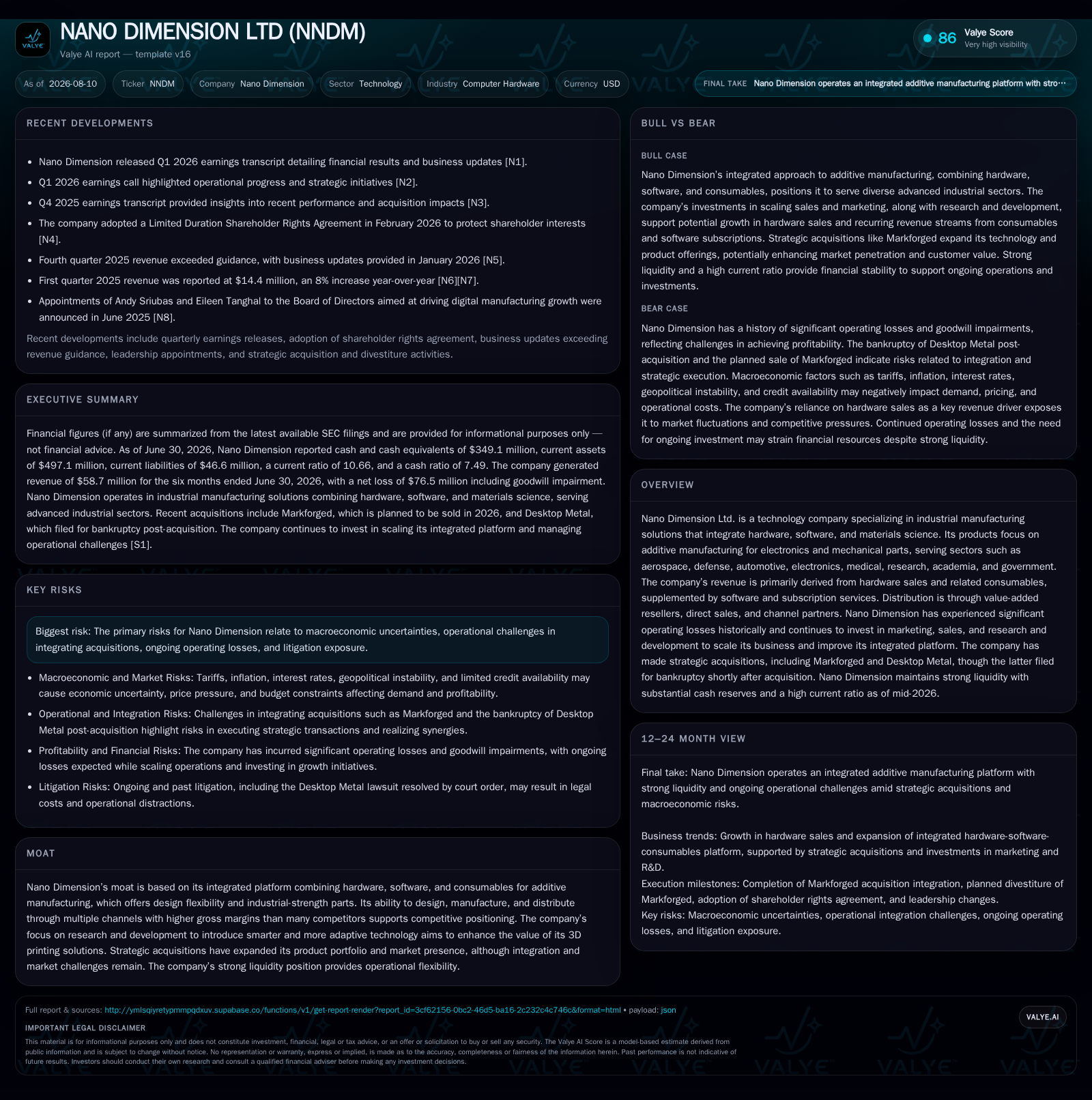
Nano Dimension Ltd reported revenue growth to $58.7 million for the first half of 2026 driven primarily by increased hardware sales, which are core to its strategy of fueling future recurring consumables and software revenues. Despite the top-line rise, net losses widened to $76.5 million due largely to a $40.4 million goodwill impairment and continued high operating expenses. The company is streamlining after the bankruptcy of Desktop Metal and impending sale of Markforged as it refocuses on scaling its integrated hardware-software-consumables platform. Macro risks persist, but strong cash reserves support ongoing R&D and sales investments needed to deepen market penetration.
Recent Operating Update: Q2 2026 Results and Strategic Transactions
Despite rising revenues, Nano Dimension reported net losses totaling $76.5 million for H1 2026 versus $36.9 million previously, heavily influenced by a $40.4 million goodwill impairment relating to previous acquisitions [S5]. This reflects ongoing challenges integrating prior strategic moves, notably the acquisition of Desktop Metal on April 2, 2025 for $180.3 million [S6]. Desktop Metal filed for Chapter 11 bankruptcy protection just under four months later on July 28, 2025; all income-producing assets subsequently sold within Q3 2025 [S6]. The rapid failure of this acquisition underscores execution risks inherent in aggressive inorganic expansion strategies within the complex additive manufacturing space.
Further signaling portfolio optimization, Nano Dimension announced an agreement on May 27, 2026 to sell Markforged—acquired earlier in April 2025 for $116.2 million—to Stratasys Ltd., with closing anticipated in H2 2026 subject to regulatory approvals [S4][S26]. Markforged provided complementary cloud-based software platforms alongside reliable metal and composite printers aimed at factory-floor production applications [S6]. Offloading this business may reflect a strategic retreat toward core strengths or capital redeployment considerations.
Business Model: Integrated Hardware-Software-Consumables Platform
Nano Dimension operates within the industrial additive manufacturing industry sector where companies generate most revenue through capital equipment (specialized advanced 3D printers) paired with proprietary consumables like engineered filaments or resins and software suites often delivered via subscription models [S2]. Customers largely consist of aerospace, defense contractors, automotive manufacturers, electronics firms, medical device makers, research institutions, academia, and government agencies requiring rapid prototyping or small batch production of high-strength complex parts
The company monetizes through upfront hardware sales—generating substantial immediate revenue—and thereafter via recurring consumable material purchases buttressed by subscription fees for its software platforms that enable precise design-to-manufacturing workflows [S8]. Distribution channels are mixed: direct sales teams engage with large enterprise accounts while value-added resellers (VARs) facilitate reach into diverse markets with installations sometimes handled by partner firms [S8]. This dual-channel strategy balances scalability with customer intimacy.
Maintaining high gross margins relative to peers stems from controlling both product fabrication—often employing third-party manufacturers combined with internal operations—and leveraging proprietary technology integrations across hardware-software-consumables that competitors may lack [S2]. Continued investment in research and development plays a crucial role by advancing smarter adaptive printing technologies intended to deepen differentiation and raise switching costs over time [S2].
Industry Structure and Competitive Positioning
Nano Dimension sits among firms striving for an industrial ecosystem combining hardware innovation with embedded software intelligence and proprietary material science — an approach mirrored by peers such as Stratasys Ltd., Markforged pre-divestiture, and Desktop Metal before its bankruptcy chapter. This integrated model supports sustainable revenue streams through locking customers into recurring consumables as their installed base grows.
However, the industrial additive manufacturing arena faces challenges including capital-intensive R&D demands, long customer sales cycles influenced by macroeconomic capital expenditure budgets (especially defense and aerospace), supply chain complexities affecting component sourcing and cost inflation pressures [S2]. Moreover, rapid innovation cycles render technological obsolescence a persistent threat while litigation risks heighten due diligence burdens in M&A activities—as evidenced by Desktop Metal litigation costs related to acquisition disputes [S17]. Nano Dimension’s balance sheet shows cash & equivalents of $349 million as of June 30, 2026, with a strong current ratio above 10x, providing operational flexibility unmatched by some peers coping with cash burn or refinancing constraints [F1].
Growth Drivers
Key drivers supporting Nano’s future revenue expansion revolve around:
- Increased penetration within existing segments benefiting from additive manufacturing’s advantages — customized production runs replacing traditional tooling-heavy processes.
- Geographic expansion leveraging international demand from aerospace & defense clusters alongside growing medical device customization needs.
- Enhanced R&D delivering more adaptive printer functions boosting average selling prices (ASP) per unit and improving consumable yield efficiency.
- Strengthened channel partnerships enabling broader market access while balancing direct enterprise engagement.
- Positive seasonality effects with historically elevated third/fourth quarter hardware orders aligning with governmental fiscal cycles allowing budget spend-downs [S26][S8]
Risks and Watchpoints
The principal risks tempering Nano Dimension’s outlook include:
- Persistently high operating losses constraining free cash flow improvements amid scaling investments.
- Integration difficulties exemplified by the failed Desktop Metal acquisition impacting goodwill impairment charges and potential distraction from organic growth initiatives.
- Macroeconomic uncertainties like tariffs impinging supplier cost structures or inflation limiting customer capital spending budgets at times.
- Supply chain disruptions unsettling timely delivery schedules or escalating component procurement costs adversely affecting gross margin profiles.
- Legal exposures such as ongoing litigation tied to past transactions imposing additional expense burdens.
- Competitive pressure from established incumbents or emerging innovators potentially eroding pricing power or market share.
- Dependence on consumables revenue streams which require continuous installed base growth alongside stable utilization rates.
- Sales cycle elongation risking near-term order flow stability given complex buyer decision processes in key sectors.
What To Watch Next
Upcoming milestones include watching for:
- Closure of Markforged sale to Stratasys in H2 2026 providing clarity on capital allocation plans post-divestiture [S4].
- Quarterly updates on hardware unit shipments potentially signaling uptake acceleration or deceleration trends ahead.
- Sequential gross margin movement indicating progress managing supply chain pressures or product mix shifts between hardware versus consumables lines.
- R&D spending patterns relative to revenue indicating commitment durability toward platform advancements requisite for competitive positioning.
- Cash burn trajectory alongside any commentary regarding potential financing needs given ongoing operating losses despite strong liquidity currently.
- Any regulatory developments impacting additive manufacturing technology adoption either positively through incentives or negatively via compliance burdens.
Financial Profile Discussion
Nano Dimension demonstrates usual characteristics for an industrial additive manufacturer in early scale phases: current revenue growth paired with deep operating losses reflecting heavy investments into developing an integrated printing ecosystem [F1]
The company reported accumulated net deficits surpassing $1 billion driven significantly by goodwill impairments reflective of recent M&A setbacks predominantly around Desktop Metal’s bankruptcy fallout [S5][F1]. While such large impairments weigh negatively on net income figures short term, they also cleanly reset asset valuations facilitating clearer future profitability assessment if core business execution improves.
Operating expenses remain substantial particularly driven by R&D payrolls plus share-based compensation outlays aimed at sustaining technology leadership accompanied by sizeable sales/marketing spending needed to scale market presence [S7][S17]. Balancing these cost centers against ramped-up revenues will determine if Nano can transition toward break-even profitability over the next one to two years as anticipated by management contingently upon successful commercial execution amid prevailing economic headwinds.
Continued monitoring of margins among hardware versus consumables will be essential since hardware typically carries lower gross margins but serves as the gateway product; enhancing consumable attach rates improves overall profitability leverage akin to SaaS model dynamics embedded within their wider platform solution offering.
This analysis uses publicly available SEC filings up to August 7th, 2026 combined with sector knowledge relevant to industrial additive manufacturing platforms integrating hardware-software-consumables solutions. It does not provide investment advice but aims to clarify Nano Dimension Ltd’s operational context amid current market developments including M&A impacts and macroeconomic challenges.
Disclaimer: This is research-only, informational analysis and not investment advice. It may include AI-generated interpretation and general industry context. Always verify important details using primary sources.

Comments