
Red River Bancshares Expands Louisiana Franchise with Margin Gains and Digital Push
Strong Q2 results reinforce Red River Bancshares' growth strategy centered on regional expansion and efficiency.
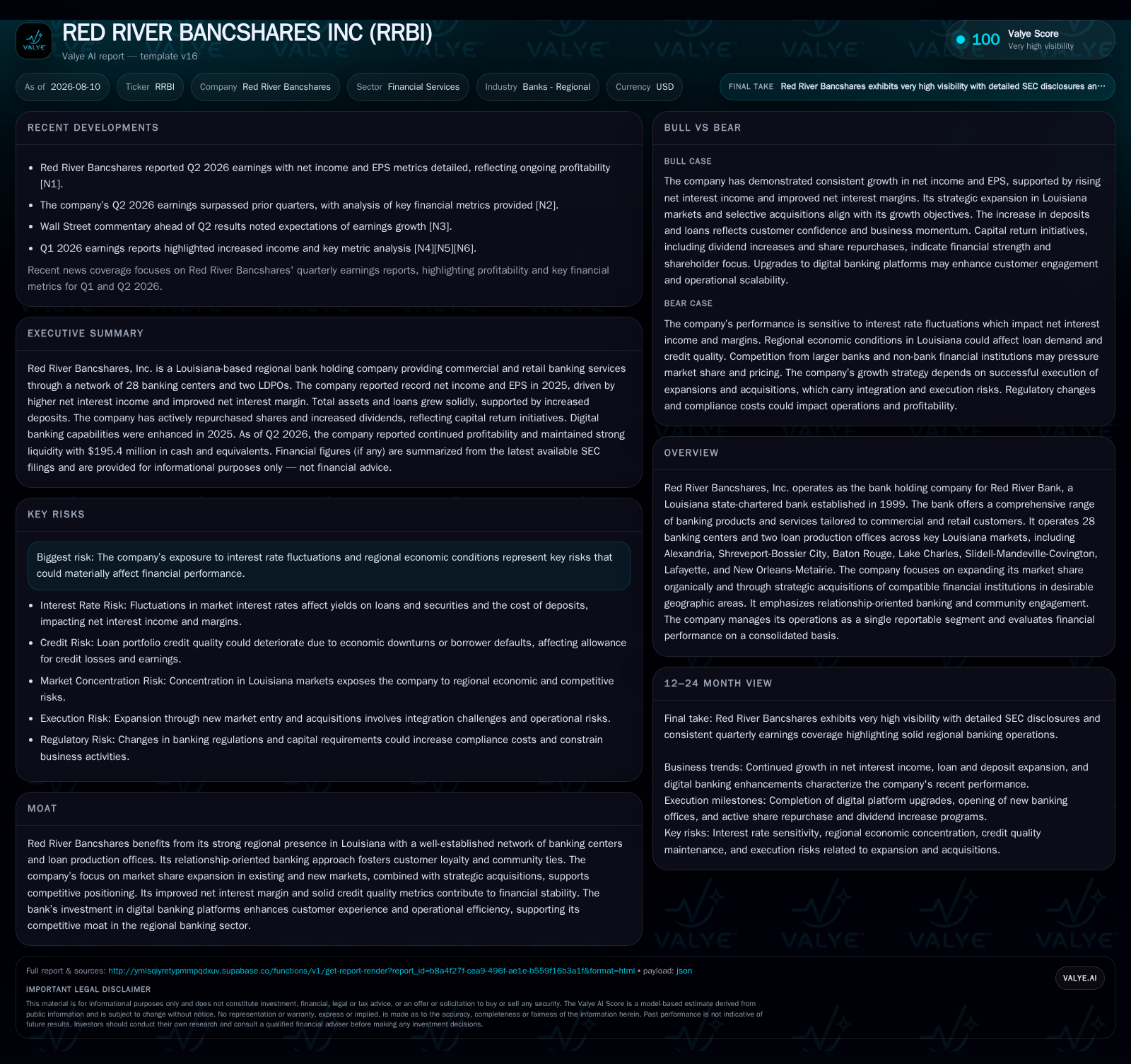
Red River Bancshares, a Louisiana-focused regional bank holding company, reported solid operating performance in the second quarter of 2026, driven by improved net interest margin and loan growth. The company continues to leverage its extensive Louisiana footprint of 28 banking centers and two loan production offices, emphasizing relationship banking and community engagement. Recent investments in digital platforms and a renewed stock repurchase program complement its organic growth and acquisition strategy, positioning it well amidst regional economic variability and competitive pressures. Key risks remain tied to interest rate fluctuations and localized economic cycles.
Recent Operating Update
Red River Bancshares Inc. released its Q2 2026 results reflecting continuity in its positive operating trends observed during 2025 [S2][N1][N2]. Management commentary indicates ongoing focused asset-liability management contributed to sustained margin improvement amid the prevailing interest rate environment [S2].
Loan growth remains a central engine for revenue expansion; during 2025 loans held for investment grew approximately 8.4% year-over-year to $2.25 billion with healthy new loan originations particularly in commercial real estate and industrial sectors within their core Louisiana markets [S1]. This growth trajectory aligns with the bank's relationship-driven lending model emphasizing middle-market commercial customers familiar with localized economic conditions.
The company operates exclusively through Red River Bank with no material segmental complexity, managing all financial performance on a consolidated basis [S1]. Its geographic footprint encompasses key Louisiana MSAs including Alexandria, Shreveport-Bossier City, Baton Rouge, Lake Charles, Slidell-Mandeville-Covington, Lafayette, and New Orleans-Metairie with a total of 28 full-service banking centers and two loan production offices [S1]. This dense regional presence underpins strategic objectives to organically grow market share while selectively pursuing acquisitions of financially compatible institutions within desirable proximate territories.
Business Model Overview
Red River Bancshares functions as a traditional regional bank holding company generating most revenue from net interest income derived from lending activities funded primarily by low-cost core deposits [S1]. The business model leverages local market expertise to originate loans predominantly secured by commercial real estate assets alongside working capital financing for regional businesses. The deposit base acts as both stable funding source and profit center via fee-based checking accounts and treasury services.
A material proportion of deposits are noninterest-bearing or low-cost core deposits supporting favorable asset-liability spreads [S17]. Deposits totaled nearly $3 billion as of late 2025, up about 5.6% year-over-year reflecting benefits from entrenched customer relationships and community ties [S1]. Excess liquidity is prudently invested in high-quality securities portfolios with a sizable portion available-for-sale or held-to-maturity to manage interest income volatility [S1][S5].
The company also earns fee income from ancillary banking products including payments processing and debit/credit card services which provide diversification beyond pure net interest income although these make up a smaller fraction of total revenues [S1]. Operational effectiveness is maintained through moderate expense growth relative to revenue gains evident in the improvement of efficiency ratio from above 60% down to roughly 56% by end-2025 [S17].
Investment in digital banking platforms upgraded early in 2025 has bolstered client engagement channels enhancing both customer retention and cost efficiencies—a vital competitive weapon as fintech alternatives proliferate even within established regional banking markets [S19]
Industry Structure and Competitive Position
In the regional banking sector, Red River Bancshares competes primarily against similarly sized Louisiana-centric banks as well as larger national banks operating regional branches within these markets. Community banks with strong local knowledge represent both direct competitors for commercial lending relationships and partners for service referrals.
Relative peers often cited include other mid-sized Southern regional banks such as Regions Financial Corporation or Synovus Financial Corp though Red River maintains a tighter geographic focus limited exclusively to Louisiana which is an advantage for local market saturation but creates geographic concentration risk.
The company's moat derives from longstanding community ties through relationship-oriented bankers who deeply understand customer needs—a significant switching cost advantage given businesses' reliance on trusted credit lines and personalized service. Its robust deposit franchise was ranked favorably among peers by third-party research indicating strength in funding cost control critical in rising interest rate environments [S19].
Growth Drivers
Several vectors underpin growth prospects:
- Organic Loan Portfolio Expansion: Sustained demand for commercial real estate financing coupled with mid-market industrial lending drives volume growth [S19]
Monitoring these variables will be pivotal especially around loan delinquency trends, deposit pricing shifts, regulatory developments, and digital platform usage metrics.
What To Watch Next
Key near-term performance gauges include:
- Quarterly updates on NIM trajectory against evolving rate assumptions reflecting Federal Reserve policies.
- Loan growth pace particularly new commitments in targeted commercial sectors versus payoffs or prepayments.
- Deposit inflows trend overall plus mix shift toward noninterest bearing balances supporting margin sustainability.
- Credit quality indicators such as allowance coverage ratio stability amid any emerging stress signals.
- Progress on planned acquisitions: announcements or completions providing scale synergies or footprint extension.
- Digital platform adoption rates metrics evidencing customer retention or new account openings attributable to tech investments.
- Capital allocation actions including timing/frequency adjustments on dividend payments or buybacks reflecting cash flow outlooks.
Consistent execution here will validate durable earnings power versus one-off cyclical gains observed previously.
Financial Profile Discussion
At June 30, 2026, Red River Bancshares reported cash and equivalents totaling approximately $195 million providing ample liquidity buffer alongside its securities portfolio used strategically for liquidity needs [F1][S5]. The bank benefits from strong capital ratios comfortably exceeding regulatory minima supported by retained earnings adding roughly $43 million net income in calendar year 2025 [S27][F1].
No borrowings were outstanding across its Federal Home Loan Bank or Federal Reserve Discount Window lines at latest reporting dates underscoring strong funding discipline reliant mainly on stable customer deposits approaching $3 billion scale [S4][S22]. Deposit base quality is augmented by diversified categories including significant noninterest-bearing balances (~31%) that reduce average funding costs versus peers reliant on more expensive term deposits.
Capital allocation has been proactive: dividends increased notably (+50%) across recent years signaling confidence alongside robust stock repurchase programs now doubled for full-year authorization at $10 million range leveraging share price opportunities [S9][S19]. Efficiency gains evidenced by declining efficiency ratios below mid-50%s complement profitability expansion generating returns on average equity near 12.6%, favorable relative to typical regional bank peers targeting low double-digit ROEs [S17].
It reflects no investment advice but aims at providing an informed institutional perspective grounded in regulatory filings and industry context.
Disclaimer: This is research-only, informational analysis and not investment advice. It may include AI-generated interpretation and general industry context. Always verify important details using primary sources.

Comments