
Fluor's Backlog Dynamics and Execution Efficiency Shape Near-Term Outlook
Fluor Corp’s August 2026 10-Q reveals how backlog trends, project execution risks, and capital deployment inform its revenue visibility and margin prospects.
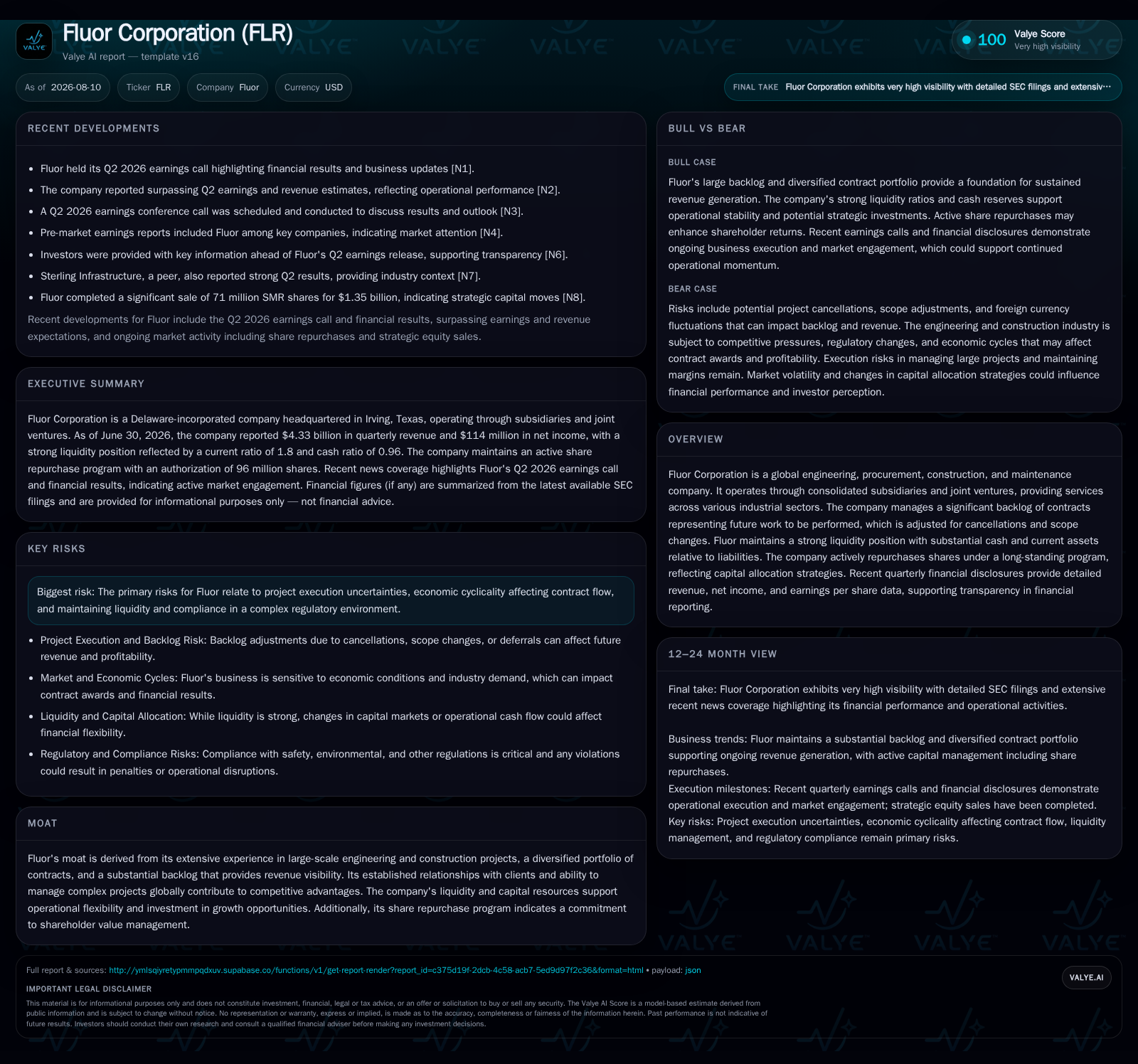
In its latest quarterly filing, Fluor Corporation reported a sizeable backlog adjusted for cancellations and scope changes, underscoring steady revenue visibility but highlighting ongoing exposure to project execution and contract risks. The company’s aggressive share repurchase activity balances strong liquidity against cyclical uncertainties in new contract awards. Fluor’s operational complexity, including the mix of fixed-price and cost-plus contracts, shapes margin volatility amid industry-wide challenges. Compared to multinational EPC peers like Jacobs Engineering and KBR, Fluor maintains competitive scale with a healthy current ratio, supporting its capital allocation flexibility going forward.
Quarterly Backlog Trends Signal Revenue Visibility With Margin Implications
Fluor’s latest Form 10-Q for the quarter ending June 30, 2026 underscores the importance of backlog as the cornerstone metric for forecasting future revenue streams in its Engineering, Procurement, and Construction (EPC) business model [S2]. The company maintains a sizable backlog figure representing the total dollar value of work remaining on awarded contracts after factoring in known project cancellations, scope reductions, deferrals, and foreign currency impacts. This adjusted backlog is essential for understanding not just absolute opportunity size but also risk exposure to client-driven changes that directly reshape expected margins downstream [S3], [S1].
Backlog stability or growth typically signals robust demand from key industrial sectors such as infrastructure development and energy projects where Fluor holds longstanding relationships. However, given the complexity of multi-year projects — which often contain both fixed-price and cost-plus elements — fluctuations in scope or cancellations can rapidly alter expected profitability. Fluor’s transparent reporting of such adjustments enhances visibility into operational health but calls for disciplined management of project delivery fidelity to safeguard margins.
Project Execution Challenges: Impact on Margins and Contract Risks
Project execution remains a critical lever influencing financial outcomes at Fluor. The EPC industry’s inherent operational complexity means that issues such as schedule delays or cost overruns disproportionately affect fixed-price contracts where risk is largely borne by the contractor rather than the client [S1], [S2]. Fluor’s disclosures emphasize ongoing efforts to navigate these execution challenges through proactive change order negotiation — which attempts to recover costs or expand contract scope when project deviations occur — thereby partially offsetting adverse margin impacts.
Nonetheless, increased volume or unpredictability of change orders signals operational friction that can erode profitability if not carefully managed. The balance between fixed-price contracts that incentivize efficiency versus cost-plus contracts that provide reimbursement plus fee highlights the nuanced risk profile within Fluor’s portfolio. Sustained margin pressure from execution variances would require close monitoring of project completion percentages and schedule adherence metrics where available.
Capital Deployment Strategy: Share Repurchases Balanced Against Liquidity Needs
Fluor’s recent aggressive share repurchase program activity demonstrated in Q2 2026 reflects a strategic use of excess liquidity to enhance shareholder returns while retaining sufficient financial flexibility amidst a volatile EPC contract market [S2], [S6], [F1]. Over six million shares were repurchased at an average price near $48.74 each during the quarter under an authorization expanded earlier in 2026 to nearly 96 million shares.
This buyback cadence aligns with a liquidity profile supported by approximately $2.9 billion in cash and equivalents against total debt near $1.07 billion, yielding a net cash position above $1.85 billion as of June 30, 2026 [F1]. Such liquidity management ensures capacity to weather fluctuations in new awards or unexpected cash flow timing without constraining operational investment.
Peer Framework: Positioning Fluor Among Multinational EPC Competitors
Within the multinational EPC peer group encompassing Jacobs Engineering Group, KBR Inc., and AECOM, Fluor occupies a comparable position characterized by a broad service portfolio spanning industrial sectors globally. While all these players navigate similar strategic risks from fixed-price contract exposure and execution variability, Fluor’s reported backlog size offers credible revenue visibility.
Its liquidity buffer compares favorably alongside peers traditionally managing elevated working capital needs due to staggered billing milestones across complex projects. However, peer comparisons highlight sector pressures such as competitive bidding that compresses pricing power requiring contractors like Fluor to differentiate through execution reliability, effective procurement networks, and joint venture capabilities enabling access to high-value contracts.
Growth Prospects Tied to Infrastructure Spending and Energy Investment Cycles
Fluor’s growth trajectory hinges heavily on macro drivers such as government infrastructure programs, industrial modernization initiatives, renewable energy development cycles, and sustained capital investment in traditional energy sectors [Industry Knowledge Layer; S1]. The company’s ability to convert these external demand signals into new awards replenishing its backlog remains vital.
While the latest filings do not disclose precise new award figures for Q2 2026, consistent reporting underscores their importance as leading indicators feeding future revenue recognition. Market expansion into emerging economies’ industrialization efforts further complements opportunity sets beyond North American or Western benchmarks.
Operational Risks: Managing Scope Changes and Contract Cancellations
Contractual volatility emerges in operational disclosures noting sensitivity to scope adjustments or outright cancellations that shrink expected backlog value with immediate profit implications [S2], [S1]. These dynamics pose challenges for accurate revenue recognition timing since EPC projects require milestone-based billing reconciled against incurred costs.
Robust monitoring frameworks around change order volume and contractual amendment negotiations form frontline defenses preserving margin integrity. Failure to manage these effectively could result in downside surprises impacting quarterly earnings rhythm notably given Fluor’s sizable fixed-price exposure.
Forward Looking Indicators: Contract Awards Pipeline, Schedule Adherence, and Liquidity Metrics
Going forward, investors should monitor several quantitative markers from Fluor updates inclusive of:
- New awards volume indicative of sales effectiveness amid industry cyclicality,
- Project completion percentiles reflecting delivery cadence versus plan,
- Schedule adherence data when available illuminating risk exposure movements,
- Cash flow trends supporting liquidity ratios,
- Quarterly share repurchase activity signaling management confidence. These KPIs function as proximate signals forecasting earnings momentum within typically protracted EPC project life cycles [S2], [N1], [F1].
Financial Profile Discussion: Balance Sheet Strength Amid Industry Cyclicality
As of June 30, 2026 balance sheet snapshots affirm Fluor’s financial resilience — cash & equivalents stand at roughly $2.9 billion against total debt near $1.07 billion yielding a net cash position (cash minus debt) above $1.85 billion [F1]. The current ratio is approximately 1.8x, reflecting current assets near $5.69 billion against current liabilities of about $3.17 billion [F1].
This liquidity profile supports ongoing operational needs including procurement funding cycles typical for EPC workloads while facilitating shareholder-friendly actions exemplified by ongoing buybacks described earlier. In comparison with peer benchmarks within large multinational EPCs where leverage tends toward moderate levels due to capital intensive projects this positioning grants Fluor discretionary capacity to absorb short-term earnings shocks or pursue opportunistic investments without undue strain.
This analysis synthesizes Fluor Corporation's recent SEC disclosures alongside industry fundamentals for a nuanced perspective on how contract backlog dynamics coupled with execution risk management critically determine near-term financial performance and strategic options within the volatile EPC service landscape.
Disclaimer: This is research-only, informational analysis and not investment advice. It may include AI-generated interpretation and general industry context. Always verify important details using primary sources.

Comments