
First United Corp's Diversified Model Supports Stable Growth Despite Interest Rate Pressures
Recent quarterly results highlight resilient net interest income and cautious credit management amid evolving market conditions.
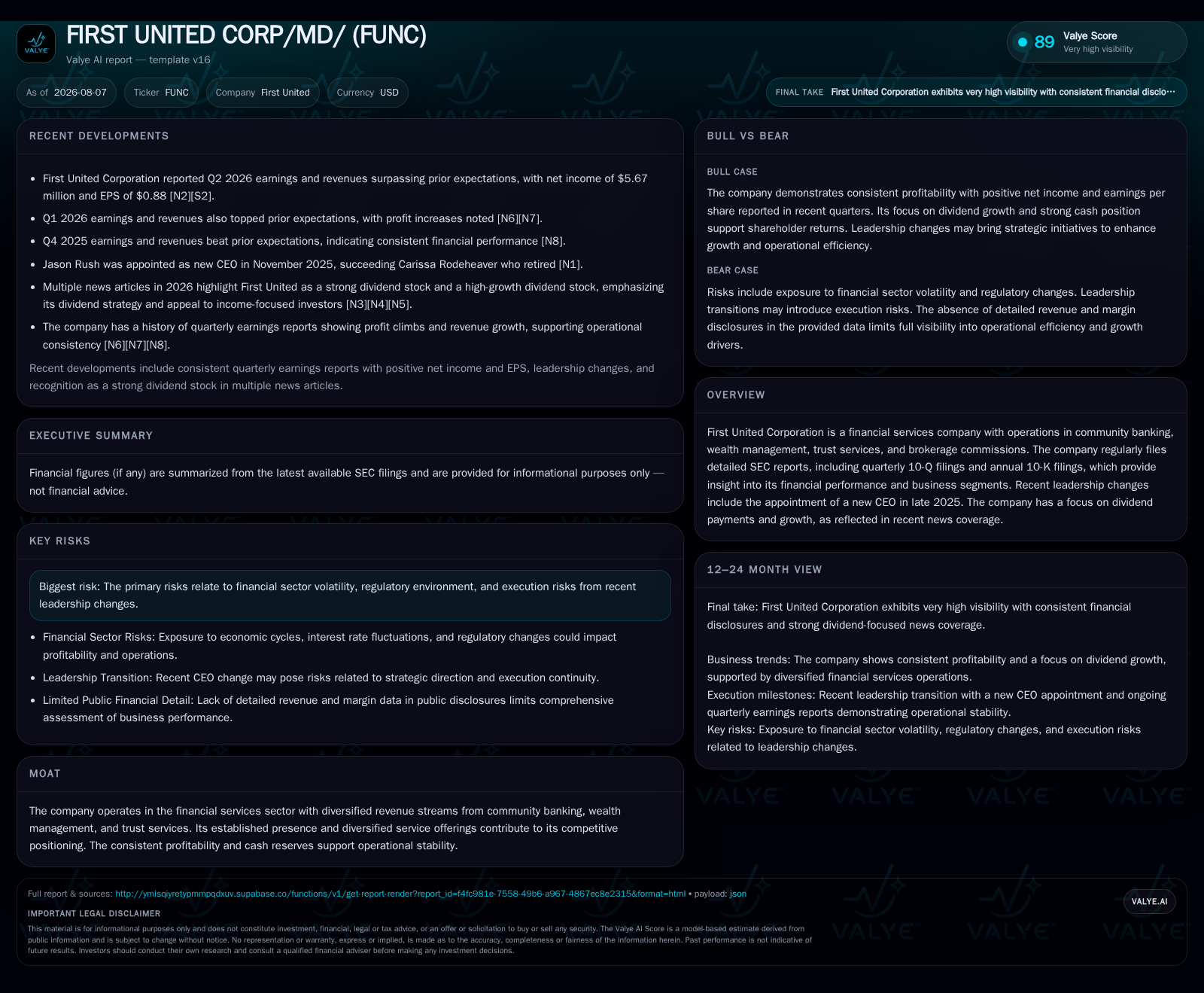
First United Corporation (FUNC) reported stable second-quarter results with net interest income growth driven by loan portfolio expansion and steady investment income, despite a lower cash balance. Credit quality remains sound with limited reserve build, supporting ongoing profitability. The company’s diversified revenue streams across community banking, wealth management, and trust services underpin operational stability in a moderately challenging regional banking environment. Recent leadership changes and focus on dividend growth add strategic layers to its financial profile.
Recent Operating Update
In the second quarter ending June 30, 2026, First United Corporation demonstrated a modest increase in total interest income compared to the same period last year. Interest and fees on loans rose from $44.0 million to $46.3 million, reflecting sustained loan portfolio growth or improved pricing in lending activities [S2]. Investment income remained stable, with taxable securities generating about $3.8 million and tax-exempt securities contributing $0.1 million, underlying the importance of the company’s available-for-sale investment securities portfolio as a source of diversified income [S2]. However, the company's cash and cash equivalents decreased significantly from approximately $131.6 million at year-end 2025 to $85.2 million by mid-2026 [F1], potentially reducing low-risk liquidity income but freeing capital for loans or investments.
Net income for the quarter held steady at roughly $5.7 million, close to prior-year levels, indicating resilience despite some margin pressures attributed to market fluctuations [S2]. Other comprehensive income included unrealized holding gains of $0.4 million on available-for-sale securities, suggesting cautious optimism regarding investment portfolio valuations.
Business Model Analysis
First United operates primarily as a regional community bank offering traditional deposit-taking and lending services complemented by wealth management, trust services, and brokerage commissions. This diversified model allows the company to generate revenue from both net interest margin—driven by loan demand less funding costs—and fee-based sources that can enhance margin stability.
Revenue mechanics hinge on expanding the loan portfolio while managing deposit mix to optimize funding cost. Loans generate interest income with spreads dependent on prevailing rates and credit quality. Meanwhile, deposits provide low-cost capital though shifts in deposit beta (the responsiveness of deposit rates to market rates) can compress margins if funding costs rise faster than asset yields.
Fee income from wealth management (including assets under management) and trust commissions complements lender-derived revenues. These segments depend heavily on client retention, competitive advisory offerings, and cross-selling capabilities.
First United's operational efficiency influences profitability via the efficiency ratio; controlling operating expenses relative to total revenues is critical given regional banks’ pressure to invest in technology while managing branch costs.
Industry Structure and Competitive Position
The regional banking sector faces broad net interest margin headwinds due to recent interest rate changes and volatility. Peers like Regions Financial Corporation and M&T Bank Corporation similarly balance community banking’s core lending operations with growing wealth management platforms that provide higher-margin fee revenues.
First United’s scale is moderate relative to larger regional peers but its entrenched community presence supports stable deposit franchises that are less vulnerable to fintech disruptions seen in larger urban markets. Its combination of trust services and brokerage commissions diversifies revenue beyond traditional lending cycles common among smaller banks like First Horizon National Corporation.
Credit quality remains a pivotal competitive differentiator; First United has maintained conservative underwriting standards reflected by stable non-performing asset ratios through economic cycles [S2]. This conservative stance likely contributes positively compared with peers facing increased stressed asset volumes.
Growth Drivers
Loan portfolio expansion remains the primary growth engine for First United as it leverages local market knowledge and relationships within its community target area. Modest increases in commercial lending alongside consumer mortgage products offer volume growth potential when economic conditions support borrowing demand.
Fee-based wealth management presents a secondary growth avenue, particularly through rising assets under management fueled by demographic trends favoring retirement planning and estate services. The company’s trust services business benefits from cross-selling into these wealth segments providing recurring commission streams.
Operational efficiencies driven by selective technology investments could enhance margins long-term by reducing transaction costs and enhancing customer engagement platforms.
Dividend policies tied closely to earnings support shareholder loyalty but require balancing against capital needs for organic loan growth or opportunistic acquisitions—a strategic tension that will influence future capital allocation decisions.
Risks and Watchpoints
Interest rate volatility remains a core risk impacting net interest margin sustainability; unexpected rate shifts could elevate funding cost faster than asset yield adjustment due to deposit beta exposure.
Credit risk is ever-present given general economic uncertainty; while current metrics show disciplined provisioning without material reserve buildup [S2], any downturn could impair asset quality quickly given exposure diversity including commercial real estate segments.
Leadership changes introduced in late 2025 add execution risks; maintaining strategic continuity while pursuing growth initiatives hinges on new CEO effectiveness.
Regulatory changes may impose incremental compliance costs or capital requirements influencing return-on-equity metrics negatively if stringent standards tighten further.
Liquidity monitoring is warranted given recent cash balance decline paired with total debt near $31 million against $85 million in cash equivalents—while net debt is negative this could shift if deposit outflows or capitalization changes occur unexpectedly [F1]
Competitive pressures from larger regional banks with scale advantages in technology and product breadth may constrain pricing power or client retention outside core niche markets.
What to Watch Next
Upcoming quarterly filings will clarify the trajectory of net interest margin amidst evolving rate environments and reveal how loan mix adjustments affect overall asset yields.
Monitoring non-performing asset trends and provision expense will provide forward-looking indicators of credit cycle impacts on First United’s risk profile.
Assets under management growth rates within wealth management can signal success of cross-selling strategies and client acquisition effectiveness over time.
Dividend announcements combined with any share repurchase plans will reveal capital allocation priorities embedding strategic posture toward shareholders versus reinvestment needs.
Leadership commentary around digital transformation efforts or any branch network changes will flag adaptation pace relative to peer benchmarks often cited within industry discourse.
Financial Profile Discussion
At June 30, 2026, First United reported approximately $85.2 million in cash and cash equivalents versus total debt of about $31 million resulting in a negative net debt position near -$54 million [F1]. This strong liquidity cushion supports ongoing lending activity flexibility while limiting refinancing pressures even amid tightening credit markets.
Net income trends show modest growth reflective of steady operational execution: the first half of 2026 posted net income increasing slightly versus comparable periods last year ($12.3 million vs $11.8 million), indicating robustness against seasonal volatility [S2]
Capital adequacy remains prudent though specific tier ratios were not detailed herein; maintaining tangible book value per share amidst dividend payouts will be critical for sustaining investor confidence.
Efficiency ratio data was not explicitly disclosed this quarter but remains an essential KPI for later quarters given industry-wide cost optimization efforts especially at regional banks facing digital disruption challenges.
This analysis synthesizes First United's latest SEC filings with industry context reflecting typical metrics critical for gauging performance in regional community banking and wealth management sectors. It emphasizes operational drivers behind reported figures without extrapolating unsupported claims or forecasts beyond documented evidence sources [S1][S2][S3][F1][N1].
Disclaimer: This is research-only, informational analysis and not investment advice. It may include AI-generated interpretation and general industry context. Always verify important details using primary sources.

Comments