
Brownie's Marine Group Advances Battery-Powered Diving Systems Amid Liquidity Challenges
Latest quarter highlights ongoing strategic transition to battery-powered marine breathing technologies amid financial constraints.
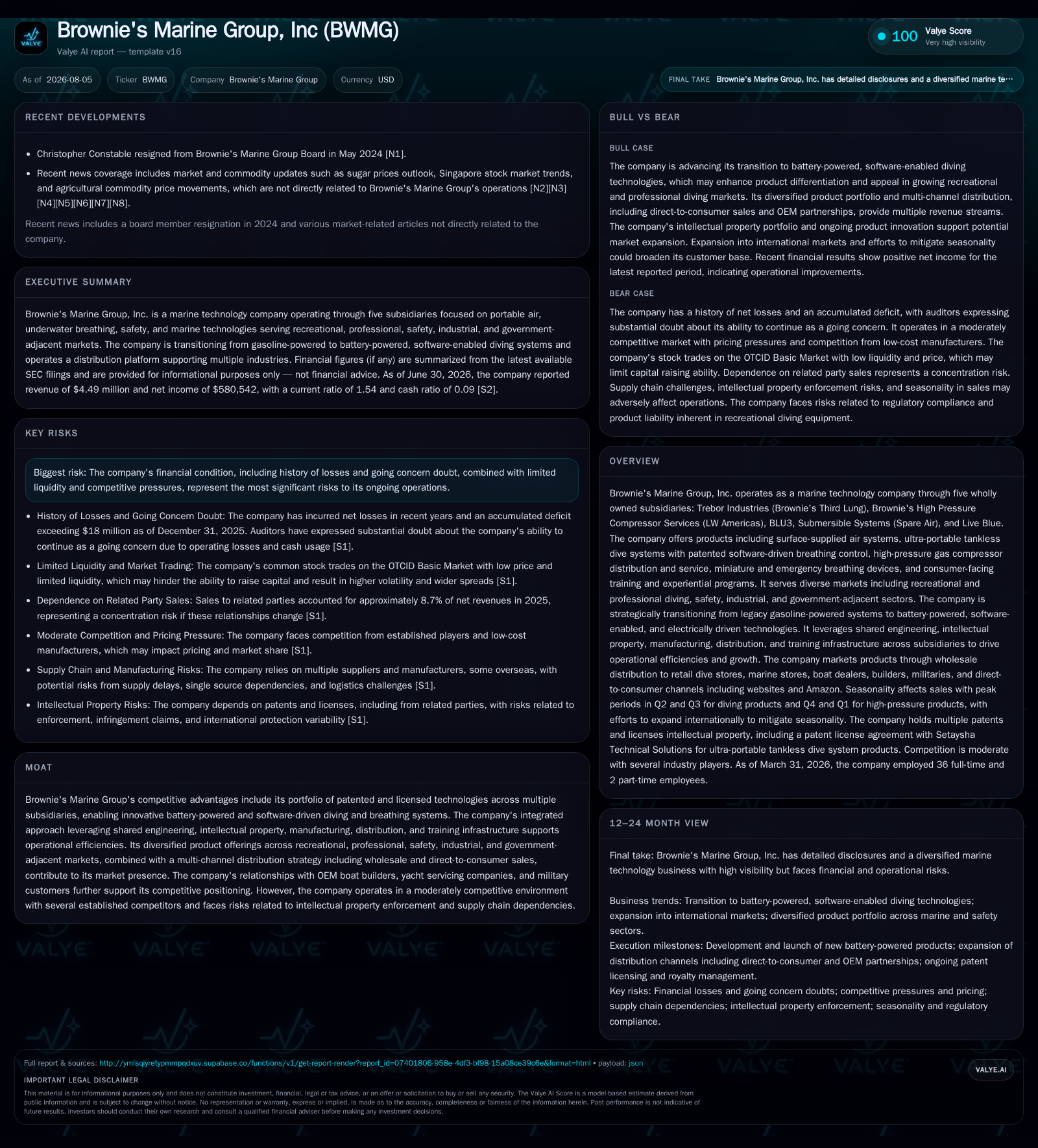
Brownie's Marine Group's 2026 second-quarter filing reveals progress in shifting from legacy gasoline-powered to innovative battery-powered diving systems supported by proprietary software. Despite operational efforts and an expanded multi-channel distribution model serving recreational, professional, OEM, and government-adjacent customers, the company continues to face liquidity pressures and recurring losses, raising going concern questions. The business leverages a diversified product mix across five subsidiaries, with patented technology fostering differentiation but also creating dependency on related-party licensing. Market expansion in recreational diving and government sectors provides growth avenues, though competition from low-cost manufacturers and seasonal demand variability pose risks.
Latest Quarterly Operating Trends Reveal Transition Progress during Financial Pressure
Brownie's Marine Group’s latest 10-Q filing dated August 4, 2026 underscores ongoing transition efforts to replace legacy gasoline-powered surface-supplied air (SSA) systems with battery-powered alternatives. The flagship Sea Lion® system now incorporates instant-change battery technology permitting extended shallow-water dives supporting multiple divers simultaneously — a critical upgrade intended to improve reliability and environmental footprint [S2][S1]. This pivot aligns with broader industry trends favoring electrically driven marine equipment over internal combustion engines due to operational efficiency and regulatory preferences.
However, these innovation-driven efforts coincide with continued financial strain. The company reported persistent net losses—$105,149 for the full year ending December 31, 2025—and an accumulated deficit exceeding $18 million [S1][F1]. Operating expenses outpaced gross profit despite recent SG&A reductions. The auditors have flagged substantial doubt about Brownie’s ability to continue as a going concern reflecting operating cash burn exceeding $100k annually [S1]. These results highlight the capital-intensive nature of developing next-generation marine breathing technologies coupled with challenges scaling production and sales rapidly enough to achieve profitability.
Adding a governance dimension, Brownie’s Marine Group appointed Mikkel Pitzner to the Board mid-July 2026 [S3], potentially signaling management’s intent to strengthen oversight as it navigates this structural transition.
Product Portfolio Shaped by Patented Battery-Powered Innovations Enhancing Competitive Moat
At the heart of Brownie’s technology leadership is its portfolio of patented devices spread across five wholly owned subsidiaries each delivering complementary offerings within the marine breathing ecosystem. Brownie’s Third Lung leads with surface-supplied air systems featuring the Sea Lion platform transitioned to electrically powered units supported by proprietary battery packs enabling instant swaps on boats—a feature tailored for both recreational divers and professional operators requiring uninterrupted air supply [S1].
BLU3 contributes ultra-portable tankless dive systems embedded with patented breathing control software that dynamically adjusts airflow—a notable differentiation addressing diver comfort and safety through real-time gas flow modulation. This software-centric approach contrasts sharply with gasoline-era mechanical controls common among legacy producers [S1].
Moreover, LW Americas focuses on high-pressure compressor distribution and after-sales service feeding both industrial use cases and recreational markets where compressor reliability is pivotal. Submersible Systems (Spare Air) offers miniature emergency breathing devices designed for redundancy safety while Live Blue drives consumer training and experiential programs enhancing market adoption by building user confidence.
This integrated suite benefits operationally from shared engineering resources and manufacturing knowhow while protecting innovations through intellectual property licenses held by CEO Robert Carmichael-affiliated entities—an arrangement that concentrates IP dependency risk yet sustains competitive advantage via exclusivity [S1][S5].
Multi-Channel Distribution Serves Diverse Customer Base While Leveraging OEM Partnerships
Brownie’s revenue model spans direct sales to end users including recreational and professional divers purchasing units online or at trade shows; wholesale channels distributing to specialized marine retailers; OEM partnerships embedding products like Sea Lion into boat builds; as well as contracts serving government-adjacent clients reliant on highly regulated safety standards [S1]
The OEM channel is particularly strategic since integrating SSA systems into new boats secures volume commitments anchored in boat sales cycles rather than spot purchases. Complementing hardware sales are service contracts chiefly through LW Americas’ compressor servicing network offering recurring revenue potential while maintaining customer touchpoints throughout equipment lifespan.
Seasonality remains pronounced—the diving equipment segment peaks in U.S. Q2/Q3 summer months while compressor-related equipment experiences increased demand in Q4/Q1 due in part to maintenance schedules aligned with industrial operations [S6]. Expansion efforts target geographic diversification beyond North America aiming to smooth revenue volatility inherent in weather-dependent leisure activities.
Competitive Dynamics Highlighted by Innovation Race and Pricing Pressures from Low-Cost Providers
Brownie competes in a moderately crowded market wherein innovation is a critical differentiator against entrenched players such as Aqua Lung America (scuba equipment), Coltri America (compressors), and Bauer Compressors Inc., all possessing strong brand recognition and scale advantages [S1]. Emerging competition includes low-cost portable breathing device makers like AirBuddy targeting price-sensitive consumers primarily through online channels.
Brownie balances medium-tier pricing emphasizing patented features like software-enhanced breathing controls absent in many commoditized Chinese-manufactured rival products. However, pricing power is constrained by customer sensitivity in largely discretionary spending categories while product quality expectations remain high due to safety implications.
Maintaining an active product innovation pipeline backed by R&D expenditure—even if modest at $3.6k reported in 2025—remains essential to sustain relevance amidst accelerating technological shifts towards electrically powered platforms integrated with digital safety monitoring [S1]
Drivers Supporting Growth: Market Expansion in Recreational & Professional Diving Plus Government Demand
Market data sourced from Fortune Market Insight indicates the diving market poised for expansion from $2.2 billion in 2025 surpassing $2.6 billion by 2030 underpinned by growing recreational participation fueled by tourism growth and experiential leisure trends [S1]. Additionally, rising regulatory scrutiny around diver safety bolsters demand for sophisticated equipment capable of delivering consistent clean air supply confidently.
Professional diving applications extend beyond leisure into industrial inspection, underwater construction, military use cases accelerating demand for reliable compressor systems servicing multifaceted environments [S1]. Government contracts focusing on public safety also drive incremental volumes for emergency breathing apparatus manufactured by Brownie’s Spare Air line.
The company’s acquisition of Sunrise Paddleboards assets further diversifies experiential offerings beyond equipment into rental services and training programs potentially enhancing customer acquisition funnels through hands-on exposure [S16]
Principal Risks: Financial Health Constraints, Intellectual Property Dependencies, And Market Seasonality
Financial sustainability remains paramount risk given repeated net losses accumulating an $18 million deficit undermining capital adequacy. Liquidity constraints are aggravated by reliance on capital raises via equity offerings in an OTCID Basic Market environment characterized by limited trading volumes and volatility elevating cost of capital [S1][S5]. No firm financing commitments leave substantial uncertainty on near-term funding availability imperative for continued R&D investment.
Dependence on licensed IP controlled principally by CEO Robert Carmichael-affiliated entities introduces material risk should licensing terms disrupt or if onerous royalty obligations materialize disproportionally relative to revenue generation [S1][S5]. Moreover, failure to protect patents globally exposes the company to infringement risks potentially diluting competitive advantage given enforcement challenges internationally [S8][S12].
Supply chain disruptions relating notably to components sourced from China may compound production delays affecting timely delivery jeopardizing customer satisfaction.
What To Watch: Progress on Technology Adoption Milestones, OEM Integrations And Cash Flow Outlook
Upcoming milestones entail measuring commercial traction for newly launched battery-powered Sea Lion products including uptake within OEM boat builder channels which could provide scalable volume anchors reducing sales variability [S2][S3]. Equally crucial will be monitoring renewal rates of compressor service contracts signaling aftermarket retention vital for margin stability.
Operational execution on integration of Sunrise Paddleboards assets may yield cross-selling synergies amplifying consumer engagement through combined rental-training-product ecosystems [S16]
Management’s capacity to curb operating losses at scale coupled with any improvements in gross margins via higher ASPs or optimized production would materially influence breach of going concern concerns flagged recently.
Financial Profile Discussion: Liquidity Position And Operating Losses Framing Near-Term Viability
The lack of firm funding commitments constrains agility amid ongoing product transitions requiring sustained R&D outlays despite cost control improvements. Persistently fragile earnings underscore tight management needed over receivables, inventories, and payables cycles alongside strategic initiatives securing deeper OEM alliances or expanding higher-margin recurring revenue streams via service contracts.
In summary, Brownie’s Marine Group faces a critical juncture balancing promising technological repositioning anchored in proprietary battery-powered diving solutions against financial capacity limitations requiring vigilant cost management and successful market adoption execution to avoid liquidity tightening compromising viability.
This analysis synthesizes available disclosures up to August 4, 2026 without projecting future performance or investment research views. All company-specific claims reflect cited SEC filings or credible secondary sources within defined report windows.
Disclaimer: This is research-only, informational analysis and not investment advice. It may include AI-generated interpretation and general industry context. Always verify important details using primary sources.

Comments