
Hyster-Yale Confronts Profit Pressures with Global Footprint and Aftermarket Potential
Q2 2026 results show margin compression amid cyclical softness, while aftermarket and fleet management services offer durable revenue streams.
Hyster-Yale’s latest quarterly report reveals continued challenges from cyclical demand softness impacting profitability despite a top-line beat in Q2 2026. The company leans on its broad global manufacturing footprint across multiple continents and a diversified product portfolio spanning lift trucks, attachments, and energy solutions to serve varied markets. Growth initiatives center on expanding its aftermarket parts and fleet management services, which provide steadier revenue streams less sensitive to new truck sales cycles. However, raw material inflation and supply chain constraints persist as margin headwinds. Monitoring unit volume trends, service contract penetration, and capacity utilization will be crucial to assess recovery trajectory.
Q2 Operating Realities: Revenue Beats Amid Profit Margin Pressure
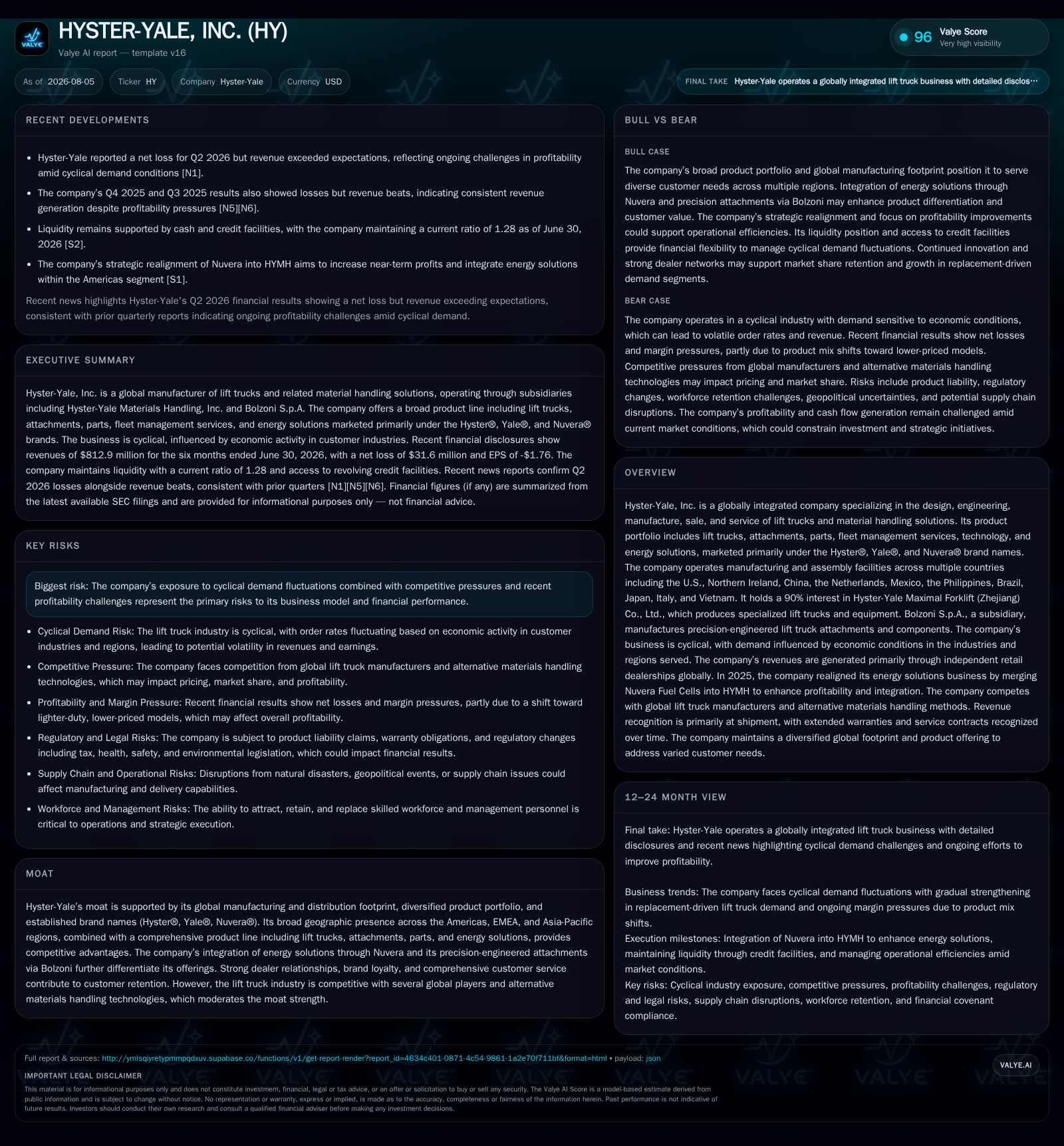
In its second quarter ended June 30, 2026, Hyster-Yale reported revenues that exceeded market expectations thanks to modestly resilient lift truck unit sales and steady aftermarket parts business [S2][S3][N1]. However, the operating income remained negative due to persistent margin compression. Rising raw material costs combined with freight inflation and supply chain constraints pressured manufacturing expense ratios. This dynamic underscores the cyclicality characteristic of the lift truck industry where volume softness translates quickly into under-absorbed fixed costs and profitability erosion.
Despite higher revenue driven by both equipment sales and service contract renewals, inflationary headwinds and pricing competition weakened operating margin performance. The near-term profit challenges highlight the firm's exposure to macroeconomic industrial demand cycles as well as commodity price shifts. Management’s commentary also pointed to ongoing efforts in working capital discipline and supply chain efficiency improvements intended to moderate margin pressure [S2][S3]. Such operational refinements will be critical as the company seeks to stabilize earnings in a challenging external environment.
Core Offering Dynamics: Lift Trucks Portfolio Meets Service-Driven Stability
Hyster-Yale operates a broad product portfolio featuring its flagship Hyster® and Yale® lift trucks alongside Nuvera® energy solutions [S1]. The company targets diverse customer segments including warehouse operations, manufacturing plants, logistics providers, and port equipment operators through application-tailored lift trucks ranging from counterbalanced forklifts to rough terrain models [S1]. Bolzoni S.p.A., a subsidiary focused on precision-engineered attachments marketed under Bolzoni®, Auramo®, Meyer®, and Silver Line brands further complements this offering by addressing specialized load handling needs.
The business model monetizes through direct equipment sales primarily transacted via an extensive independent dealer network supplemented by aftermarket parts sales, scheduled maintenance contracts, fleet management subscriptions, and technology-enabled asset monitoring services [S1]. This combination provides recurring revenue streams that partially offset new truck order cyclicality. Aftermarket parts revenue is especially important given its higher margin profile relative to capital equipment sales. Additionally, the expanding penetration of fleet management services leveraging telematics offers strategic differentiation in service stickiness and customer retention
This balanced mix between hardware sales susceptible to economic swings and recurring-service income sources creates resilience across the product lifecycle. It also aligns with broader industry trends where OEMs seek deeper customer engagement post-sale to enhance lifetime value amid competitive pressure.
Global Manufacturing & Dealer Network: Scale Advantage in an Intense Market
Hyster-Yale maintains a geographically diversified manufacturing footprint with assembly facilities in key regions including the United States (several states), Northern Ireland, China (multiple sites), the Netherlands, Mexico, Brazil, Japan, Italy, Vietnam among others [S1]. This global presence enables tailored local market responsiveness while optimizing logistics costs and lead times. It also supports multi-brand production strategies that can flex across regions depending on demand dynamics.
The company's dealer network is vital not only for distribution of new trucks but also critical for aftermarket parts sales and customer service delivery—components that drive margin stability [S1]. This wide-reaching network fosters brand loyalty via proximity support and technical expertise.
Capital intensity inherent in manufacturing industrial vehicles means capacity utilization rates materially influence unit cost absorption; lower volume stretches fixed overhead leading to profit volatility during downturns. Hyster-Yale’s geographic diversity partially tempers region-specific economic fluctuations yet maintaining efficiency across multiple plants remains a management challenge.
Competitive Landscape: Peer Benchmarks Highlight Innovation & Geographic Reach
Hyster-Yale competes within a consolidated global market featuring major players such as Toyota Material Handling and KION Group—companies noted for substantial scale manufacturing footprints combined with wide geographic diversification. These peers often benefit from broader R&D budgets enabling faster innovation cycles particularly around energy-efficient powertrains (electric forklifts) and digital fleet management solutions.
Pricing power is partly determined by brand strength backed by dealer networks providing comprehensive aftermarket service. Hyster-Yale’s ability to integrate energy solutions via Nuvera alongside precision-engineered attachment offerings via Bolzoni adds differentiation but must be weighed against the entrenched positioning of larger OEMs who aggressively push electric vehicle options amid rising environmental regulations.
Maintaining quality performance standards alongside continuous innovation is critical given the shift toward smart warehouses and automated material handling systems where telematics adoption sets future winners apart.
Growth Vectors: Fleet Management & Aftermarket Services as Resilience Pillars
A pivotal growth lever for Hyster-Yale lies in expanding its fleet management subscriptions that deliver recurring revenue decoupled from capital equipment purchase cycles [S1]. With rising adoption of IoT-enabled telematics platforms embedding real-time asset monitoring capabilities into lift trucks, the company aims to capitalize on predictive maintenance contracts improving operational uptime for customers.
Simultaneously increasing service contract penetration strengthens margin profiles due to lower volatility compared with hardware sales [S1]. The strategic consolidation of Nuvera Fuel Cells LLC into the Americas segment represents a move toward integrated clean energy solutions enhancing product differentiation while addressing growing electrification trends
Investing in these complementary service lines can enable Hyster-Yale to cross-sell offerings into existing installed bases across regions leveraging its dealer ecosystem—an advantage over firms with narrower portfolios.
Market Risks and Operational Constraints: Navigating Demand Cyclicality and Cost Pressures
Consistent risks underpinning Hyster-Yale’s industry include macroeconomic sensitivity where capital expenditures by customers fluctuate sharply with industrial production activity [S1][S2]. The cyclicality compresses earnings visibility particularly when combined with input cost volatility from raw materials such as steel prices impacting manufacturing margins.
Supply chain disruptions remain a constraint slowing delivery schedules affecting both new trucks and parts availability globally [S2]. Regulatory changes concerning emissions standards require continued R&D investments sustaining competitiveness but adding near-term expenses.
The high dependency on independent dealers places emphasis on maintaining strong relationships; any erosion here could impair aftermarket revenues or increase reliance on discounting new truck sales fostering margin deterioration [S1]. Currency fluctuations also introduce complexity given cross-border operations spanning multiple currencies
What to Watch: Indicators for Volume Recovery, Margin Trends, Product Launches, Capacity Utilization
Key near-term milestones include sequential order backlog growth signaling inflection in demand momentum [S2]. Observing trends in average selling prices per unit reflecting pricing power or discount pressure will provide early signs of margin normalization or further compression
Tracking increases in aftermarket parts revenue along with fleet management subscription additions will confirm execution success in stable income growth avenues less exposed to cyclical shocks.
Capital expenditure patterns earmarked for facility modernization or expansion reveal willingness to scale manufacturing capacity anticipating recovery phases [S1]. Close attention to dealer network coverage metrics linked to customer retention informs durability of installed base monetization strategies.
Financial Profile Discussion: Contextualizing Liquidity, Leverage, and Cash Flow Support
As of mid-2026, Hyster-Yale exhibits moderate leverage with total debt around $496 million offset by approximately $66 million cash balances resulting in net debt close to $431 million [F1]. The current ratio stands at a comfortable 1.28 indicating adequate short-term liquidity coverage relative to liabilities due within one year [F1].
Term loan maturities extend through 2028 supported by revolving credit facilities maturing in 2030 providing financing flexibility for operational needs or strategic investments [S4][S5][S6]. Capital expenditures are forecasted between $55–75 million for 2026 consistent with modernization efforts but monitored prudently aligned with volume improvements [S13].
Overall financial flexibility underpins execution capacity despite near-term earnings pressures providing runway for profitable growth initiatives focusing on durable aftermarket services expansion.
This analysis synthesizes recently disclosed quarterly results alongside annual context underpinning Hyster-Yale’s strategic positioning within industrial material handling equipment markets characterized by cyclical demand patterns. It highlights key levers related to portfolio diversification into service contracts and digital fleet management that may cushion earnings volatility while underscoring areas of ongoing risk from macro sensitivity and input cost inflation. Investors should focus on forthcoming quarterly indicators such as backlog developments, pricing realization trends, subscription growth metrics alongside improvements in manufacturing utilization signaling potential rebound phases. The firm’s sizeable global manufacturing footprint combined with established dealer networks remains foundational advantages albeit not immune to competitive pressures from larger OEM peers innovating aggressively around electrification and automation integration.
Disclaimer: This is research-only, informational analysis and not investment advice. It may include AI-generated interpretation and general industry context. Always verify important details using primary sources.

Comments