
SPX Technologies Advances in Data Center Growth and Navigates Geopolitical Cost Pressures
Q2 2026 results highlight robust revenue gains driven by data center expansion amid complex tariff and supply chain dynamics.
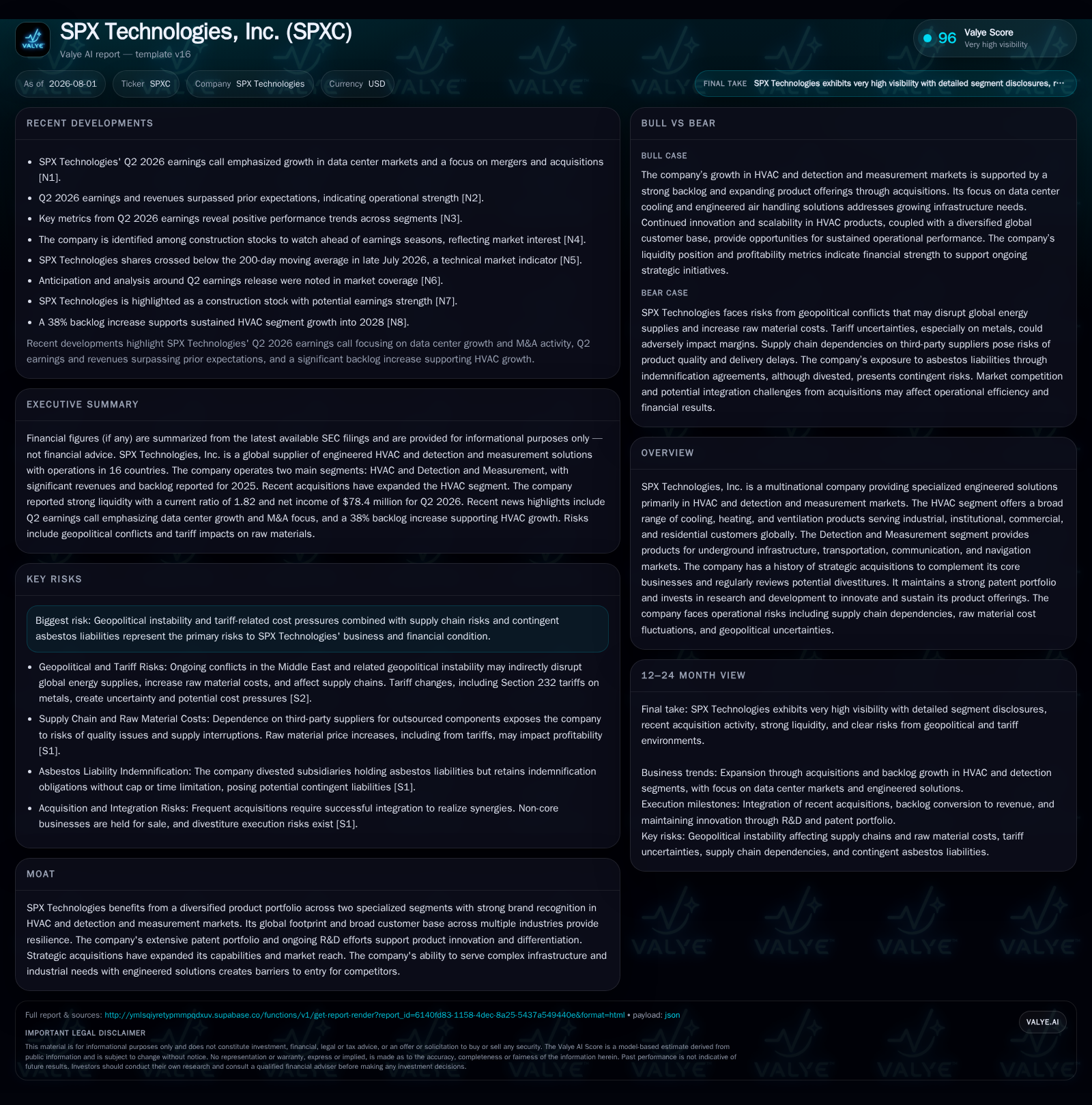
SPX Technologies reported stronger-than-expected Q2 2026 revenue performance fueled by growth in its HVAC and detection and measurement segments, notably within data center infrastructure. The company continues to leverage strategic acquisitions while managing raw material cost inflation from new tariffs and geopolitical tensions. Despite cyclical capital spending risks and supply chain challenges, SPX’s diversified portfolio and patent-backed innovation provide competitive resilience. Key near-term indicators to monitor include backlog trends, pricing effectiveness amid cost pressures, and execution on targeted M&A initiatives.
Latest Quarterly Operating Update: Q2 2026 Performance Highlights
SPX Technologies’ Q2 2026 earnings filing reveals revenues that surpassed market expectations, underscoring sustained momentum especially within the company’s HVAC segment focused on data center infrastructure growth [S2][S3][N2]. The company emphasized robust order intake related to commercial and industrial cooling solutions critical for expanding data centers, a high-growth end market driven by escalating digital storage demands [N1]. Concurrently, detection and measurement product lines contributed steady project-based revenues tied to underground infrastructure and transportation sectors.
Despite encouraging top-line results, SPX flagged rising raw material costs due to newly imposed U.S. tariffs on aluminum, steel, and copper introduced under Section 232 of the Trade Expansion Act starting in early 2026. These tariffs apply broadly at full customs value rather than proportionate metal content levels as under previous regimes, increasing input costs significantly [S2]. Although management has been able to partially mitigate this pressure through pricing adjustments and supply chain optimization, lingering uncertainties around tariff duration, potential escalations or retaliatory trade measures pose risk to margin sustainability.
Geopolitical tensions—primarily stemming from conflict in the Middle East involving the United States, Israel, and Iran—constitute an indirect but meaningful risk as they have triggered energy price volatility that exacerbates inflationary pressures on commodity inputs and disrupt global supply chains [S2]. While SPX does not have direct operations in affected regions, these macroeconomic dynamics could influence customer capital spending decisions or trigger supply delays.
Seasonally, the business anticipates stronger performance entering the latter half of calendar year 2026 as commercial heating product sales ramp up with colder months approaching—a pattern consistent with historical fluctuations identified in prior annual filings [S1]. This seasonal cadence provides some predictability amidst broader cyclicality.
Business Model Deep Dive: Engineered Solutions with Diversified Revenue Streams
SPX Technologies operates two primary segments serving industrial HVAC systems and detection & measurement markets. Revenue generation arises mostly from direct sales of engineered products distributed globally through a mix of direct contracts with institutional clients (e.g., utilities, infrastructure operators) and indirect channels targeting commercial building operators [S1]
Within HVAC, product offerings span cooling towers, air handlers, heat exchangers, and complete ventilation systems tailored for data centers, manufacturing plants, hospitals, educational institutions, and residential projects. These high-engineering content products command premium pricing justified by customization requirements and stringent compliance standards related to energy efficiency and emissions regulations. SPX enhances recurring revenue streams by providing aftermarket parts along with maintenance contracts ensuring ongoing customer engagement beyond initial equipment sale.
The detection and measurement segment focuses on sophisticated instrumentation for underground utility locators, transportation monitoring devices, navigation aids, and communication infrastructure testing. These tend toward project-based sales cycles often aligned with large infrastructure investments or regulatory-driven upgrades requiring specialized equipment solutions.
A critical characteristic of SPX’s model is its emphasis on innovation backed by a strong patent portfolio that shields proprietary technologies supporting differentiated features highly valued by customers with demanding technical specifications. The company allocates significant resources into research & development to maintain this edge while selectively pursuing strategic acquisitions that expand technological capabilities or enable entry into adjacent niche markets. This acquisition-driven growth complements organic innovation by adding breadth without diluting engineering rigor [S1][N1].
Margins depend heavily on effective supply chain management given exposure to volatile raw material prices—especially metals—and operational execution at manufacturing facilities where capacity utilization impacts fixed cost absorption. Pricing power varies across product lines but tends to benefit from limited competition in highly engineered segments where switching costs for customers are elevated.
Industry Structure and Competitive Positioning
The industrial engineered solutions sector serving HVAC systems and detection/measurement equipment is characterized by moderate fragmentation but a handful of well-established players dominate core segments. Peers like Carrier Global specialize heavily in large-scale HVAC system manufacturing with extensive global distribution; Emerson Electric operates across industrial automation including measurement instrumentation; Johnson Controls integrates building controls alongside HVAC offerings; Honeywell focuses more on industrial control safety systems; Pentair serves fluid management niches overlapping some SPX applications.
SPX positions itself as a mid-sized player innovating within specialized engineered niches characterized by higher entry barriers due to product complexity, certification requirements, and long product lifecycles tied closely to capital expenditure cycles of end users. Its diversified portfolio across two distinct but complementary markets provides some buffer against cyclicality isolated to any single vertical.
Competitive advantages derive from several factors: their strong patent portfolio reinforces product differentiation; global footprint supports diverse end markets mitigating geographic concentration risk; specialized service networks enhance aftermarket penetration providing additional margin stability; finally strategic acquisition activity bolsters scale and accelerates technology adoption relative to peers reliant primarily on organic innovation. Nevertheless, SPX must continuously navigate pricing pressures stemming from customers’ procurement sophistication especially during downturns impacting capital investment budgets.
Growth Drivers
SPX’s near- to medium-term growth prospects are closely correlated with broader industry drivers:
- Infrastructure investment: Expanding global urbanization combined with aging native infrastructure fuels demand for replacement HVAC equipment alongside advanced detection tools for utilities.
- Data center expansion: Rapid buildout of hyperscale data centers worldwide creates sustained demand for precision cooling systems critical for operational uptime.
- Environmental regulations: Increasing regulatory focus on energy efficiency mandates upgrades or replacement of legacy HVAC units generating retrofit opportunities.
- Technological advances: Innovations such as IoT-enabled connected HVAC devices or enhanced detection instrumentation open cross-selling prospects within existing customer bases.
- Maintenance cycles: Recurring aftermarket parts sales tied to maintenance schedules generate higher margin stability beyond project spikes.
- M&A strategy: Targeted acquisitions allow entry into specialty sub-segments or geographies otherwise difficult to penetrate organically.
Watchpoints include tracking how effectively SPX leverages price increases without hampering volume growth amid raw material inflation; shifts in customer buying patterns particularly among data center developers; evolution of geopolitical tensions affecting supply chestnuts; pace of service contract uptake which stabilizes margins; plus timely completion of integration milestones associated with recent acquisitions disclosed.
What To Watch Next
Upcoming milestones that will shed further light on SPX’s trajectory comprise:
- Quarterly updates on backlog levels offer insights into demand pipeline health particularly important given project-based order nature.
- Detailed margin disclosures post-tariff implementation reveal success of pricing strategies versus input cost escalation exposure.
- Announcements regarding further acquisitions signal management’s confidence in inorganic growth avenues complementing organic innovation efforts.
- Progress on new product launches leveraging patented technologies will measure continued competitiveness against peer incumbents.
- Second-half seasonal uptick performance relative to historical baselines validates model stability assumptions around cyclical effects documented since prior years.
Broadly speaking, operational execution over coming quarters that sustains above-market revenue growth while containing inflationary margin erosion would affirm durability of strategic initiatives against macroeconomic challenges currently shaping industrial hardware markets globally.
Financial Profile Discussion
As of June 27, 2026, SPX Technologies holds cash & equivalents totaling approximately $166 million against total debt near $530 million, driving net debt around $364 million—a moderate leverage level common within capital-intensive engineered hardware industries focused on long-term contract fulfillment [F1]. Current assets stand at roughly $1.10 billion versus current liabilities near $604 million, yielding a healthy current ratio around 1.82 indicating adequate near-term liquidity cushion supporting working capital needs amidst seasonal fluctuations [F1].
Overall financial positioning reflects a solid foundation enabling strategic flexibility while preserving operational resilience despite external headwinds from tariffs and global geopolitical uncertainties noted previously [S2][F1]. Careful monitoring of leverage metrics alongside cash flow generation trends will be imperative as new tariffs take fuller effect over subsequent quarters potentially requiring incremental working capital for inventory buildup or supplier prepayments incentivized by volatile commodity cost environments.
This analysis presents an informed view drawn from SPX Technologies’ most recent quarterly SEC filings supported by contemporaneous news updates integrating industry-specific framing relevant to engineered industrial hardware companies serving critical infrastructure markets without relying on unsupported forward projections or speculative claims.
Disclaimer: This is research-only, informational analysis and not investment advice. It may include AI-generated interpretation and general industry context. Always verify important details using primary sources.

Comments