
Wave Life Sciences Advances RNA Therapeutics Pipeline Amid Strong Liquidity and Developmental Challenges
Wave Life Sciences reported its Q2 2026 financial results highlighting continued investment in RNA-based genetic medicines with a robust cash position supporting its pipeline progress.
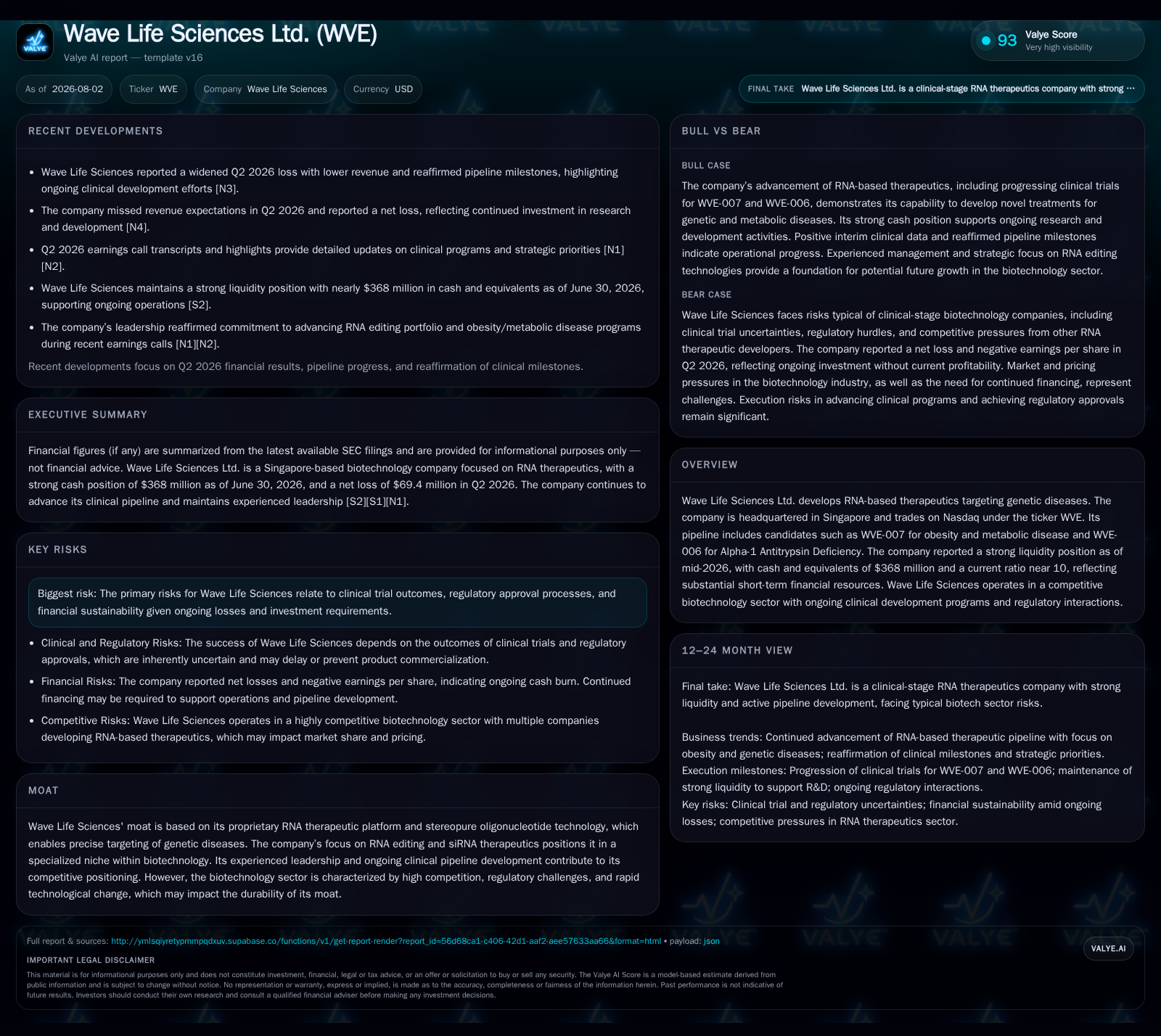
In its latest quarterly update, Wave Life Sciences reinforced its focus on RNA therapeutics for genetic diseases, underscored by its stereopure oligonucleotide platform and clinical programs in obesity (WVE-007) and Alpha-1 Antitrypsin Deficiency (WVE-006). Despite widening net losses and limited near-term revenue, the company’s strong liquidity position with nearly $370 million in cash as of June 2026 underpins ongoing R&D investment. Operating within a highly competitive and innovation-driven biotechnology landscape, Wave faces typical sector risks including clinical trial and regulatory uncertainties but benefits from proprietary technology and a diversified pipeline. Key operational markers to watch include clinical trial enrollment and progression, regulatory milestones, and partnership development.
Recent Operating Update
Wave Life Sciences released its Q2 2026 earnings on July 30, confirming the continuation of dedicated investment toward its RNA therapeutic pipeline. The company disclosed maintaining a strong liquidity position with cash and cash equivalents standing at $368 million as of June 30, 2026, underpinning an enviably high current ratio near 10 [F1][S2]. Despite posting widening net losses reflective of increased R&D spending typical of early clinical-stage biotech firms, Wave reaffirmed key pipeline milestones including ongoing trials for WVE-007 in obesity/metabolic disease and WVE-006 targeting Alpha-1 Antitrypsin Deficiency (AATD) [S2][S3].
The Q2 results revealed no significant revenue increase since the company remains predominantly research-driven without commercial products launched. This situation aligns with the sector norm where upfront investment precedes regulatory approvals or monetization events such as milestone payments or licensing fees. Wave reiterated plans to accelerate regulatory engagements particularly by assuming full control over WVE-006’s development pathway earlier this year [S15], signaling strategic intent to streamline approvals.
Business Model Overview
Wave operates primarily as a discovery-through-clinical-development biotech entity focused on RNA therapeutics based on its proprietary stereopure oligonucleotide platform. This technology enables precise targeting of genetic diseases by delivering RNA molecules designed to modulate gene expression or edit defective genes. Core pipeline candidates include WVE-007 (an siRNA conjugated agent in Phase 2a for obesity/metabolic disorders) and WVE-006 (an AIMer RNA editing candidate targeting AATD), representing diversified molecular approaches within the RNA modality spectrum [S1][N11].
Revenue mechanics hinge predominantly on R&D collaborations or licensing arrangements common in this industry stage. Until product commercialization, Wave incurs substantial operating losses driven by research expenses and clinical trial costs [F1]. Monetization occurs through milestone payments upon clinical progression or partnering deals rather than product sales presently.
The company collaborates selectively with contract research organizations for trial execution but maintains significant internal expertise in molecular design and early manufacturing scale-up [S1]. Intellectual property protection through patents on stereopure constructs forms part of Wave's competitive moat alongside technical differentiation from peers who rely on different oligonucleotide chemistries
Industry Structure and Competitive Position
Operating within the highly competitive RNA therapeutics segment of biotechnology places Wave among innovators employing antisense oligonucleotides, siRNAs, and emerging RNA editing platforms. Peers like Ionis Pharmaceuticals and Alnylam Pharmaceuticals set benchmarks in clinical trial design rigor and regulatory success for analogous modalities. In this environment, rational differentiation arises from platform specificity—stereopure oligonucleotides offer potentially improved safety or potency—and indication targeting strategy.
The biotechnology value chain sees Wave active from discovery through mid-stage clinical development without late-stage commercialization infrastructure yet. Unlike large pharma players that combine platform breadth with global marketing forces, Wave's scalability depends on successful partnership out-licensing or acquisition prospects after proof-of-concept achievements.
Clinical trial progression success rates remain an industry-wide challenge; engineering endpoints that satisfy regulators while demonstrating meaningful patient benefit requires sophisticated trial design capabilities [S1]. The manufacturing scale-up necessary for therapeutic dosing—especially for subcutaneously administered agents like WVE-006—is another critical operational factor impacting downstream commercialization readiness
Growth Drivers
Key growth drivers are anchored in advancing late preclinical candidates into human trials with positive safety/tolerability profiles driving initial efficacy signals. The transition of WVE-007 into Phase 2a reflects progress toward validating mechanism-of-action hypotheses in targeted metabolic disorders [N11]. Similarly, WVE-006 progress leverages novel RNA editing AIMer technology offering precision gene correction advantages that could open new treatment paradigms for AATD [S15].
Regulatory strategy acceleration by reclaiming full program control aids more direct interaction with agencies to optimize filing timelines—critical given competing molecules targeting similar orphan or niche diseases [S15]. Strategic partnerships remain potential catalysts not only reflecting external validation but also offsetting capital requirements via milestone payments or shared development costs.
Technological advances improving delivery efficiency or stereopure chemistry refinements represent incremental yet important demand signals signaling sustained R&D relevance. Broader market demand for precision medicine offerings aligned with genetic disease etiology supports underlying structural market expansion in RNA therapeutics.
Risks and Watchpoints
The principal risks mirror typical biotechnology uncertainties: clinical trial failures or delays pose critical threats given that positive pivotal data remain prerequisites for regulatory approval and future revenues [S13]. Regulatory timelines can be protracted or uncertain due to the novel mechanisms employed by RNA editing candidates.
Financial sustainability through prolonged R&D cycles requires consistent capital access despite cash reserves currently sufficient for the medium term; however further fundraising may dilute existing shareholders or introduce financing risk if pipeline progress stalls [F1][S13]. Manufacturing scale-up complexities could also impede late-stage readiness should technical challenges arise replicating stereopure constructs at commercial scale.
Competitive risk from superior next-generation therapies or faster-moving players further constrains market opportunity windows. Intellectual property enforcement adds another overlay risk layer amid growing patent disputes within innovative biotech sectors.
What to Watch Next
Upcoming milestones include enrollment pace updates from the ongoing Phase 2a INLIGHT study evaluating WVE-007’s efficacy endpoints which will materially influence timing of endpoint data availability [N11]. Additional interim results from the RestorAATion-2 trial assessing WVE-006 safety/efficacy remain critical to validate the AIMer approach’s therapeutic potential.
Regulatory submissions reflecting FDA engagement outcomes around candidate approval pathways will be pivotal to elucidate likely commercial launch horizons. Monitoring partnership announcements would clarify external validation trends alongside capital infusion prospects essential for sustained pipeline expansion.
Financial markers such as quarterly burn rate relative to liquidity dissipation will offer signals about operational efficiency adjustments or upcoming financing rounds impacting longer-term viability.
Strategic elements including progress on corporate redomiciliation might influence investor perceptions via anticipated governance alignment benefits though without direct operational effect in near term [S24].
Financial Profile Discussion
Wave Life Sciences' financial profile features significant operating losses consistent with high R&D investment phases standard among biotech innovators before product commercialization. As of June 30, 2026, cash and equivalents stood robustly at $368 million complemented by current assets totaling approximately $508 million against current liabilities near $50 million—yielding a pro forma current ratio just under 10 [F1]. This liquidity buffer provides substantial runway supporting ongoing costly clinical programs amid minimal revenues derived primarily from licensing or partnership milestones previously recognized.
Operating losses widen as Wave escalates spending toward advancing pipeline assets through expensive clinical phases reflected in the negative operating income figure reported last year [F1]. This financial structure underscores typical biotech reliance on capital markets or deal-making until internal commercialization capabilities mature post-regulatory approvals.
In summary, Wave maintains well-funded operations positioning it favorably relative to many similarly staged peers facing funding constraints; however capital efficiency will require careful management alongside achieving key development inflection points to secure future non-dilutive funding sources.
Disclaimer: This is research-only, informational analysis and not investment advice. It may include AI-generated interpretation and general industry context. Always verify important details using primary sources.

Comments