
ALKAMI TECHNOLOGY Extends Digital Banking SaaS Leadership Through Integration and Long-Term Contracts
Alkami's latest quarter confirms growth-driven investments and subscription revenue resilience anchored by deep FI client relationships.
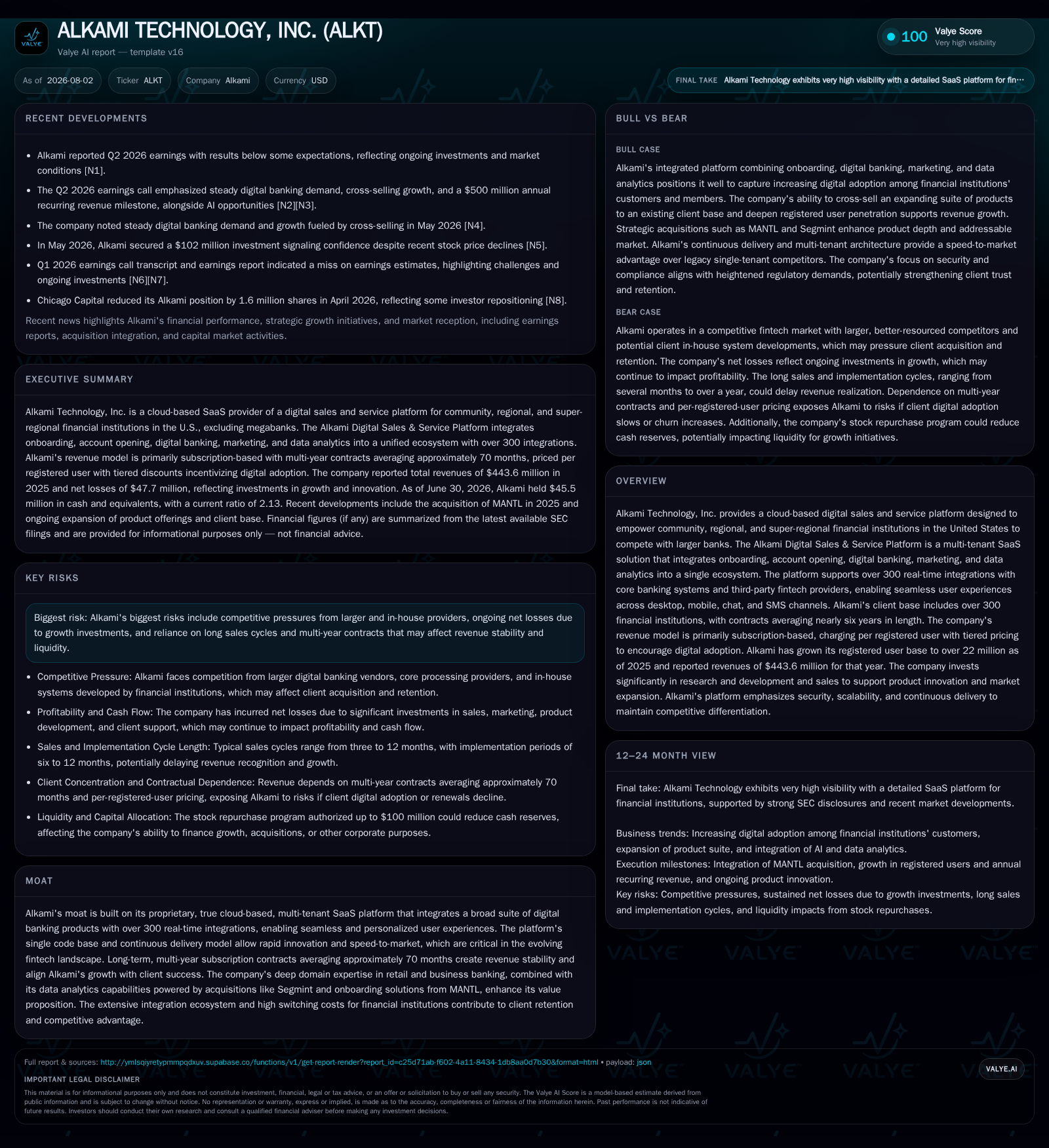
Alkami Technology reported Q2 2026 results highlighting continued expansion of its cloud-native digital banking platform for community and regional financial institutions. Its subscription-based model, grounded in per-registered-user pricing and long-term contracts averaging nearly six years, drives predictable revenue with strong renewal dynamics. The company’s strategic acquisitions, broad integration ecosystem of over 300 real-time connections, and focus on onboarding and data analytics underpin competitive differentiation. While significant investments keep Alkami operating at a net loss, its cash position and customer base growth demonstrate ongoing scalability potential amid competitive risks from larger incumbents and in-house bank solutions.
Recent Operating Update
Business Model Overview
Alkami operates a cloud-native digital sales and service platform designed chiefly for community, regional, and super-regional U.S. financial institutions — segments often underserved by larger fintech vendors or banks’ proprietary solutions [S1]. The Alkami Digital Sales & Service Platform consolidates onboarding/account opening, digital banking across channels (desktop/mobile/chat/SMS), marketing automation, payments, financial analytics, and risk reporting into an integrated SaaS ecosystem.
Revenue is predominantly subscription-based with contracts averaging approximately 70 months (nearly six years), ensuring high visibility into recurring revenues with built-in alignment to client success metrics [S1]. This extended contract duration also acts as a natural churn barrier—especially given the platform’s complexity—which can be disruptive for clients to replace due to the scale of implementation required. Monetization occurs via per-registered-user pricing tiers that scale with an FI's end-user penetration; pricing tiers offer discounts at volume thresholds to encourage deeper digital adoption by the financial institution's customers or members.
Clients are primarily banks or credit unions who pay for software licenses tied to their registered user base — individuals or businesses authorized on their accounts within the Alkami ecosystem. The tiered pricing incentivizes FIs to promote internal user adoption digitally while enabling Alkami to predictably grow annual recurring revenue (ARR) alongside client engagement levels [S1]. Implementation durations typically range from six to twelve months post-contract signing due to integration depth with clients’ core banking systems and third-party fintech partners
Alkami complements this core offering by steadily extending its product suite through acquisitions: ACH Alert enhances fraud prevention solutions; Segmint adds cloud-based financial data analytics; MANTL (acquired March 2025) integrates onboarding and loan origination capabilities targeting commercial as well as retail deposit accounts [S1]. This modular expansion allows cross-selling within existing clients enhancing lifetime value (LTV) and deepens stickiness without fragmenting the operation due to the single code base multi-tenant architecture.
Industry Structure and Competitive Position
The fintech SaaS market for financial institutions is fragmented with large players including nCino, Q2 Holdings, Finastra, core banking vendors like FIS/Fiserv, third-party fintech integrators, as well as large banks developing bespoke in-house digital banking platforms. Competition is rooted mainly in breadth/depth of functionality, speed-to-market through API/integration ecosystems, pricing models aligned with scalable adoption KPIs like registered users, client retention rates amid subscription renewals, quality of UX design across channels, and regulatory compliance capabilities.
Alkami distinguishes itself via its proprietary true cloud multi-tenant platform delivering rapid innovation velocity through a single code base maintained continuously without traditional upgrade disruptions [S1][S10]. Its ecosystem supports over 300 real-time integrations with back-office systems including payments networks, mortgage servicing platforms, bill pay providers, electronic document management systems, money movement rails, personal financial management tools—all crucial for delivering seamless end-user experiences. These integrations facilitate FIs competing more effectively against larger banks by enabling personalized digital journeys that span onboarding through account servicing.
Client retention benefits from high switching costs arising out of integration complexity combined with long contractual tenure averaging about 70 months. Customer-facing UX design across desktop/mobile/chat/SMS channels nurtures durable connections between FIs and their account holders—both consumers and businesses—reinforcing engagement metrics that underpin incremental usage fees under tiered pricing models. Nevertheless, competition remains fierce especially given some potential clients’ preference or capability to develop internal platforms which can disrupt renewal prospects.
Growth Drivers
Fundamental industry trends drive demand growth for Alkami’s platform:
- Persistent digital transformation efforts among community/regional FIs pressured by larger banks’ technological advantage.
- Increased cloud migration favoring scalable SaaS delivery that lowers FI operational overhead relative to legacy on-premise systems.
- Expanding product suites augmenting customer acquisition capabilities through onboarding/loan origination modules from MANTL acquisition.
- Enhanced data analytics powering targeted marketing campaigns leveraging transaction-level insights via Segmint integration.
- Regulatory mandates encouraging modernization away from siloed legacy systems towards integrated platforms supporting compliance reporting.
- Pricing models tied directly to registered user growth couple Alkami’s revenue trajectory with FI customer/member adoption rates.
- The growing importance of omnichannel UX personalization spanning mobile apps to SMS engagement increases strategic significance of integrated platforms like Alkami’s.
- Cross-selling opportunities inside existing client relationships improve margins over time through expanded usage beyond initial core deployments.
These drivers show structural tailwinds rather than temporary cyclical boosts given the pace of cloud adoption across mid-tier banking institutions.
Risks and Watchpoints
Alkami faces several notable risks:
- Continuing net losses driven by aggressive investments in sales & marketing plus R&D strain near-term profitability despite positive cash flow trends at times [F1][S1].
- Lengthy sales cycles (3–12 months) coupled with extensive implementation timelines (6–12 months) introduce revenue visibility challenges especially if macroeconomic uncertainty impacts FI spending decisions.
- Dependency on rapidly evolving fintech integrations necessitates continuous innovation; failure to maintain pace could erode competitive advantage.
- Competition from larger fintech firms possessing greater resources or from FIs opting for bespoke internal development could limit new client acquisition momentum or induce attrition risks.
- The stock repurchase program authorized at $100 million may reduce available cash for strategic investments while increasing share price volatility—a double-edged capital allocation decision [S22].
- Cybersecurity threats persistently loom given sensitive data handled; breaches could harm reputation or lead to regulatory penalties.
- Regulatory changes impacting licensing terms or technology standards might require costly adaptation delaying feature rollout schedules.
- Concentration risk tied to U.S.-centric FI clientele exposes revenues to sector-specific downturns or consolidation impacts affecting overall FI technology budgets.
Monitoring new contract signings volume, renewal rates on expiring multi-year agreements beyond Q3/Q4 periods along with registered user adoption velocity will be key execution metrics going forward.
What To Watch Next
Key milestones include quarterly updates on:
- Registered user growth sustaining proportionate ARR ramp reflecting deeper FI customer engagement.
- Multi-year contract renewal success rates indicating retention stability given platform switching complexities.
- Pace of new FI client conversions signaling broadening market footprint amid competitive pressures.
- Module adoption rate trends especially for recently integrated MANTL onboarding functionality revealing upsell progress.
- Margin progression curves balancing sales/implementation expense inflation against scale efficiencies within SaaS delivery model.
- Capital allocation outcomes particularly related to share repurchase execution impact on liquidity versus reinvestment capacity.
- Any disclosures around technology innovations potentially accelerating speed-to-market or enhancing UX differentiation vs peers.
Collectively these will signal whether Alkami can balance ongoing investment with margin improvement while deepening client relationships essential for durable subscription income streams.
Financial Profile Discussion
Alkami entered H1 2026 with a solid liquidity position comprising approximately $45.5 million in cash and equivalents against current liabilities near $83 million yielding a healthy current ratio of about 2.13—indicative of sufficient short-term asset coverage amid operating outflows [F1]
The recent authorization of a $100 million share repurchase program undertaken at management discretion introduces variability in liquidity deployment; it may heighten stock price fluctuations while reducing immediately available capital for organic development or bolt-on acquisitions [S22]. This must be balanced alongside growth funding needs given industry dynamics demanding constant reinvestment into R&D and sales/implementation teams. Despite continuing net losses reflecting growth-phase economics typical among emerging fintech SaaS providers focused on scale over profitability currently, Alkami’s multi-year contract base aligned with expanding registered user counts provides underpinning towards eventual margin leverage opportunities if revenue scales sufficiently accelerate renewal stability remains high [S1][F1].
Disclaimer: This analysis is based exclusively on public filings dated through July 30, 2026 ([S2], [S3], [S1]) alongside corroborating news releases ([N1],[N2]) and company factsheet data ([F1]). It does not constitute investment advice but rather an informed industry analyst perspective focused on operational insights anchored in documented disclosures.
Disclaimer: This is research-only, informational analysis and not investment advice. It may include AI-generated interpretation and general industry context. Always verify important details using primary sources.

Comments