
SUJA LIFE Advances Product Innovation and Brand Building While Managing Growth-Phase Financial Challenges
Latest quarterly results highlight SUJA's focus on flavor portfolio expansion amid ongoing net losses and moderate liquidity.
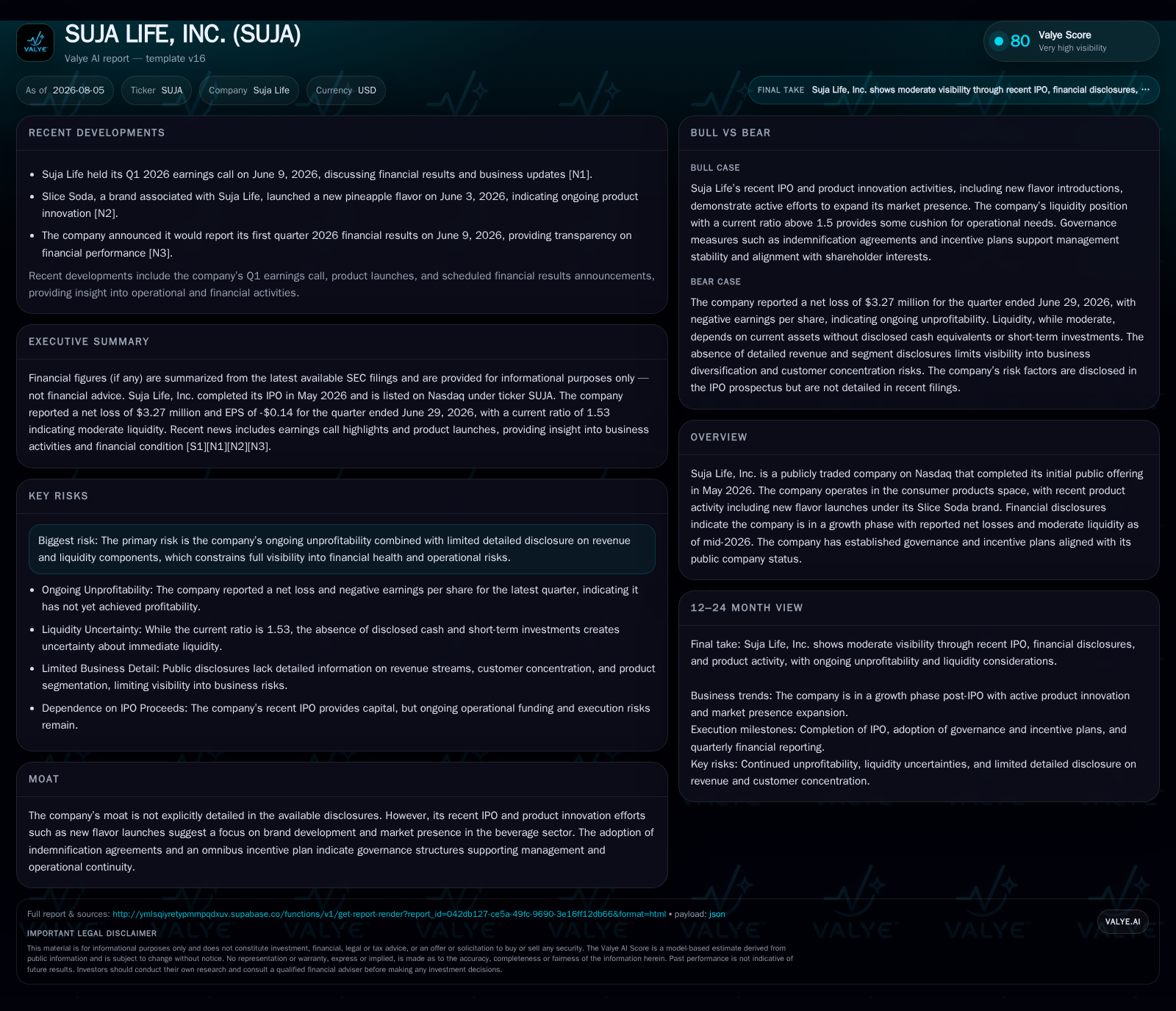
Suja Life, Inc. reported its financial results for Q2 2026 following its May IPO, showcasing continued investment in new product flavors under its Slice Soda brand as a key growth strategy. Operating losses persist as the company expands distribution and marketing efforts, consistent with its growth-stage profile. Liquidity remains adequate with a current ratio above 1.5, though substantial debt on the balance sheet indicates careful capital management is required. Industry pressures from competition and input costs pose risks to margin improvement.
Recent Operating Update: Post-IPO Expansion With Focus on Flavor Innovation
Suja Life released its fiscal Q2 results on August 4, 2026 — covering the quarter ended June 29 — its first set of financials after completing a May IPO [S2][S3]. This period captures key strategic moves including new flavored beverage introductions under the Slice Soda brand umbrella intended to drive consumer engagement and broaden the flavor portfolio. Such product innovation is critical in the increasingly fragmented beverage space where brand differentiation drives shelf presence and consumer preference.
The company continues to operate at a loss with an operating loss of approximately $20.5 million but narrowed net income loss to $3.3 million for this quarter [F1]. The reduced bottom-line impact signals early operational leverage potentially from scale efficiencies or more targeted sales efforts; however, persistent negative operating income reflects significant ongoing investments in marketing, product development, and distribution network build-out characteristic of a beverage startup transitioning through its growth phase.
Liquidity-wise, Suja maintains $63 million in current assets against $41 million in current liabilities delivering a healthy current ratio of 1.53 [F1]. However, it carries substantial total debt near $165 million raising questions about financing structure sustainability amid extended unprofitability [F1]. This capital structure underscores the critical need for advancing revenue growth while controlling cash burn.
Business Model: Branded Beverage Manufacturing with Innovation-Led Revenue Strategy
Suja Life operates primarily as a manufacturer and marketer of branded beverages targeting health-conscious consumers seeking flavorful soda alternatives. Revenue generation depends on producing ready-to-drink products supplied through retail chains, wholesale distributors, and potentially direct-to-consumer (DTC) channels—a model reliant on broad distribution footprints and strong brand equity.
The monetization mechanism involves selling units at price points supported by a premium positioning due to product quality claims (e.g., natural ingredients). Volume growth derives from expanding retail shelf penetration and boosting sell-through rates via promotional support balanced against margin dilution risks.
Product innovation—exemplified by recent Slice Soda flavor launches—is central to keeping the product portfolio fresh and aligned with evolving consumer palates prioritizing novel tastes combined with health benefits. The capacity to successfully introduce differentiated flavors impacts customer acquisition cost (CAC) efficiency and pricing power.
From an operational perspective, costs include ingredient procurement sensitive to commodity price fluctuations (sugar substitutes, fruit extracts), packaging innovation expenses (bottle design affecting consumer perception), manufacturing overheads fixed across volume swings, plus marketing spending to stimulate trial and repeat purchases.
Industry Structure and Competitive Position
Within the consumer packaged goods beverage segment, Suja competes against established multinational conglomerates such as PepsiCo and The Coca-Cola Company who dominate mass retail but also smaller functional beverage startups carving niches through wellness-oriented offerings. These large peers excel at leveraging vast distribution networks offering unmatched channel mix breadth while maintaining deep pockets for marketing intensity.
Suja’s challenge lies in breaking through shelf visibility constraints dominated by brand incumbency while attracting consumers increasingly fragmented by taste preferences and seeking healthier options. Its moat appears nascent; success rests upon building strong brand equity anchored in authentic flavor innovation coupled with effective supply chain management ensuring high inventory turnover to avoid obsolescence.
Wholesale distribution partners like Walmart or Kroger play pivotal roles influencing shelf space allocation which significantly affects market penetration metrics—a critical KPI for Suja’s commercial momentum.
Growth Drivers
Key levers fueling Suja’s growth trajectory include:
- Distribution Expansion: Increasing footprint across grocery chains and convenience stores broadly enhances availability enabling higher sell-through rates.
- DTC Channel Development: Establishing direct consumer communication pathways reduces CAC over time while permitting personalized marketing driving loyalty.
- Sustained Product Innovation: Launching new flavors invigorates consumer excitement supporting repeat sales cycles.
- Brand Equity Building: Marketing campaigns aimed at educating consumers on product benefits reinforce premium pricing capabilities.
- Market Geographic Broadening: Gradual entry into adjacent regional markets taps unmet demand pools.
- Retail Partnerships: Collaborations with foodservice operators extend consumption occasions beyond traditional retail boundaries.
- Premiumization: Capitalizing on wellness trends allows pricing flexibility beyond commoditized sodas.
- Sustainability Initiatives: Embracing eco-friendly packaging aligns with environmentally conscious buyer segments enhancing brand stature.
These initiatives depend heavily on measured promotional intensity balancing short-term volume boosts against long-term margin dilution risks.
Risks and Watchpoints
The principal headwinds facing Suja include:
- Persistent net losses requiring continuous capital raises or operational improvements to reach sustainable profitability.
- Volatile commodity input costs threaten gross margin stability necessitating agile supply chain adjustments.
- Intense competition can compress ASPs (average selling prices) especially if private label brands increase pressure through lower prices.
- High promotional discount rates might erode brand value if prolonged beyond strategic intent harming full-price sell-through ratios.
- Dependence on key retailers for shelf presence heightens vulnerability should partners shift focus toward larger incumbents or emerging competitors.
- Potential inventory obsolescence due to rapid flavor cycle turnover increases storage carrying costs.
- Regulatory scrutiny over labeling claims may constrain marketing flexibility impacting perceived health benefits messaging.
- Elevated CAC during accelerated rollouts risks inflating customer acquisition spend without commensurate retention gains.
- Financial leverage demands vigilant liquidity management amid uncertain cash flow forecasts given negative operating income dynamics.
- Brand dilution risk exists if newer product extensions fail to resonate undermining existing franchise strength.
Monitoring changes in quarterly net sales growth rates alongside gross margin percentage movements will provide insight into how effectively these risks are being managed in real-time operations.
What to Watch Next
Investors and observers should track several critical milestones:
- Subsequent quarterly earnings releases revealing trends in profitability improvement or expense normalization post-heavy initial growth investments [S2][S3].
- Updates on distribution footprint expansion quantifying number of retail outlets reached as this directly correlates with revenue scalability potential.
- Progress reports on DTC channel rollout effectiveness via reported contribution to net sales percentage illuminating customer loyalty trajectory over time.
- Announcements regarding additional flavor innovations or packaging enhancements signaling continued commitment to differentiation ambitions.
- Promotional expense ratio versus sales benchmarking indicating balance between short-term volume stimulation versus long-term margin preservation.
- Any disclosures concerning liquidity events such as refinancings or capital injections reflecting solvency considerations tied to existing $165 million debt burden [F1].
- Management commentary surrounding competitive dynamics especially relative positioning vis-à-vis private labels or functional beverage upstarts impacting pricing strategy adjustments.
Financial Profile Discussion
As of June 29, 2026 quarter-end [F1], Suja Life’s financial framework reveals typical growth-phase characteristics marked by substantial leverage combined with moderate short-term liquidity:
Disclaimer: This is research-only, informational analysis and not investment advice. It may include AI-generated interpretation and general industry context. Always verify important details using primary sources.

Comments