
JFrog’s Software Supply Chain Momentum Accelerates on Cloud Subscription Expansion
JFrog’s Q2 2026 results highlight accelerating SaaS subscription growth and deeper AI/ML integration, reinforcing its platform leadership in software supply chain management.
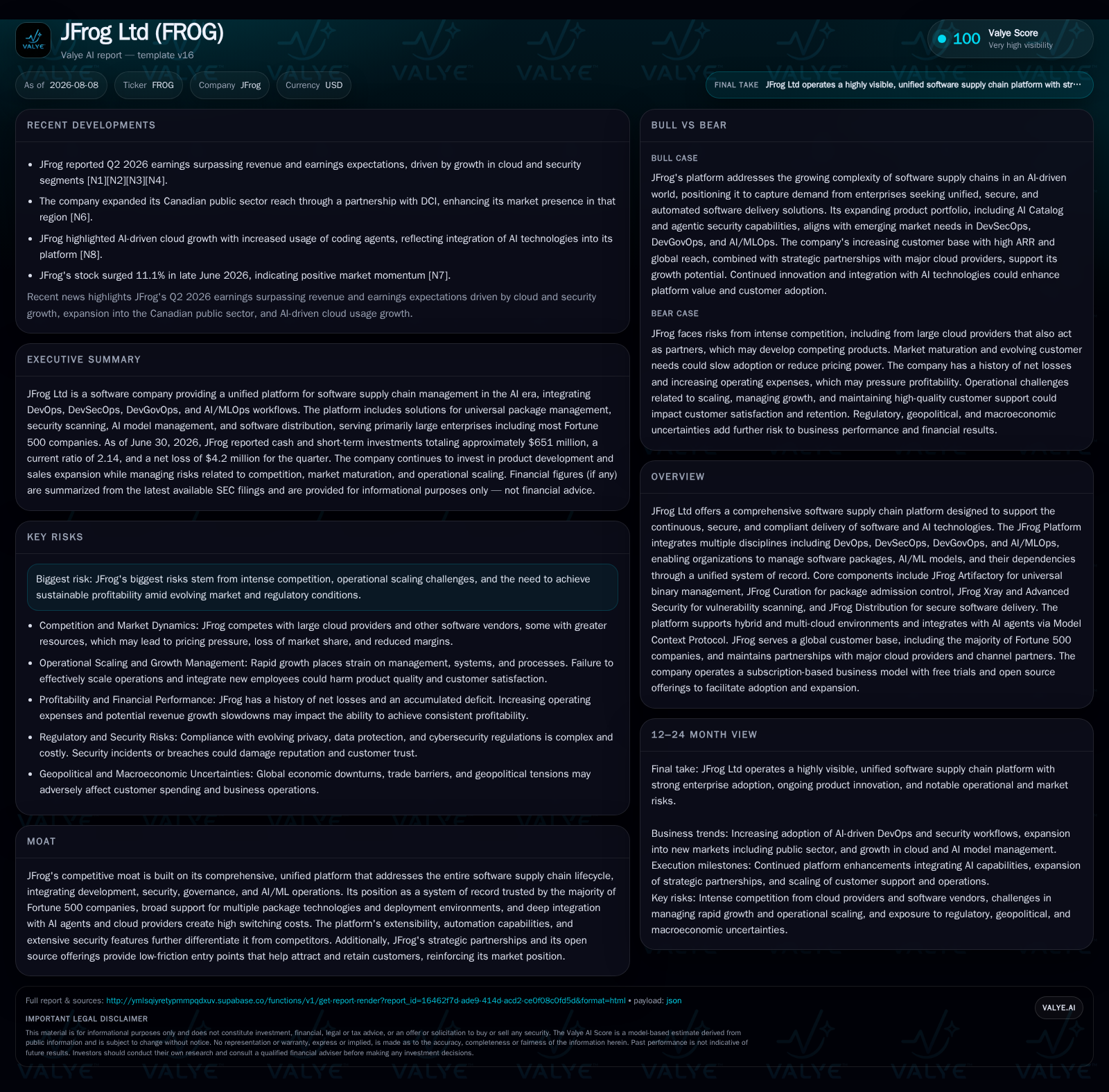
In its August 2026 quarterly filing, JFrog reported continued growth driven by an increasing share of cloud-hosted SaaS subscriptions, now contributing nearly half of total revenue. The company’s unified software supply chain platform integrates development, security, governance, and AI/ML workflows, serving a broad set of enterprise customers dominated by Fortune 500 firms. JFrog’s distinctive position as a system of record trusted for artifact management and vulnerability scanning underpins strong renewal dynamics amid intensifying competition. While operational losses persist due to ongoing investments, the solid liquidity position supports disciplined growth execution with focus on expanding AI/ML and DevSecOps capabilities.
Q2 Dynamics Illuminate SaaS Transition Strengthening Platform Reach
JFrog's most recent quarterly filing dated August 7, 2026 confirms an inflection point in the company’s migration toward cloud-hosted SaaS subscriptions. This transition aligns with broader software supply chain SaaS industry trends where customers increasingly prefer ratable billing models tied to operational usage over upfront perpetual license payments.
Management commentary accompanying these results emphasized expanding active subscription counts and usage metrics such as package downloads and vulnerability scans performed—KPIs that underscore rising platform reliance across customer environments [N3]. The greater share of SaaS revenue improves visibility into recurring cash flows and creates higher switching costs by consolidating software supply chain operations within JFrog's platform ecosystem.
How JFrog Monetizes Its Unified Software Supply Chain Ecosystem
JFrog operates principally via subscription-based monetization targeting multiple user roles within large enterprises—developers pushing binaries through CI/CD pipelines; security teams leveraging vulnerability scanning; governance inspectors maintaining compliance; and AI/ML engineers operationalizing models at scale. The company offers tiered subscription plans split between self-managed deployments—where customers host on-premises or private clouds—and fully managed JFrog SaaS subscriptions across public cloud infrastructure.
Subscription contracts vary from monthly to multi-year terms with revenue recognition depending on the delivery model: upfront for self-managed licenses since customers gain immediate access upon order fulfillment versus ratable recognition over contract periods for SaaS consumption based on minimum usage commitments plus any overages [S1]. This hybrid revenue approach has required sophisticated operational controls to balance renewals and align sales incentives.
Notably, approximately 56% of total revenue derives from Enterprise Plus subscriptions offering end-to-end solutions that integrate binary management (Artifactory), package admission control (Curation), vulnerability scanning (Xray), advanced security modules, and secure distribution capabilities [S1]. This bundling caters to highly regulated sectors demanding granular risk controls tightly embedded into development workflows
Extensive open source components underpin the funneling mechanism—from free trials to low-code community editions—enabling developers and security practitioners to adopt JFrog tools organically before converting into paid seat licenses or platform-wide subscriptions. This drives network effects critical for sustaining long-term platform engagement.
Security-Driven Differentiation Amid Evolving Compliance Demands
Enterprise software supply chains face increasing scrutiny due to prolific adoption paired with emerging regulatory frameworks around software provenance and data security. In response, JFrog has prioritized integrating robust vulnerability scanning through Xray alongside Advanced Security suites delivering automated policy enforcement within CI/CD pipelines.
The inclusion of DevSecOps security tools reinforces customer retention by mitigating risks tied to open source component vulnerabilities or unregulated container deployment across complex hybrid/multi-cloud estates. Moreover, compliance modules supporting audit trails cater to governance officers increasingly tasked with ensuring end-to-end trustworthiness in rapid software releases enabled by Liquid Software practices. These attributes deepen switching costs given the criticality of continuous security validation embedded within products.
Competitive Landscape: Peer Comparison Highlights Platform Breadth and Customer Concentration
Within the software supply chain market segment encompassing DevOps tool providers like GitLab and security-centric vendors such as Sonatype, JFrog's comprehensive platform is distinguished by its early lead in universal binary management combined with integrated AI/ML Ops capabilities supporting emerging MLOps use cases. Peers typically compete along dimensions of integration ease with existing CI/CD ecosystems, extensibility into AI workflows, multi-cloud deployment flexibility, and breadth of supported package types.
JFrog's extensive penetration among top Fortune 100 clients—reported at about 83%—and diversified global footprint including roughly 40% international revenue signal both scale advantage and customer trust at enterprise levels that many competitors strive to match [S1]. While renewal rates are not explicitly disclosed in the latest filings, management commentary points to high retention driven by rising platform adoption intensity reinforced through broad feature sets addressing developer velocity and security simultaneously.
Growth Potential from Expanding DevSecOps & MLOps Adoption
Market demand for platforms capable of orchestrating AI/ML workflows alongside traditional software artifacts is accelerating. MLOps is emerging as a strategic capability to govern model lifecycle management akin to code release processes. JFrog's platform extensions embracing Model Context Protocols to integrate AI agents reflect a forward-looking strategy anticipating increased automation via agentic AI tooling within software delivery pipelines.
Simultaneously, enterprises’ growing digital footprints coupled with regulatory pressures mandating secure supply chains fuel broader DevSecOps adoption that synergizes vulnerability assessment tools with binary control mechanisms provided by JFrog’s suite. These dynamics undergird sustainable top-line expansion opportunities bolstered by migration from on-premises licensing models toward scalable SaaS deployments favored in hybrid cloud architectures [S1].
Strategic partnerships with major public cloud vendors augment market reach while channel collaborations facilitate sector-specific penetration exemplified recently by Canadian public sector expansions leveraging local integrations [N6].
Risks from Competition, Scaling Complexities, And Market Macro Variability
JFrog faces substantive risks consistent with technology-centric SaaS providers operating in rapidly evolving markets. Competitive challenges stem from both established incumbents refining integrated offerings (e.g., GitLab’s all-in-one DevOps suites) and emerging specialized startups innovating niche capabilities potentially disrupting portions of the value chain.
Operationally, scaling infrastructure reliability alongside continuous product enhancements imposes cost pressures impacting profitability trajectories as evidenced by sustained net losses in recent years despite robust revenue growth [F1]. Regulatory complexity pertaining to data protection laws spanning multiple geographies adds compliance overhead while necessitating adaptable governance functionalities embedding into the platform.
Macroeconomic uncertainties influencing enterprise IT budgets may curtail discretionary spending impacting new customer acquisition or slowing upgrade cycles. Intellectual property risks also arise given JFrog’s open source footprint which while lowering adoption barriers may expose proprietary features to competitive replication without direct monetization offsetting potential erosion.
Key Upcoming Milestones: Customer Wins, Feature Rollouts, And Renewal Trends
Following the strong Q2 performance announcement accompanied by positive earnings beats relative to estimates [N1], company focus remains attuned to tracking subscription renewal rates as a key forward indicator of revenue durability amidst shifting product mix towards SaaS. Incremental rollout of AI-powered automation tools aimed at enhancing packaging curation and security scanning represents core execution priorities driving incremental ARPU improvements.
Additionally, announcements around expanded industry vertical engagements leveraging tailored compliance templates could expand addressable markets beyond traditional technology-heavy sectors. Monitoring quarterly active subscription counts alongside usage statistics such as package downloads will be instrumental in gauging organic growth velocity complemented by upsell success within installed bases [N3], [S2].
Financial Profile Discussion: Solid Liquidity Amid Operating Losses Signals Controlled Investment Phase
As of June 30, 2026, JFrog held $96.7 million in cash and equivalents against current liabilities of $476.6 million resulting in a current ratio of approximately 2.14 reflecting comfortable near-term liquidity cushions [F1]. Despite this financial stability supporting ongoing investments in R&D for platform extensions particularly in security enhancements and AI/ML integrations, the company reported continuing operating losses underscoring an investment-heavy phase typical for SaaS companies balancing growth acceleration against profitability scaling challenges [S2].
The financial profile suggests a controlled capital allocation approach retaining optionality for acquisitions or strategic deployments while preserving sufficient operating runway amidst intensifying competitive pressures.
This analysis synthesizes JFrog’s latest regulatory disclosures augmented by industry context without issuing investment advice. Fundamental shifts toward cloud-hosted recurring revenues backed by integrated security and AI-driven functionality reinforce JFrog’s position at the forefront of software supply chain management platforms while highlighting execution-critical growth opportunities alongside inherent sector risks.
Disclaimer: This is research-only, informational analysis and not investment advice. It may include AI-generated interpretation and general industry context. Always verify important details using primary sources.

Comments