
Twilio’s Usage-Driven Growth and Developer Ecosystem Fuel Q2 Momentum
Twilio’s latest quarterly results highlight strong usage-based revenue growth driven by an expanding developer base alongside evolving AI integration and platform innovation.
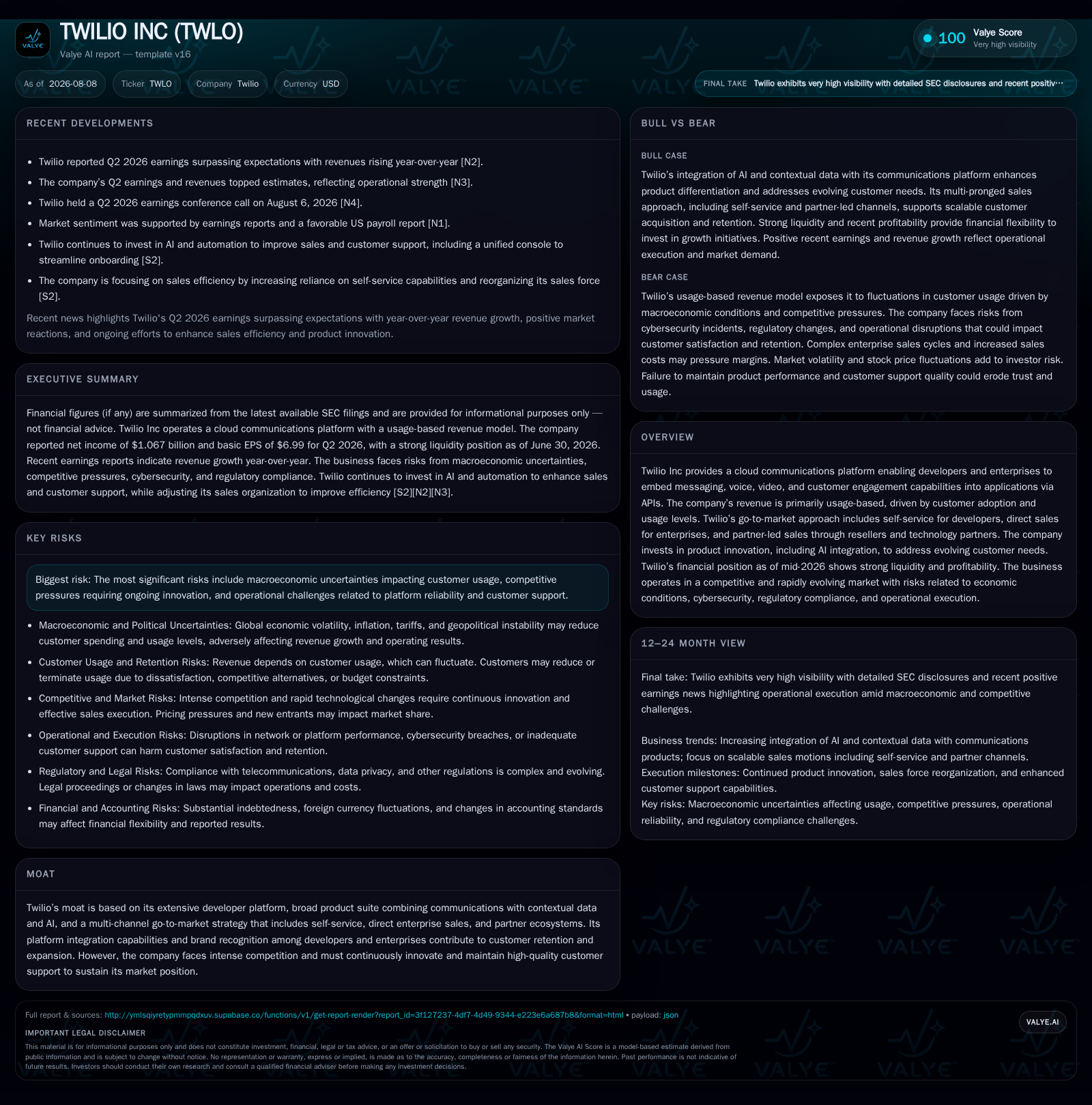
In its Q2 2026 10-Q filing, Twilio reported revenue growth exceeding market expectations on the back of increased API usage and a growing number of active developers, validating the durability of its usage-based pricing model amid economic uncertainties [S2][S3][N3][N4]. The company’s multi-channel cloud communications platform continues to evolve with strategic AI integration that enhances customer engagement capabilities and helps differentiate Twilio in a competitive landscape [S1][S2]. Operational focus remains on balancing self-service developer adoption with direct enterprise sales and partner-led channels, although execution risks around platform reliability and cybersecurity persist [S1][S2]. Despite macroeconomic and regulatory headwinds, Twilio’s liquidity position supports ongoing investments in product innovation and global expansion [F1][S2]. Investors should monitor key KPIs such as active developer counts, API volumes, ARPU trends, and operational metrics to validate sustained momentum through upcoming quarters.
Q2 Usage Growth Drives Revenue Beat Amid Evolving Customer Adoption Trends
Twilio’s Q2 2026 financial results filed on August 7 reveal continued strength in its core usage-based revenue model. The company reported revenue growth surpassing street estimates primarily fueled by increased API calls and message volumes reflecting accelerating customer adoption across its programmable messaging, voice, and video platforms [S2][N3][N4]. This usage growth was supported by an expanding count of active developers leveraging Twilio’s self-service platform to embed communications into applications — a critical leading indicator given the direct correlation between active developers and incremental usage revenues. However, Twilio continues to face inherent volatility risks stemming from fluctuating customer usage levels that can be influenced by seasonality or broader macroeconomic conditions, introducing variability in quarterly top-line performance [S1][S2]. Sustained improvements in average revenue per user (ARPU) will be pivotal as they balance raw user count growth with monetization effectiveness.
Platform Innovation With AI Integration Strengthens Developer Engagement and Product Relevance
The company’s investment focus on integrating AI-driven capabilities throughout its cloud communications platform has emerged as a strategic differentiator. Enhanced programmable messaging combined with contextual data analytics powered by generative AI technologies expand the range of use cases Twilio can address — particularly in personalized customer engagement solutions via multi-channel communication including SMS, voice, email, and video APIs [S1][S2]. These advances help maintain relevance within an increasingly crowded marketplace by enabling customers to deliver more intelligent interactions at scale while simplifying developer implementation. Product innovation anchored by AI is integral not only for driving new adoption but also for deepening expansion within existing accounts, creating a protective moat based on enriched platform functionality.
Balancing Multi-Channel Sales: Self-Service Developers Versus Enterprise Direct Demand Dynamics
Twilio’s go-to-market approach strategically combines lightweight self-service onboarding tailored to individual developers with dedicated direct sales efforts targeting midsize to large enterprises requiring tailored support. Additionally, robust partner ecosystem channels – consisting of resellers and ISVs (Independent Software Vendors) – amplify reach into niche verticals and geographies [S1][S2]. This blended model enables scalable customer acquisition while facilitating upselling opportunities across varying buyer personas. Operationally, this demands efficient coordination to manage differing sales cycles, retention profiles, and customer acquisition costs (CAC). Maintaining low friction for developer self-service users is essential for funnel volume growth; meanwhile enterprise relationships drive higher ARPU but entail greater sales expense investments.
Competitive Landscape Pressure Highlights Need for Continual Product Differentiation and Market Awareness
Within the cloud communications platform industry—comprising peers like Vonage (Nexmo), Bandwidth, and MessageBird—Twilio occupies a leading position marked by broad product suite breadth and deep developer adoption. Nonetheless competition remains intense with pressure on pricing models given commoditized telecommunications APIs alongside rapid innovation cycles demanding relentless product development [S1]. Twilio’s brand recognition among developers combined with its integrated AI enhancements affords differentiation versus competitors offering narrower feature sets or less mature ecosystems. However, competitive dynamics necessitate ongoing focus on retaining developer loyalty through exceptional platform experience and establishing tighter integrations across adjacent SaaS vendors focused on customer engagement such as Salesforce or Zendesk.
'Operational Resilience': Platform Reliability And Cybersecurity Risks Remain Critical Watchpoints
Maintaining high platform uptime is non-negotiable due to the real-time nature of communications workloads handled by Twilio. Any disruption not only jeopardizes immediate service delivery but also risks long-term customer churn impacting ARPU trajectories. Dependency on third-party network service providers introduces additional complexity around service continuity and cost management. Moreover, cybersecurity threats present persistent challenges given sensitive data traversing Twilio’s infrastructure alongside evolving regulatory compliance mandates globally [S1][S2]. Effective risk management here forms the foundation of trust essential for retaining enterprise clients reliant on secure communications.
'Growth Drivers' Amplify Potential but Regulatory And Economic Headwinds Temper Visibility
Longer-term demand tailwinds stem from accelerating digital transformation trends pushing businesses toward programmable omnichannel engagement strategies. Growing adoption of AI-driven interaction models further expands addressable use cases. International geographic expansions plus partner channel development offer avenues for scaling market penetration beyond saturated domestic markets [S1][S2]. However macroeconomic uncertainties—such as tightening IT budgets or inflationary pressure—and emerging telecommunications regulations introduce visibility constraints around usage growth sustainability. Execution discipline in capitalizing on these drivers while navigating external uncertainties will shape growth trajectories.
Financial Profile Discussion: Strong Liquidity Supports Innovation Amid Investment Drive
As of June 30, 2026, Twilio held approximately $823 million in cash and equivalents against total debt nearing $993 million resulting in net debt around $170 million—a leverage profile that remains manageable given the scale of operations and cash flow generation potential [F1]. Profitability improvements reflected through expanding non-GAAP operating margins support funding continued R&D critical for technology leadership while balancing sales/marketing investments powering customer acquisition. Despite debt maturity concentration in late-decade notes due in 2029 and 2031 carrying moderate fixed interest rates (~3.6%-3.9%), refinancing or liquidity events may arise depending on market conditions.
Key Milestones Ahead: Monitoring Usage Metrics, Churn Trends, And Execution On AI Rollouts
Investors should track forthcoming quarters’ signals including sustained increases in monthly active developers adopting new APIs alongside steady or improving ARPU metrics to confirm enhanced monetization quality post-AI product integration [S2]. Platform reliability performance indicators such as uptime percentages alongside churn rates will provide insight into operational health amidst growing scale. The timely introduction of generative AI features across the suite will serve as tangible proof points whether innovation investments translate into commercial traction driving durable growth paths. Additionally monitoring competitive developments or regulatory changes impacting telecommunications services remains prudent to anticipate operational or margin pressures.
This analysis synthesizes recent quarterly data alongside annual disclosures emphasizing business model specifics grounded on solid SEC evidence without speculative extrapolation. While Twilio exhibits promising momentum fueled by usage-driven growth supported by a vibrant developer ecosystem enhanced through AI innovations, navigating intensifying competitor dynamics, execution risks around reliability/security, and external macro-regulatory factors remain crucial focal points.
Disclaimer: This report is for informational purposes only and does not constitute investment advice or research views.
Disclaimer: This is research-only, informational analysis and not investment advice. It may include AI-generated interpretation and general industry context. Always verify important details using primary sources.

Comments