
Parks America Navigates Seasonal Demand and Refinances Debt in Regional Safari Park Sector
Latest quarterly results highlight steady operating performance amid typical seasonal patterns and refinancing activity.
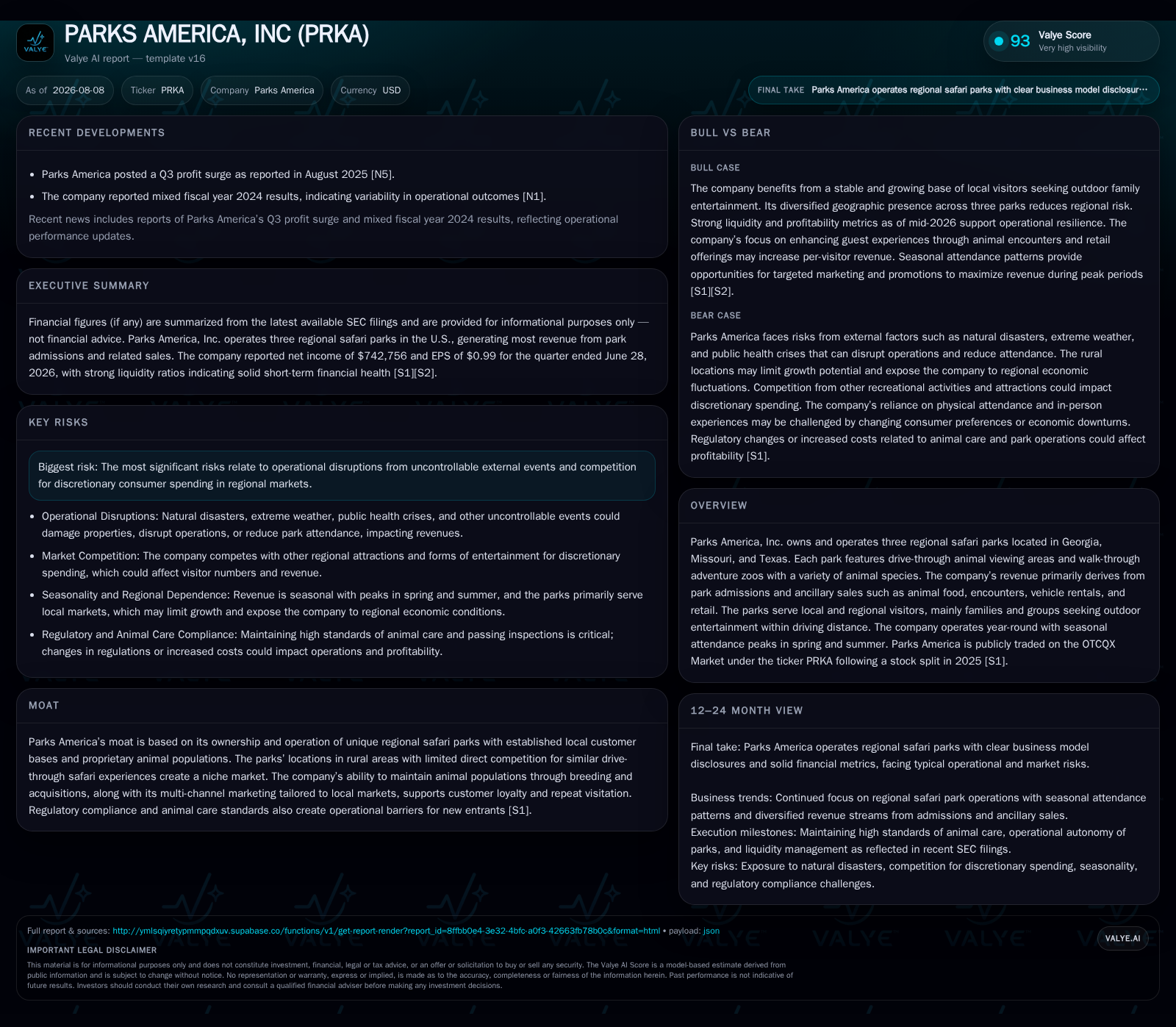
Parks America, Inc. operates three regional safari parks serving local and regional families through drive-through safaris and walk-through zoos. The company reported steady third quarter results reflecting seasonal attendance trends, with a significant share of annual revenue concentrated in spring and summer quarters. The recent refinancing of its Texas-based subsidiary’s term loan improved capital structure and fixed interest costs, supporting operational resilience. Parks America’s moat rests on unique regional animal attractions and limited direct competition, although discretionary spending sensitivity and natural disaster risks remain key headwinds.
Recent Operating Update
Concurrently, the company executed a refinancing transaction for Aggieland-Parks, Inc., its Texas subsidiary, securing a $2.33 million term loan with seven-year maturity at an adjusted fixed interest rate of approximately 6.99% through an interest rate swap arrangement [S18][S20]. This refinancing eliminated a previously required $2.5 million cash collateral reserve tied to prior debt agreements, improving liquidity flexibility at the subsidiary level. The loan is secured by substantially all Aggieland-Parks assets with covenants including a debt service coverage ratio minimum of 1.20 [S18][S21].
In corporate governance developments, Geoff Gannon transitioned to full-time CEO on March 31, 2026, strengthening leadership continuity after initially assuming the role on a part-time basis since mid-2024 [S27]. Stockholder voting outcomes in early 2026 reflected stable board composition with no contentious governance issues noted [S22]. Legal proceedings settled related to an employment dispute in Texas with a $75,000 payment with no ongoing material litigation affecting operations [S1].
Business Model Overview
Parks America owns and operates three regional safari parks located strategically in Georgia, Missouri, and Texas through wholly owned subsidiaries acquired between 2005 and 2020 [S1][S16]. Each location features drive-through safari experiences allowing guests vehicle access to observe animals in expansive habitats complemented by walk-through adventure zoos hosting diverse species. This hybrid product offering targets families and groups seeking affordable outdoor family recreation within driving distance of metropolitan centers.
Revenue streams are anchored by admissions fees supplemented by ancillary sales including vehicle rentals suitable for safari drives, specialty animal food purchases for guest interaction feeding experiences, paid animal encounters designed as upcharge attractions, retail merchandise sales such as apparel and toys, and concession food & beverage offerings [S1]. These ancillary streams diversify monetization beyond ticketing volume alone providing incremental per-visitor revenue leverage.
The company predominantly sources animals domestically through breeding programs or auctions rather than imports; herd management involves periodic sales or inter-park transfers to maintain genetic diversity while optimizing population sizes aligned with park capacities [S1]. This proprietary animal population underpins the unique visitor draw.
Marketing approaches emphasize multi-channel promotional efforts customized to each regional market aiming to deepen penetration within core local catchment areas. Parks operate year-round but heavily rely on spring/summer visitation due to favorable weather conditions shaping discretionary outdoor entertainment demand [S1][S16].
Industry Structure and Competitive Position
Operating within the leisure and recreation parks sector specifically regional safari and wildlife parks segment, Parks America occupies a niche focusing on semi-naturalistic animal viewing experiences differentiated from traditional amusement or theme parks that may prioritize rides or themed attractions. Its competitors are also likely smaller regional amusement operators or standalone zoological parks offering public admission models but without as extensive drive-through safari components.
Proximity to metropolitan areas is a competitive factor; the company’s rural/site-specific locations create differentiated market niches with relatively low direct competition for similar drive-through safari experiences within those geographies [S1][S16]. However, broader competition includes diverse family entertainment options such as cinemas, sporting events, vacation destinations, or other forms of outdoor recreation vying for consumer discretionary dollars.
Maintaining high standards of animal welfare evidenced by passing recent regulatory inspections supports compliance barriers for potential entrants given federal/state oversight complexities [S1]. The ability to breed animals onsite or acquire selectively aids sustained uniqueness compared to parks reliant extensively on external acquisitions.
Brand loyalty is fostered through proprietary animal populations combined with tailored customer engagement approaches focusing on repeat visitation incentives suited to local/regional visitors. Nonetheless, discretionary spend sensitivity presents ongoing competitive pressure especially during macroeconomic downturns or inflationary periods that curtail leisure travel or out-of-home consumption.
Growth Drivers
Parks America growth prospects largely hinge on expanding local/regional population bases within their current markets alongside increasing tourism inflows attracted by experiential outdoor entertainment trends favoring nature-based activities post-pandemic recovery cycles. Enhancements in visitor amenities such as improved picnic areas or renovated walk-through exhibits could support higher per-visitor spending on retail or concessions.
The development of new animal exhibits or special encounter programs offers avenues for ancillary revenue expansion while enhancing park appeal potentially mitigating some weather-related seasonal attendance volatility. Partnership opportunities with local schools or community groups can also deepen market penetration through educational programming fostering early brand engagement.
Marketing efficiency gains targeting core demographic segments via digital channels tailored to regional nuances offer avenues to optimize customer acquisition costs balanced against retention initiatives driving repeat visitation rates — a key KPI underpinning stable admissions revenue growth patterns.
Strategic acquisitions expansion remains an option given Parks America’s track record acquiring safari parks since initial entry in 2005.
Risks and Watchpoints
Weather-related disruptions pose perennial risks evidenced by prior tornado damage at the Georgia park affecting operations temporarily—the potential financial impact from property repairs coupled with reduced attendance during closures remains material if severe events recur unpredictably [S1]. Climate change linked extreme weather frequency could exacerbate such exposure over time.
The reliance on consumer discretionary spending introduces macroeconomic risk layers where inflationary pressures or recessionary environments reduce visitor frequency or ancillary spending levels impacting margins materially. Regional economic health directly informs demand elasticity alongside changing consumer confidence metrics [S1].
Competitive pressures extend beyond direct safari park peers into alternative entertainment spheres competing for limited leisure budgets particularly in congested metropolitan-adjacent markets potentially eroding market share without continual reinvestment in attraction quality.
Regulatory compliance demands around animal care standards require ongoing capital and operating investments; non-compliance risks include fines or reputational damage undermining visitor trust.[S1]
Liquidity constraints linked to outstanding indebtedness—while recent refinancings have improved covenants—maintain watchpoints especially if adverse operating conditions impair cash flows necessitating potential capital allocation tradeoffs between maintenance capex versus growth-oriented expenditures [F1]
What to Watch Next
Operational resilience indicators like restoration speed post any adverse weather event will reveal management agility essential given physical asset intensiveness of the business model.
Also worth observing is any capital deployment toward expanding guest amenities or acquisition announcements expanding geographic footprint impacting medium-term growth trajectories.
Leadership stability following CEO’s transition to full-time engagement could manifest in clearer strategic communication and execution consistency.[S27]
Financial Profile Discussion
As of June 28, 2026, Parks America maintained roughly $4.34 million in cash and equivalents against current liabilities near $1.02 million resulting in a strong current ratio approximating 4.77 which signals robust short-term liquidity [F1]. Current assets totaled about $4.87 million supporting operational buffer needs while total debt was reported around $3.19 million as of September 28, 2025—the most recent full data point—suggesting manageable leverage especially given net debt appears negative owing to ample cash holdings exceeding debt obligations [F1].
The recent refinancing transaction locks in fixed-rate interest costs at just below 7% effectively insulating interest expense from rising rate volatility accompanying SOFR benchmark fluctuations observed earlier this year [S18][S20]. This hedging strategy enhances predictability of financing expenses critical given discretionary earnings vulnerable to seasonal swings.
Dividend payments have not been made historically aligning with common industry practice prioritizing reinvestment amid moderate scale operations while ownership concentration limits broad shareholder influence over capital return policies [S29].
This analysis synthesizes recent SEC filings through mid-2026 integrating operational updates with financial context reflective of Parks America’s role as a focused operator within regional safari and wildlife parks sector emphasizing experiential family outdoor entertainment constrained by seasonal demand patterns and economic sensitivities typical of this niche leisure sub-industry.
Investors should continue tracking seasonal visitation metrics alongside capital structure developments while factoring inherent risks related to environmental exposures characteristic of asset-heavy outdoor entertainment operators.
Disclaimer: This is research-only, informational analysis and not investment advice. It may include AI-generated interpretation and general industry context. Always verify important details using primary sources.

Comments