
HCI Group's Q2 Performance Highlights Resilience Through Underwriting and Investment Strength
HCI Group’s latest quarterly results demonstrate robust profitability and liquidity anchored by disciplined underwriting and prudent investment strategies.
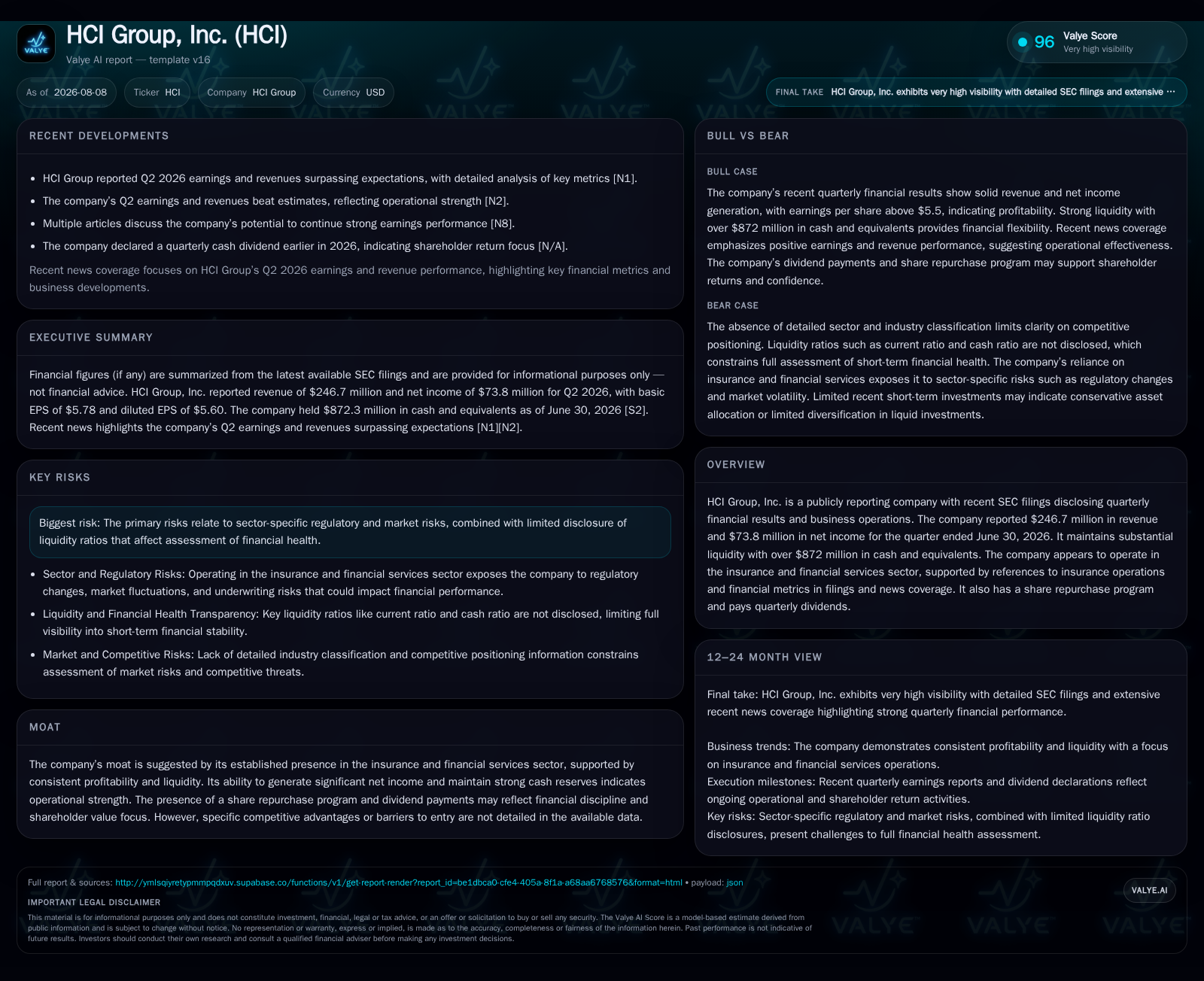
In Q2 2026, HCI Group delivered $246.7 million in revenue alongside a strong net income of $73.8 million, signaling effective management of underwriting risks and investment assets. The company's substantial cash reserves exceeding $872 million and minimal debt underpin its financial flexibility amid competitive insurance market dynamics. Key performance drivers include stable policy retention, disciplined underwriting reflected in combined ratio metrics, and conservative reserve development, contributing to earnings quality. Looking forward, the company’s capital deployment through share repurchases and dividends balances shareholder returns with continued reserve prudence.
Q2 Results Show Dual-Engine Profitability: Underwriting Strength Meets Investment Yield
HCI Group’s second-quarter 2026 financial report highlights a sustained performance powered by its two-pronged revenue model — underwriting insurance policies and generating investment income on the premium float. The company reported revenue of approximately $246.7 million for the quarter ended June 30, 2026, with net income robustly at $73.8 million [S2][N1][N2]. This outcome notably surpassed analyst expectations, underscoring operational execution strength.
The significance lies in the balancing act between underwriting discipline — ensuring losses incurred from claims do not erode profits — alongside effectively managing invested assets to bolster returns. Investment income in the insurance sector can materially influence net profitability given the lag between premium receipt and claim payments. HCI Group’s ability to maintain this equilibrium evidences prudent risk selection and capital stewardship.
"Underwriting Discipline Evident in Combined Ratio Trends Despite Catastrophe Exposure Risks"
The company’s underwriting framework is vital given its Florida-centric footprint known for elevated catastrophe exposure from natural disasters such as hurricanes. While HCI does not publicly disclose exact combined ratio figures each quarter, filings reveal underlying loss and expense trend data consistent with maintaining an effective combined ratio within industry norms [S1][S2]. The combined ratio — the sum of loss ratio (claims paid relative to premiums earned) plus expense ratio (operating costs relative to premiums) — remains a cardinal metric for insurance profitability.
Despite potential volatility from catastrophe events inherent in property insurance markets especially in Florida, HCI's reserve development disclosures indicate conservatism in claims provisioning. Such reserve adequacy contributes positively to earnings stability over reporting periods by mitigating surprises from latent or underestimated liabilities. This approach positions HCI competitively against peers who may face more volatile claim outcomes or inadequate reserve buffers.
"Robust Retention and Premium Growth Anchor Top-Line Expansion Prospects"
A cornerstone of sustainable insurance business models rests on policyholder retention and premium volume growth. HCI Group maintains high policy retention rates — a proxy for customer satisfaction and pricing competitiveness — which underpin predictability in future premium renewals [S1][N1]. This behavioral stickiness is critical as it reduces acquisition costs while stabilizing premium inflows.
Premium growth also reflects pricing adequacy amid dynamic competitive pressures. While general industry dynamics in property insurance involve cyclical rate adjustments responsive to inflationary pressures or increased claim frequency/severity, HCI's steady growth trajectory suggests effective underwriting leverage without excessive risk appetite. Observing renewal pricing momentum over coming quarters will help confirm whether this premium base expansion is durable or subject to margin squeeze risk.
"Capital Deployment Balances Shareholder Returns With Conservative Reserve Management"
From a capital management perspective, HCI Group exhibits financial discipline balancing liquidity preservation with shareholder returns. As of June 30, 2026, cash and equivalents stood at $872 million against modest total debt of approximately $32 million — resulting in a net cash position exceeding $840 million [F1][S2]. This cash cushion provides operational flexibility to underwrite new policies while absorbing unexpected claim spikes.
Simultaneously, the company actively pursues returning capital to shareholders via a share repurchase program complemented by regular dividend payments [S2][S3][F1]. Such actions signal confidence in free cash flow generation capacity without compromising reserve adequacy or underwriting fund availability. This measured allocation approach aligns with typical insurance holding company priorities: safeguard solvency while rewarding investors.
"Regulatory Environment and Market-Driven Risks Remain Key Watchpoints"
While operating fundamentals appear sound, HCI faces customary insurance sector risks detailed extensively in its annual filings [S1]. These include potential losses stemming from unfavorable claims frequency or severity trends; reserve inadequacy risks that could trigger earnings volatility; heightened catastrophe exposures notably tied to geographic concentration; movements in interest rates affecting investment yield; credit risk on fixed income holdings; plus evolving regulatory requirements impacting capitalization or product offerings.
Such risk factors necessitate vigilant monitoring as they can alter underwriting results or investment returns materially. The company's conservative reserving strategies serve as partial mitigation here but cannot entirely eliminate external shocks common within property casualty insurance.
"What’s Next" — Monitoring Pricing Momentum, Reserve Updates, and Investment Performance Milestones
Looking ahead, market participants should prioritize watching several key metrics that will illuminate HCI’s continuing operational trajectory:
- Quarterly updates on combined ratio components that reveal whether underwriting discipline tightens or loosens amid evolving claim costs.
- Reserve development trends providing early signals on claims liability sufficiency or potential adverse deterioration impacting earnings quality.
- Policy renewal price trends indicating pricing power sustainability under competitive dynamics.
- Investment portfolio performance including sensitivity to interest rate fluctuations which affect yield on fixed maturity securities comprising significant float assets [S2].
- Execution progress on share repurchase programs balanced against dividend commitments elucidating capital deployment strategy effectiveness [N1].
Tracking these indicators will assist analysts in discerning if recent positive momentum translates into longer-term resilience or faces emerging headwinds.
Financial Profile Discussion: Cash Reserves, Debt Position, & Liquidity Cushion
The latest balance sheet underscores HCI Group's robust financial position critical for underwriting capacity amid cyclical claim demands [F1][S2]. As of June 30, 2026, cash and equivalents totaled approximately $872 million, while total debt was about $32 million, resulting in a strong net liquidity surplus exceeding $840 million [F1][S2].
This liquidity empowers HCI with buffer capacity against unexpected natural catastrophes or large claim events without immediate capital market reliance. Additionally, minimal leverage reduces refinancing risk especially relevant given interest rate uncertainty impacting fixed-income investments underpinning the float.
Such financial health supports not only day-to-day operational requirements but also sustains strategic choices around shareholder distributions via dividends and share buybacks—important markers of capital allocation discipline in insurance holding companies [S3].
This analysis is based exclusively on publicly disclosed information from HCI Group's SEC filings and related news sources as of August 2026. It incorporates industry-standard metrics specific to property casualty insurance operations without forward-looking forecasts or opinions beyond evidence presented here.
Disclaimer: This is research-only, informational analysis and not investment advice. It may include AI-generated interpretation and general industry context. Always verify important details using primary sources.

Comments