
Community Financial System Expands Scale with Acquisition While Maintaining Stable Margins
Q2 2026 results reflect organic growth and integration benefits from recent acquisitions amid steady asset quality and capital metrics.
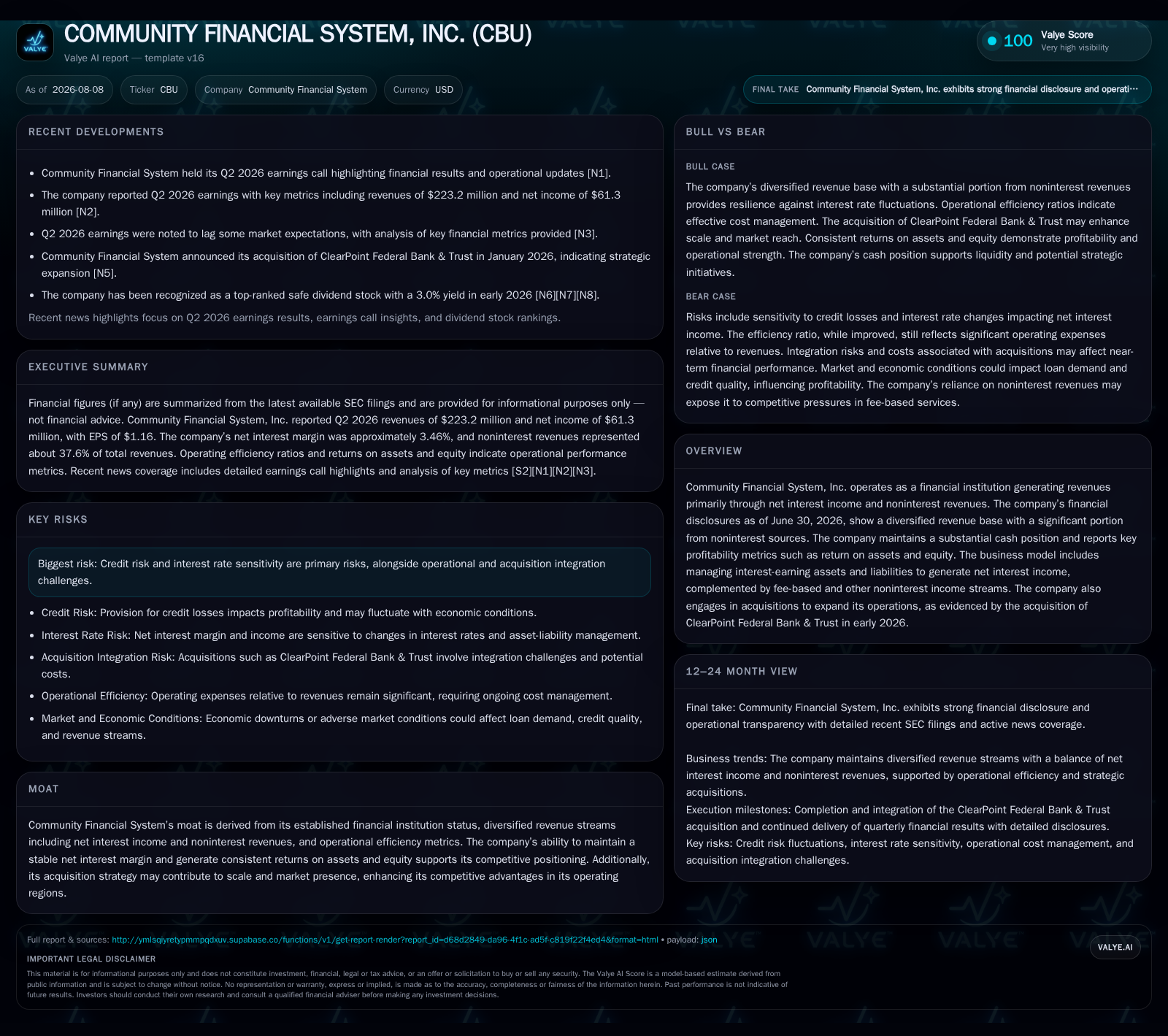
Community Financial System, Inc. reported solid second-quarter 2026 operating results driven by both organic loan growth and the strategic acquisition of ClearPoint Federal Bank & Trust. The company continues to generate stable net interest margins around 3.45%, supported by disciplined asset-liability management and a diversified revenue mix. Credit quality remains sound with provision for credit losses growing modestly in line with loan portfolio expansion. Community Financial’s acquisition strategy is enhancing scale and fee income diversification, positioning it competitively among regional banks focused on operational efficiency and steady returns. Key watchpoints include successful acquisition integration, sustained net interest margin in a fluctuating interest rate environment, and ongoing credit performance.
Latest Operating Update
The acquisition of ClearPoint Federal Bank & Trust early in 2026 represents a pivotal event enhancing Community Financial’s scale, geographic footprint, and fee-income platform. This transaction contributed not only incremental performing loans and core deposits but also expanded wealth management and financial services offerings [S1][S19]. Integration expenses were contained relative to the financial uplift observed, with acquisition-related costs representing a minor proportion of total noninterest expenses during the quarter [S2].
Credit quality remains stable with provision for credit losses showing a measured increase to $4.6 million, in line with loan portfolio growth rather than deterioration in credit standards or asset quality issues [S2]. This is consonant with Community Financial’s prudent underwriting policies and ongoing risk management practices.
Business Model and Revenue Mechanics
Community Financial operates as a regional community bank focused on serving retail and commercial customers through deposit accounts, lending products including residential mortgage loans, commercial loans, and indirect auto financing, alongside ancillary financial services such as wealth management under its subsidiaries [S1]. The primary revenue driver continues to be net interest income—the spread between interest earned on loans and securities versus payments made on deposits and borrowings—complemented by fee income streams from account servicing fees, insurance commissions, and wealth advisory fees.
The company manages an actively repriced loan portfolio aligned with evolving market rates, while its deposit base largely consists of low-cost core deposits that dampen overall funding costs. The reported increase in net interest margin reflects both the firm’s success in navigating the current interest rate environment by moderating deposit betas (the sensitivity of deposit costs to benchmark rate changes) and optimizing asset yields [S13]. Fee-based income diversification through acquisitions broadens the noninterest revenue base, helping reduce reliance on volatile interest rate spreads.
Operational efficiency remains a key focus area. Community Financial has undertaken restructuring aimed at optimizing branch staffing to reflect shifting customer behaviors favoring digital channels over physical transactions—a trend that aligns well with cost containment efforts seen throughout the regional banking sector [S10]. While restructuring expenses flag short-term charges, these investments aim at sustainable productivity improvements.
Industry Positioning and Competitive Context
In the regional banking landscape characterized by competitive pressures from large national banks as well as fintech disruptors, Community Financial leverages its local market knowledge, established customer relationships, and diversified product offerings. Its moderate scale allows nimble adaptation to local economic conditions while still providing a range of service lines often associated with larger institutions.
Peers typically achieve net interest margins between roughly 3% to 3.6% depending on their funding mix and loan portfolios; thus Community Financial’s ~3.45% NIM places it competitively within this median range, especially reflecting positive recent trajectory during a rising rate phase. The company also demonstrates adequate capital buffers consistent with regulatory norms for community banks.
Acquisition activity is prevalent among regional peers seeking scale economies and geographic diversification; Community Financial’s ClearPoint acquisition aligns with this trend by adding meaningful core deposits ($543 million from Santander branches acquired previously) and enhancing noninterest revenues via expanded wealth management capabilities [S19]. Successful integration—both operationally and culturally—is essential given typical challenges such as system harmonization and retention of acquired customer bases.
Growth Drivers
Key drivers include:
- Loan Portfolio Expansion: Organic loan growth through targeted marketing and cross-selling enhances yield accretion given disciplined underwriting.
- Acquisitions: Strategic deals like ClearPoint Federal Bank & Trust augment scale rapidly while diversifying earnings sources.
- Net Interest Margin Leverage: Effective management of asset repricing versus deposit betas amid fluctuating rates supports margin expansion potential.
- Fee Income Growth: Wealth management services contribute higher-margin revenue streams less correlated with interest rate cycles.
- Operational Efficiency Initiatives: Restructuring efforts addressing branch staffing models improve long-term cost structures aligned with digital adoption.
Monitoring metrics such as loan-to-deposit ratio will provide insight into funding balance sustainability given current depositor behavior shifts impacting beta risk.
Risks and Watchpoints
The company faces typical regional bank risks including:
- Credit Risk: Although provisions remain modestly elevated due to loan growth rather than rising delinquencies currently, unexpected economic downturns could pressure asset quality.
- Interest Rate Sensitivity: Sustaining net interest margin gains depends on stable or favorable interest rate movements and controlled deposit cost inflation.
- Acquisition Integration: Continued success hinges on realizing synergy targets without eroding customer satisfaction or incurring excessive costs.
- Regulatory Changes: Compliance mandates or capital requirement evolutions may impact operational flexibility or capital deployment.
- Competitive Pressure: Larger banks’ scale advantages or fintech innovation present ongoing threats to market share retention; mitigating this requires investment in technology and service differentiation.
What To Watch Next
Investors should monitor:
- Quarterly updates on financial metrics such as net interest margin stability, loan growth rates, provision for credit losses trajectory, and fee income contributions post-acquisition milestones.
- Progress reports on integration outcomes related to ClearPoint deal including synergy realization timelines and cost savings achieved through restructuring initiatives.
- Changes in deposit composition or beta affecting funding cost against benchmark rates.
- Capital adequacy ratios ensuring room for further organic or inorganic expansion without dilution or leverage strain.
- Management commentary addressing macroeconomic outlook impacts especially credit environment dynamics.
Financial Profile Discussion
Community Financial System maintains a substantial liquidity position with cash and cash equivalents totaling approximately $258 million as of June 30, 2026 [F1]. Total debt was recorded near $1.04 billion at end-2024, with best-estimate net debt around $786 million after adjusting cash [F1]. Available regulatory filings confirm compliance with borrowing covenants and access lines supporting balanced capital structure management [S4].
Return on equity stands robust at over 12% (12.10% GAAP ROE in Q2 2026) indicating efficient use of shareholder equity to generate profits amid moderate growth parameters supported by retained earnings plus active share repurchase programs approved for up to about five percent of equity annually [S13][S6]. This careful capital stewardship underpins tangible book value appreciation over time while preserving flexibility for future transactions or dividend distribution strategies.
Overall, Community Financial maintains a stable financial foundation combining sufficient liquidity reserves, manageable debt levels matched against sizable core deposit funding, attractive profitability ratios relative to peers, and ongoing capital deployment aligned with strategic priorities [F1][S6][S13]
This analysis is based solely on publicly available information filed with the SEC through August 7, 2026,[S2] supplemented by verified news releases,[N1][N2] without speculative assumptions beyond evidenced disclosures. It aims to clarify operational dynamics contextualized within the regional banking industry without investment research views.
Disclaimer: This is research-only, informational analysis and not investment advice. It may include AI-generated interpretation and general industry context. Always verify important details using primary sources.

Comments