
Ready Capital Corp’s Q2 Update Highlights Ongoing Interest Rate Pressures and Capital Structure Challenges
Latest quarterly disclosures underscore Ready Capital's ongoing losses and capital constraints amid mortgage REIT sector headwinds.
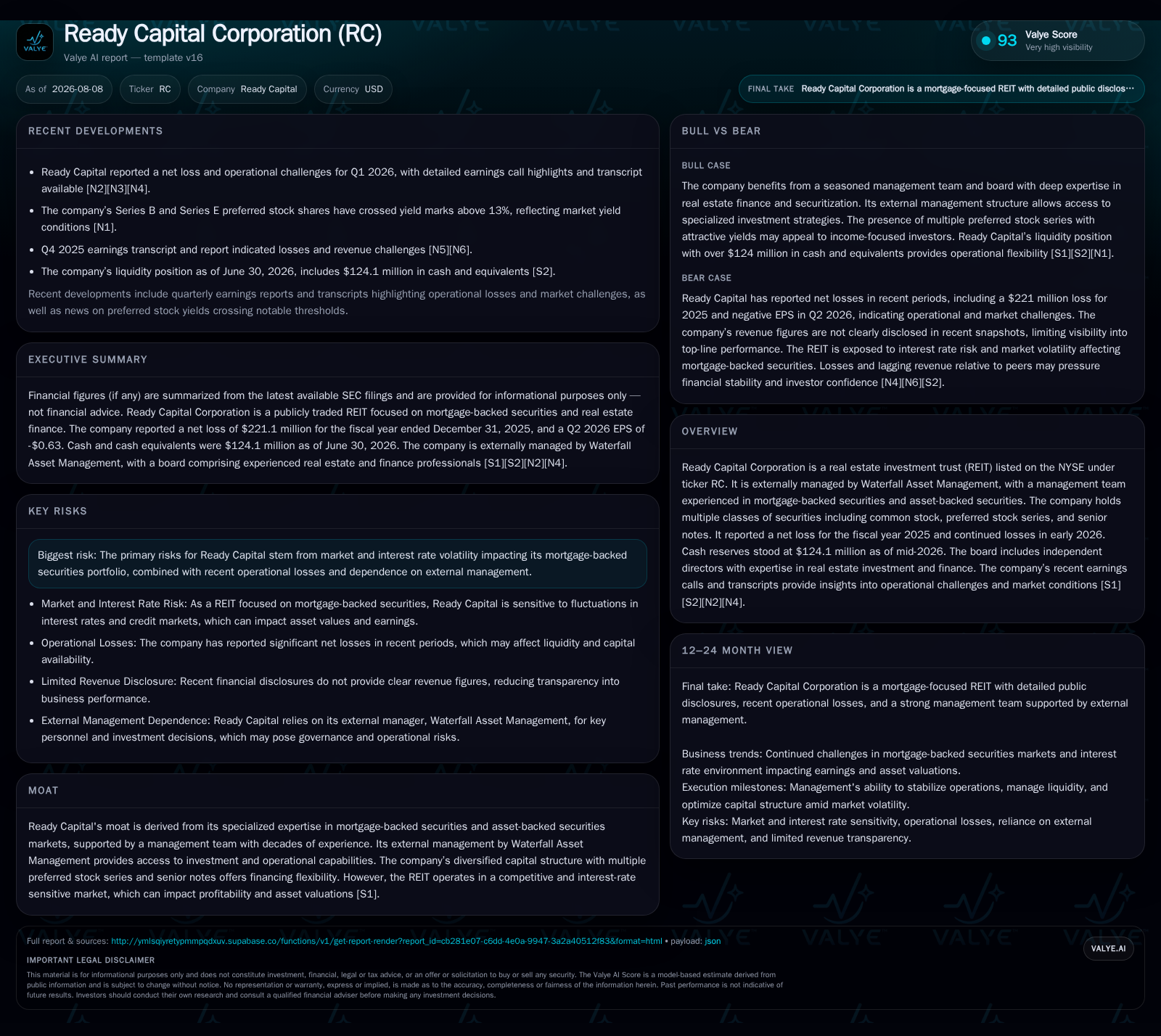
Ready Capital Corporation (RC) reported continued operating losses in its Q2 2026 filing, with net interest margins pressured by elevated interest rates affecting its mortgage-backed securities portfolio. Cash reserves stood at $124 million while total debt exceeded $1.2 billion, underscoring leverage risks amid volatile market conditions. The firm remains externally managed by Waterfall Asset Management, which provides expertise but also introduces operational dependencies. Competitive pressures and interest rate sensitivity remain key challenges for dividend sustainability and growth prospects.
Recent Operating Update
Ready Capital Corporation’s Q2 2026 10-Q filing reflects persistent operating challenges common in the mortgage REIT sector. The company reported ongoing net losses indicative of pressure on net interest margins from elevated interest rates that have negatively impacted the valuation and income streams of its mortgage-backed securities portfolio [S2]. This latest quarterly disclosure did not signal any material change in risk factors but reiterated the sensitivity of spread income to fluctuating interest environments—a defining characteristic for mortgage REITs.
At quarter-end, Ready Capital held $124.1 million in cash and cash equivalents against approximately $1.21 billion in total debt, producing a substantial net debt load near $1.09 billion, reaffirming the company’s leveraged balance sheet profile common among peers in this asset class [F1]. This leverage amplifies both upside returns in favorable markets and downside risks during periods of volatility or tightening spreads.
An event filing dated August 6, 2026 [S3] supplemented the quarterly report without materially altering the company's financial position but underscored ongoing strategic efforts by Waterfall Asset Management—the external manager overseeing Ready Capital’s operations—to navigate this challenging environment.
Business Model Overview
As a mortgage real estate investment trust (REIT), Ready Capital’s business model centers on generating revenue from the spread between yield on mortgage-related assets—primarily mortgage-backed securities (MBS) and asset-backed securities (ABS)—and the cost of funding, which predominantly comprises debt financing and preferred equity obligations [S1]. The firm leverages capital markets extensively to amplify returns, consistent with industry norms
The monetization mechanics depend critically on maintaining positive net interest margins, which are inherently susceptible to interest rate movements given the sensitivity of long-duration MBS price volatility relative to shorter-dated borrowing costs. Ready Capital does not originate loans but invests mainly in securitized product portfolios sourced from banks or loan originators.
External management by Waterfall Asset Management provides Ready Capital with specialized expertise in managing complex securitized portfolios, including navigating credit risk, prepayment variability, and liquidity considerations typical for this segment [S1]. However, this arrangement imposes a cost structure that can weigh on distributable earnings during compressive market phases
The company’s diversified capital structure includes common stock plus multiple series of preferred stock with fixed dividend obligations and senior notes due 2029, affording financial flexibility but also requiring consistent cash flow generation to service these claims without deleterious effects on equity value or dividend distributions [S1][N2]
Industry Structure and Competitive Position
Ready Capital operates within the mortgage REIT industry alongside peers such as Annaly Capital Management, AGNC Investment Corp, Starwood Property Trust, Blackstone Mortgage Trust, and Two Harbors Investment Corp. These entities contend with a cyclical business profoundly influenced by macroeconomic variables like federal funds rates, treasury yields, housing market dynamics, and credit conditions.
Competitive differentiation often hinges on scale advantages (allowing better financing terms), portfolio composition (balance between residential versus commercial MBS), risk management sophistication (hedging strategies to mitigate interest rate exposure), and operational efficiency including external management costs versus internal capabilities.
While scale peer competitors have larger asset bases enabling more robust diversification and access to cheaper leverage, Ready Capital’s niche focus combined with Waterfall’s asset management specialization offers tailored investment approaches that could be advantageous if market conditions stabilize.
Nevertheless, recent quarters reveal that Ready Capital has struggled to match stable distributable earnings levels compared to larger peers who benefit from broader asset diversification or internalized management structures. This exposes residual vulnerabilities linked to governance arrangements and market liquidity constraints affecting portfolio valuation marks.
Growth Drivers
The primary growth engine for Ready Capital lies in restoring stable or improved net interest spreads through either a decline in benchmark interest rates that reduces funding costs relative to asset yields or through origination expansion spurred by favorable mortgage market dynamics increasing asset availability at attractive yields. However, these conditions have not been sustained amid persistent economic uncertainty.
Other potential growth levers include enhancements in credit quality within underlying MBS tranches improving risk-adjusted yields; innovation in securitization structures allowing capture of higher spreads; and strategic refinements by Waterfall Asset Management aiming to optimize portfolio mix between residential and commercial assets to balance yield versus risk.
Additionally, regulatory developments potentially enhancing REIT investment appeal or easing capital formation can provide necessary tailwinds for expansion.
That said, none of these drivers have yet produced visible improvements in distributable earnings or margin expansion for Ready Capital in recent quarters—as confirmed by continued losses reported in Q2 2026 [S2]
Risks and Watchpoints
Interest rate sensitivity remains paramount: elevated rates compress net interest margin as funding costs rise faster than asset yields or cause mark-to-market losses on fixed-income portfolios [F1][S2]. Given Ready Capital's leveraged position exceeding $1 billion net debt, even modest spread contractions can materially impair earnings capacity
Credit risk within the MBS/ABS portfolios is an ongoing concern; economic downturns could elevate default risks undermining asset valuations further.
External management creates operational dependencies that need ongoing monitoring—alignment of interests between Waterfall Asset Management and shareholders may fluctuate based on fee structures pegged partly to assets under management rather than pure performance incentives [S1]
Dividend sustainability is fragile given recent distributable earnings shortfalls relative to fixed preferred dividends and debt servicing needs. Continued losses could necessitate dividend cuts or equity raises dilutive to existing holders.
Finally, valuation uncertainty inherent in illiquid mortgage assets amplifies risk especially during times of market stress where mark adjustments can sharply affect reported book values.
What to Watch Next
Key upcoming milestones for investors include Ready Capital's next quarterly results releases expected after Q3 2026 reporting period when updated NAV calculations will provide clearer signals on asset valuation trends.
Monitoring changes in Federal Reserve policy or treasury yield curves will be critical gauges for potential improvement or further pressure on spread income.
Execution metrics from Waterfall Asset Management around portfolio rebalancing activities—such as shifts from longer-duration MBS into shorter-duration loans or increased diversification into commercial property-backed assets—will indicate strategic response effectiveness.
Any announcements regarding refinancing activity concerning senior notes due beyond 2029 may reveal near-term liquidity positioning and cost-of-capital implications.
Dividend policy updates are also significant markers because they reflect distributable earnings quality vis-à-vis fixed obligations under current market conditions.
Financial Profile Discussion
Ready Capital’s balance sheet at June 30, 2026 shows cash reserves totaling about $124 million against total debt roughly $1.21 billion resulting in substantial net indebtedness near $1.09 billion [F1]. This level of leverage aligns with typical mortgage REIT profiles but amplifies vulnerability to spread tightening or funding disruptions.
Net income has remained negative into early 2026 as reflected in recent filings despite attempts at portfolio optimization [S2], underscoring profitability challenges during an adverse interest rate regime.
The diversified capital structure—comprising common stock plus multiple series of preferred stock with yields above 6%, coupled with senior notes paying fixed coupons—offers both flexibility for capital deployment but also commits the firm to sizeable fixed financial expenses that pressure distributable earnings when spread income is compressed [S1][N2]
Liquidity management will be critical going forward with reliance on access to capital markets for debt refinancings amid an environment marked by periodic bouts of volatility impacting borrowing costs across mortgage REIT peers.
Overall, Ready Capital’s financial platform reflects typical sector dynamics where operating performance swings closely track macroeconomic cycles influencing interest rates and credit markets coupled with leverage magnifying results both positively and negatively.
Disclaimer: This is research-only, informational analysis and not investment advice. It may include AI-generated interpretation and general industry context. Always verify important details using primary sources.

Comments