
Equity Bancshares Strengthens Position with Stable Net Interest Income and New Share Repurchase Initiative
Recent quarterly results reinforce Equity Bancshares’ focus on credit risk management and deposit growth within its Midwestern regional footprint.
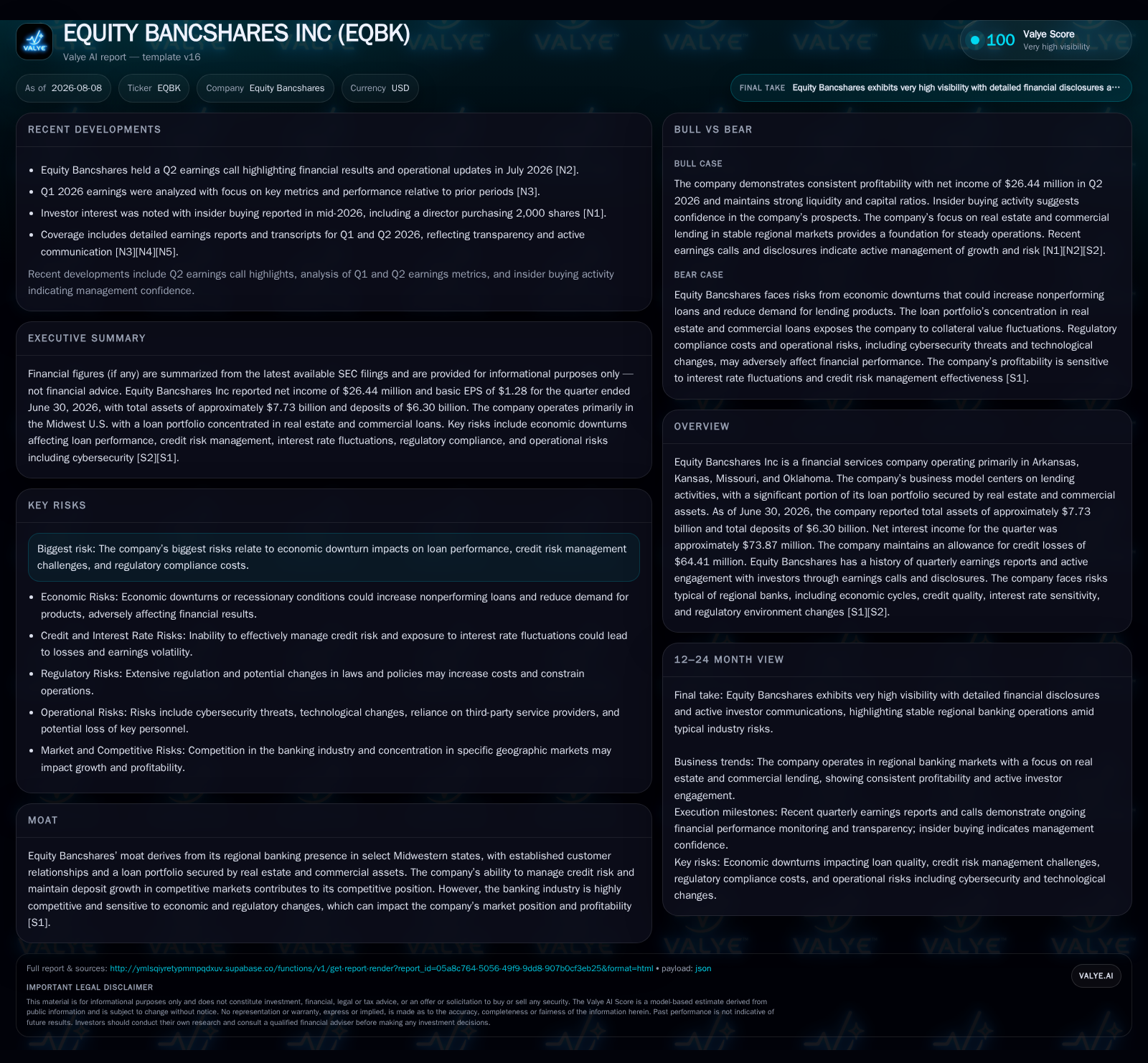
In its latest quarter ending June 30, 2026, Equity Bancshares delivered a stable net interest income of approximately $73.9 million while managing modest provisions for credit losses amid ongoing economic uncertainty. The company’s loan portfolio remains heavily weighted towards real estate and commercial assets across Arkansas, Kansas, Missouri, and Oklahoma, supporting consistent deposit growth totaling $6.3 billion. On August 5, 2026, the board approved a new share repurchase program for up to one million shares over the next year, signaling confidence in capital generation and shareholder return capacity. Equity Bancshares continues to navigate challenges typical of regional banks, balancing interest rate sensitivities, credit quality vigilance, and regulatory compliance in its defined markets.
Recent Operating Update
Equity Bancshares’ second quarter 2026 results report net interest income (NII) virtually unchanged from the preceding quarter at approximately $73.87 million [S2]. This stability showcases the company's ability to manage its core lending and deposit spread amid fluctuating market interest rates—a key performance indicator for regional banks reliant on net interest margin compression or expansion. The provision for credit losses decreased significantly to $1.3 million from nearly $6 million last quarter, suggesting improved asset quality or more conservative loan loss reserves aligned with current economic assessments [S2]. This movement reflects effective credit risk governance within their primarily real estate and commercial loan portfolio concentrated in Arkansas, Kansas, Missouri, and Oklahoma.
The total loan book remains secured predominantly by real estate collateral and commercial assets, common in regional banking models but requiring careful vigilance due to inherent concentration risks in specific markets and sectors [S1]. Deposit balances continue to support lending activities robustly with reported totals near $6.3 billion alongside total assets of roughly $7.73 billion as of June 30, 2026 [S2][S1]. Such a deposit base sustains a healthier loan-to-deposit ratio which is vital for funding liquidity without excessive dependence on wholesale funding sources.
A notable strategic development was the approval by Equity Bancshares' board on May 20, 2026, of a new share repurchase program authorizing the buyback of up to one million shares over the ensuing year or until the current plan expires at September 30, 2026 [S3]. Receiving non-objection from the Federal Reserve Bank of Kansas City signals regulatory comfort around this capital allocation move that aims to enhance shareholder value while preserving ample capital buffers typical for regionally focused lenders.
Business Model Overview
Equity Bancshares operates as a regional bank specializing in deposit-taking and diversified lending services concentrated across Midwestern states including Arkansas, Kansas, Missouri, and Oklahoma [S1]. Its revenue generation fundamentally depends on net interest income derived from lending activities against deposit costs—primarily via real estate-secured loans and commercial lending products tailored to local businesses and consumers.
This structure typifies many regional banks whose product mix leans heavily on secured loans supported by tangible collateral—real estate in particular—which impacts credit risk profiles significantly. Non-interest income arises from service fees and securities transactions but forms a smaller percentage of total revenue relative to interest earnings.
Customer acquisition and retention focused on regional markets engender stable deposit growth critical for funding loan originations sustainably without overly relying on volatile capital markets.
Industry Structure and Competitive Position
Within the broader regional banking sector—characterized by institutions serving geographically concentrated areas with localized product offerings—Equity Bancshares holds a middle-market position focusing on select Midwest states [S1]. Key peers exemplifying comparable business models include Regions Financial Corporation and FNB Corporation which also emphasize relationship banking anchored in commercial and real estate lending.
Competitive factors revolve around managing credit risk prudently while executing disciplined pricing strategies responsive to interest rate cycles. Regional banks often face pressures both from larger national banks capable of scale advantages and community-focused institutions competing on customer intimacy.
Equity Bancshares’ established presence with deep customer relationships provides some moat; however its heavy loan concentration demands constant monitoring of local economic conditions that drive borrower repayment capacity.
Growth Drivers
Several growth drivers underpin Equity Bancshares' outlook:
- Regional Economic Expansion: Population growth and expanding business activity in its core states support rising demand for commercial finance and mortgage lending.
- Deposit Base Development: Continued customer acquisition enhances low-cost funding sources critical for margin sustainability.
- Interest Rate Environment: Favorable shifts can widen net interest margins if managed adeptly across repricing assets and liabilities.
- Cross-Selling Opportunities: Fee-based services such as treasury management can augment non-interest income streams.
- Strategic Share Repurchase: Capital returning programs can reflect confidence in earnings power while potentially boosting per-share metrics.
- Operational Efficiency: Technology adoption may lower cost ratios improving overall profitability metrics such as efficiency ratio (operating expenses/net revenue).
- Selective Acquisitions/Branch Expansions: Opportunistic market share gains can broaden geographic footprint incrementally without compromising capital requirements.
Monitoring these levers through KPIs like loan growth rates, deposit trends, provisions for credit losses relative to non-performing loans ratio will be essential indicators of execution strength going forward.
Risks and Watchpoints
Equity Bancshares faces inherent risks typical among regional banks that require vigilant risk management:
- Economic Cycles: Recessions can depress loan demand while increasing defaults affecting asset quality adversely.
- Credit Quality Deterioration: Unexpected declines in collateral values (especially real estate) pose risk of higher loss severities impacting allowance adequacy.
- Interest Rate Volatility: Fluctuations challenge forecasting NIM sustainability; mismatches in asset-liability repricing may pressure margins.
- Regulatory Compliance Costs: Heightened supervision entails costs that impact operational leverage particularly for midsize banks.
- Competitive Pressures: Larger institutions or fintech disruptors could erode market share or compress pricing power.
- Concentration Risk: Heavy weighting toward real estate/commercial loans exposes vulnerability if sector downturns occur locally.
- Liquidity Constraints: Sudden deposit withdrawals or stress scenarios require robust contingency planning.
- Management Execution Risk: Success depends on retaining key personnel capable of underwriting discipline amidst growth ambitions.
Continued transparency through disclosures about allowance adequacy, non-performing loans ratio changes, and provision expenses will be important signal points signaling risk trajectory adjustments [S1][S2].
What To Watch Next
Key milestones provide actionable insights into Equity Bancshares' momentum:
- Quarterly updates on net interest margin trends especially given recent rate volatility will clarify profitability pacing [N1][N4].
- Changes in allowance for credit losses versus actual loan performance will reveal portfolio resilience under prevailing macroeconomic conditions [S2].
- Deposit growth rates compared quarterly will indicate funding stability crucial for balanced balance sheet management.
- Progression against the newly authorized share repurchase plan starting September 2026 may reflect confidence level from both management and regulators [S3].
- Any strategic moves including partnerships or modest acquisitions aimed at footprint enlargement should be closely monitored.
- Regulatory filings detailing efficiency gains or cost control measures may hint at future margin expansion possibilities.
Investor engagement via earnings calls consistently provides qualitative color around execution challenges or opportunities observed by management teams [N1]. These forums often contextualize numeric outcomes within broader strategic narratives relevant to regional banking dynamics.
This analysis is based solely on publicly available documents filed by Equity Bancshares Inc., industry knowledge frameworks applicable to regional banking institutions, and recent news reporting surrounding company developments through August 2026. It does not constitute investment advice.
Disclaimer: This is research-only, informational analysis and not investment advice. It may include AI-generated interpretation and general industry context. Always verify important details using primary sources.

Comments