
Janel Corp’s Diversified Industrial Services Model Faces Integration and Competitive Challenges
Janel Corp operates across logistics, life sciences, and manufacturing with acquisition-driven growth but contends with industry fragmentation and capital constraints.
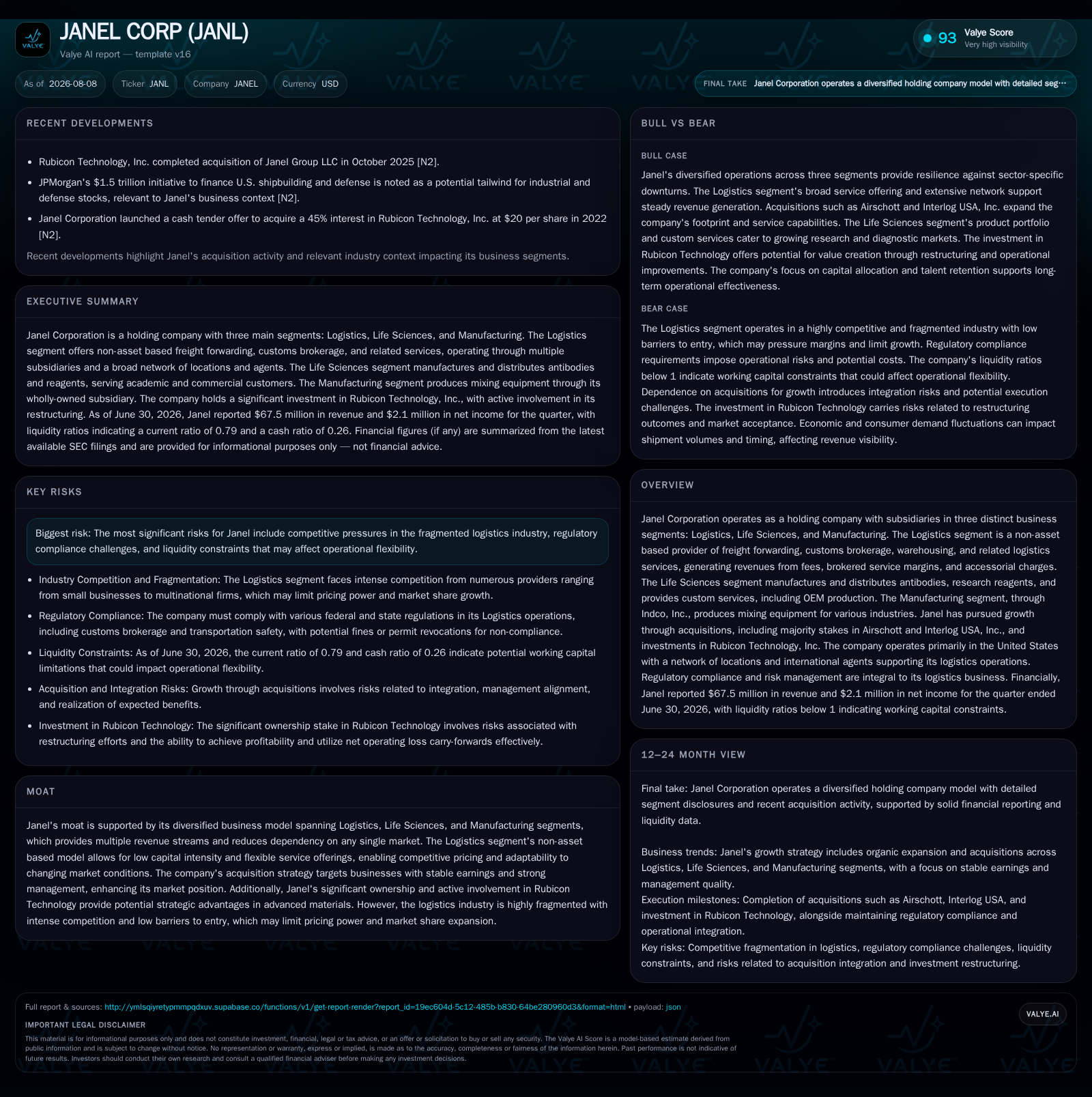
Janel Corporation, a holding company with subsidiaries in Logistics, Life Sciences, and Manufacturing segments, reported a stable operating environment in its latest quarterly 10-Q dated August 7, 2026. Its non-asset-based logistics segment maintains flexibility but faces intense pricing competition and cyclical volume risks. Life Sciences relies on high-quality reagents production amid regulatory scrutiny and market consolidation, while Manufacturing’s single-facility operations expose it to supply chain and operational risks. The company's acquisition strategy provides growth avenues but adds integration complexity and working capital pressures. Liquidity remains constrained with a current ratio below 1 despite substantial cash balances. Key watch points include successful integration of acquisitions, freight volume trends, and product innovation in Life Sciences.
Recent Operating Update
The latest quarterly report filed on August 7, 2026, confirms continuity in Janel Corp's evolving business profile without material changes to its risk factors or capital structure [S2]. Operating results reflect ongoing efforts to integrate acquisitions like Airschott (80% ownership as of June 2024) into the Logistics segment’s network. No major disruptions or deviations from prior guidance were disclosed, indicating a steady state after recent growth activities. However, the absence of upward revision underscores persistent challenges around market dynamics and operational execution common in diversified industrial service providers.
Business Model Analysis
Janel operates as a holding company with three principal segments: Logistics, Life Sciences, and Manufacturing. This multi-segment approach diversifies revenue streams across distinct but related industrial services sectors.
The Logistics segment functions as a non-asset based operator focusing on freight forwarding via air, ocean, and land carriers; customs brokerage; warehousing; trucking; and value-added services including product repackaging and cargo insurance procurement [S1],[S8]. Revenue arises from flat service fees (e.g., customs entry filings), brokered margins—capturing the spread between contracted carrier rates and customer charges—and accessorial fees covering fuel surcharges or labor. This asset-light model reduces fixed capital commitments compared to asset-heavy carriers or warehouse operators but increases reliance on third-party capacity availability and price competitiveness. The network includes twenty-eight U.S. offices managed for individual profitability yet enabled by shared back-office services such as centralized accounting [S1],[S8].
Life Sciences specializes in manufacturing biological reagents like antibodies for biomedical research clients including academic institutions and life sciences companies. Their custom OEM manufacturing offerings complement the product portfolio through bespoke production services enhancing customer stickiness and revenue predictability [S8],[S21]. This segment confronts stringent regulatory requirements affecting product quality standards related to purity and reproducibility—the critical buying criteria for scientists—which necessitates continuous process controls and investment in personnel expertise. Moreover, consolidation in pharma/biotech customers concentrates purchasing decisions adding both opportunities for scale sales and risks related to customer concentration despite an overall diverse base where the largest single customer accounts for only about 3% of revenues [S1],[S18].
The Manufacturing segment is represented by Indco Inc., producing industrial mixing equipment for varied end markets. Indco’s operations are concentrated at a single plant in Indiana employing lean manufacturing principles with limited inventory levels—exposing the business to potential interruptions from supply chain volatility or catastrophe due to lack of redundancy [S14],[S25]. Raw material costs for components like motors or steel are exposure points that may pinch margins if not effectively passed through pricing mechanisms or hedged.
Industry Structure & Competitive Positioning
Janel operates within highly fragmented industries featuring low barriers to entry—especially pronounced in logistics freight forwarding where regional mom-and-pop firms compete alongside large multinational integrators like Expeditors International or C.H. Robinson analogs. The company's non-asset based logistics approach enhances flexibility but limits captive capacity advantages relative to vertically integrated competitors who can internally control shipping resources.
In Life Sciences manufacturing, competition intensifies around innovation speed, product quality assurance, regulatory compliance costs, and ability to service large pharmaceutical accounts—a dynamic where switching costs favour established producers yet technological shifts can disrupt incumbents similar to Thermo Fisher Scientific’s domain.
The industrial mixer market is also characterized by low entry barriers with new players leveraging digital marketing channels aggressively challenging incumbent manufacturers including peers like SPX Flow or Graco analogs. Janel’s reliance on a single facility limits scale expansion options absent additional investment or acquisitions.
Growth Drivers
Organic expansion depends largely on capturing incremental share within existing customer relationships via cross-selling integrated logistics solutions or expanded reagent offerings tailored for burgeoning biomedical R&D sectors [S1],. Strategic acquisitions remain central as demonstrated by recent Airschott majority stake acquisition allowing immediate enlargement of freight forwarding volumes under Janel's umbrella.
Global trade volume recovery post-pandemic disruptions coupled with elevated complexity in customs clearance due to evolving regulation present opportunity for premium fee-based customs brokerage growth. Simultaneously outsourcing trends encourage companies to utilize third-party specialists rather than building internal logistics capabilities.
Investment in R&D processes within Life Sciences promises new reagent lines meeting rising demand for diagnostics driven by healthcare innovation cycles.
Capital expenditure upticks among industrial customers can drive demand for Indco's bespoke mixing equipment if supply chain constraints abate allowing timely order fulfillment.
Risks & Watchpoints
Acquisition integration poses multi-dimensional risks ranging from operational disruption and cultural mismatches to unforeseen liabilities assumed during transactions—all capable of diluting anticipated profitability gains from expanded scale [S1],[S16]. Working capital demands increase as newly acquired entities require upfront funding while awaiting normal cash conversion cycles.
Intense competition in logistics compresses pricing power; new entrants with innovative technology platforms could erode traditional brokerage margins affecting overall earnings quality.
Regulatory compliance burdens particularly affect Life Sciences impacting cost structures while also posing product liability exposures if quality standards falter despite insurance coverage attempts reducing financial risk but not eliminating reputational damage potential [S15],[S17].
Supply chain instability threatens Manufacturing throughput since Indco sources critical raw materials globally potentially subjected to political/economic turbulence beyond Janel's control raising input costs or causing delays detrimental to customer satisfaction.
Concentration risks include shareholder voting power dominated by few investors (~77.6% concentration), potentially influencing corporate governance decisively which may not always align with minority shareholder interests [S11].
What To Watch Next
Near-term indicators include logistics freight volume trends responding to macroeconomic signals including trade policy developments which directly impact the top line of this segment.
Successful completion and early operational results of any announced acquisitions will be crucial milestones reflecting management’s ability to execute on its stated growth strategy without undue disruption.
Life Sciences R&D pipeline announcements or new contract wins serve as bellwethers for segment vitality amid competitive pressures.
Manufacturing order backlog progression coupled with raw material cost trends will signal margin sustainability prospects.
Monitoring liquidity metrics quarterly will provide insight into working capital health impacting operational flexibility.
Financial Profile Discussion
As per the latest financial snapshot through June 30, 2026 [F1], Janel holds approximately $33.7 million in cash against total debt virtually negligible at around $100 thousand—a very conservative leverage position at the holding level suggestive of low balance sheet risk absent subsidiary indebtedness disclosure.
Net income was reported at approximately $5.66 million over the same period highlighting moderate net margin retention typical given operating expenses plus amortization considerations related to acquired goodwill.
Overall, Janel exhibits prudent capital structure positioning but must balance investments across segments carefully ensuring sustainable margin improvements concomitant with growth initiatives.
This analysis synthesizes recent SEC filings along with industry context relevant for understanding Janel Corp's operational reality without forward-looking forecasts or investment research views.
Disclaimer: This is research-only, informational analysis and not investment advice. It may include AI-generated interpretation and general industry context. Always verify important details using primary sources.

Comments