
Darling Ingredients Leverages Feedstock Integration and Joint Ventures to Strengthen Growth Profile
Q2 2026 results highlight Darling Ingredients’ strategic expansion in share repurchases, continued specialty ingredient demand, and renewable fuel production via joint ventures.
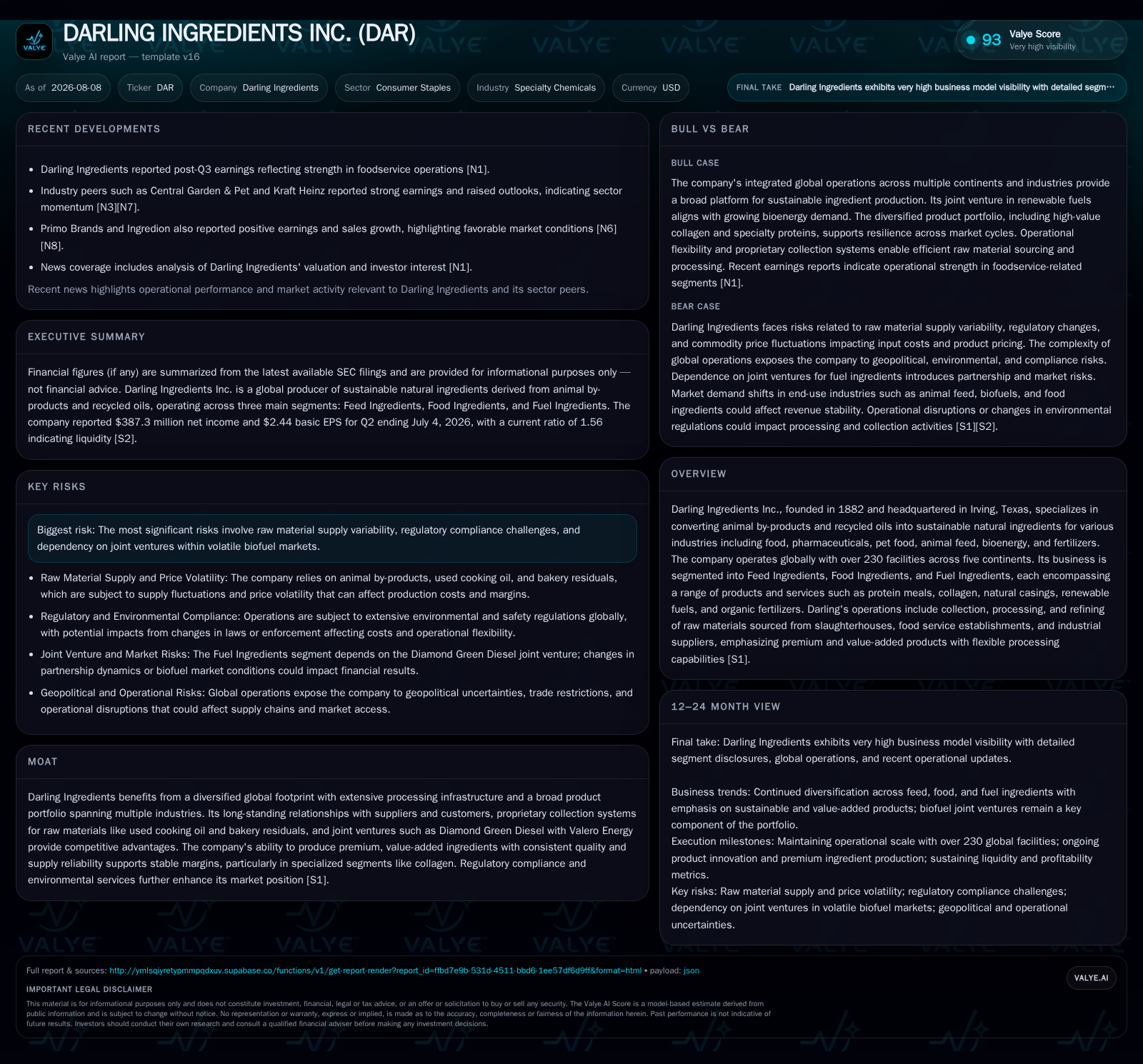
Darling Ingredients delivered operational momentum in Q2 2026 supported by strong performance in its specialty and fuel ingredient segments, underpinned by its vertically integrated feedstock collection and processing network. The company doubled its share repurchase authorization to $1 billion, signaling confidence amid ongoing bioenergy market volatility. Its joint venture with Valero Energy scales renewable diesel and sustainable aviation fuel output, while diverse product exposure across food, feed, and biofuel markets cushions against commodity cycles. Regulatory compliance and sustainability initiatives further solidify Darling’s competitive moat.
Q2 Operational Momentum Anchored in Specialty and Fuel Segments
Darling Ingredients’ Q2 2026 results reveal sustained operational strength driven primarily by its specialty ingredient segments serving foodservice-related customers, coupled with strategic moves to enhance shareholder value through share repurchase acceleration [S2][S3][N1]. The company announced an increase of its stock buyback program from $500 million to $1 billion without an expiration date, reflecting management’s confidence in free cash flow and business stability amid macroeconomic uncertainties
Demand in feed ingredients such as meat and bone meals, poultry meals, and collagen remained robust, aided by stable volumes from foodservice channels recovering post-pandemic. This segment strength contributes to volume-driven revenue resilience despite some underlying raw material cost volatility [S2][N1]. The ongoing integration of recycled oils for fuel ingredient processing complemented these fundamentals by maintaining production cadence for renewable diesel blended products
The share buyback flexibility provides Darling with an opportunistic capital allocation tool while reinforcing investor confidence amid the fluctuating bioenergy markets influenced by policy incentives and commodity cycles.
Value Chain Strength: Vertical Integration of Raw Material Sourcing and Processing Efficiency
Darling’s operating model hinges on a vertically integrated globally extensive feedstock collection network sourcing animal by-products, used cooking oil (yellow grease), bakery residuals, and other biomass streams. With over 230 processing facilities spanning five continents, the enterprise benefits from substantial scope economies that enable flexible processing capacity utilization to adjust to input availability or market demand shifts [S1]
This control over raw material sourcing insulates Darling somewhat from volatile input prices or supply disruptions common in specialty ingredients and bioenergy sectors. For instance, proprietary relationships with slaughterhouses, food service establishments, and industrial suppliers secure steady intake volumes critical for continuous production of protein meals, collagen, natural casings, fats, and fuel feedstocks [S1]. This vertical integration underpins gross margins by reducing reliance on third-party procurement costs while allowing differentiated product quality controls
Strategic Fuel Ingredient Growth Via Renewable Fuels Joint Ventures with Valero Energy
A pivotal element in Darling’s growth narrative is its joint venture involvement with Valero Energy through Diamond Green Diesel (DGD). This JV converts low-cost recycled oils including used cooking oil and animal fats into high-value renewable diesel and sustainable aviation fuels (SAF) compliant with increasingly stringent environmental standards [S1].
Although the JV’s detailed financial metrics are not outlined separately, it represents a cornerstone of Darling’s fuel ingredient segment expansion. This partnership exemplifies strategic alignment with global decarbonization trends incentivizing renewable biofuel adoption both commercially and via government mandates.
The JV’s scaling enhances Darling’s access to capital-intensive refining infrastructure otherwise beyond pure-play ingredient producers’ standalone capability. However, this structure introduces dependency risk given the exposure to syndicated decision-making dynamics and biofuel market price swings impacted by subsidy regimes or regulatory adjustments [S1]. Nonetheless, this confers operating leverage on Darling’s overall profitability when renewable fuels markets expand.
Product Portfolio Diversification Reduces Volatility Across Commodity Cycles
Darling Ingredients manages a diversified portfolio segmented into Feed Ingredients (animal proteins and meals), Food Ingredients (collagen, edible fats), and Fuel Ingredients (renewable diesel, SAF precursors). This mix mitigates cyclicality inherent in commodity-based bioenergy products through revenue stability sourced from specialty ingredient sales grounded in food nutrition demand.
Segmented product lines each react differently to raw material pricing pressures; protein meals often track livestock production trends while collagen commands more value-added pricing linked to pharmaceutical/personal care markets. Natural casings leverage niche manufacturing capabilities less sensitive to bulk commodity swings.
This segmentation supports Darling’s ability to maintain operating margin resilience even when the fuel ingredient segment faces cyclical downturns or input constraints [S1][S2]. Quarterly reporting indicated no notable softness in specialty products sales alongside fuel ingredient production holding steady—a positive sign of balanced demand profile execution
Regulatory Compliance and Sustainability Initiatives Supporting Long-Term Moat
The company operates within a complex regulatory environment given its role transforming animal by-products into consumable ingredients plus producing environmentally sensitive fuels. Adherence to food safety standards, environmental permits including wastewater treatment controls, air emissions regulations around processing sites, plus occupational health rules comprise ongoing risk considerations minimizable through robust compliance frameworks [S1].
Additionally, environmental services like grease trap collection augment Darling’s sustainability profile by encouraging circular economy practices within the foodservice industry—capturing waste streams otherwise landfilled or incinerated.
Such initiatives expand entry barriers while aligning Darling with growing corporate ESG demands among downstream customers especially in pharmaceuticals and consumer packaged goods seeking traceable sustainable ingredient sourcing. These enforceable regulatory standards enhance Darling’s moat not easily replicable by smaller or less compliant competitors [S1].
Organic Growth Drivers: Collection Network Expansion and High-Value Ingredient Innovation
Darling continues expanding feedstock acquisition channels enhancing raw material intake volumes essential for scaling processing output across all segments including high-margin specialty collagen products which cater to growing nutritional supplement markets [S1][N14]. Innovations targeting collagen purity enhancement or novel natural casing solutions add product differentiation potential supporting pricing power.
Incremental growth through collection network breadth remains a primary volume driver given the scarcity premium on quality feedstocks such as yellow grease or bakery residuals that also feed fuel ingredient supply chains. Enhanced yield rates through process improvements remain key internal KPIs likely tracked closely though not explicitly disclosed.
Strategic product innovation could further unlock margin expansion possibilities distinct from commoditized biofuel outputs reliant on fluctuating subsidy-driven economics.
Key Risks: Raw Material Supply Volatility and Biofuel Market Dependency via Joint Ventures
Management reiterates ongoing risks related to variability in raw input supply due to shifting slaughterhouse throughput patterns or competing recyclers seeking limited used cooking oil inventories causing potential price surges or procurement shortfalls [S2][S1]. These directly affect production consistency especially within tightly matched feedstock-to-product yield processes.
Further regulatory volatility impacting joint ventures like Diamond Green Diesel introduces uncertainty whether tax incentives or carbon credit schemes sustain long-term viability support for renewable fuels—a critical factor given JV contribution significance to overall growth plans.
Operational risks including plant downtime affecting approximately 230 facilities globally also present continuous challenges requiring proactive maintenance regimes.
Macro factors such as commodity price swings influencing end-user demand across food/feed/bioenergy add external noise requiring diversified portfolio balance as mitigation.
Investor Readiness: Share Repurchase Expansion Reflects Confidence Amid Market Dynamics
The recent doubling of authorized stock repurchase capacity to $1 billion signals management’s assessment of intrinsic value supportive relative to market prices plus sufficient prospective cash flow generation post-capital expenditures [S3]. This capacity notably lacks an expiration date enhancing strategic flexibility around timing share buybacks based on market conditions.
This move also suggests capital allocation discipline prioritizing shareholder returns alongside reinvestment into core processing infrastructure or potential bolt-on acquisitions within specialty ingredients or complementary bioenergy assets.
Liquidity strength combined with manageable leverage provides room for this repurchase strategy without compromising operational funding needs.
Financial Profile Discussion: Recent Liquidity Position, Debt Load, and Capital Structure
As of July 4, 2026, Darling Ingredients held cash and equivalents totaling approximately $160.7 million against total debt near $3.85 billion—translating into a net debt position around $3.69 billion [F1]. Current assets stood at $1.76 billion versus current liabilities of roughly $1.12 billion, yielding a current ratio near 1.56, indicative of adequate near-term liquidity buffers supporting working capital needs [F1].
Operating income data measured at $273 million year-to-date alongside net income near $62.8 million confirms profitability but underscores sensitivity to commodity inputs linked to earnings volatility inherent in the sector [F1]
Capital expenditures focus on maintaining steady state processing capacity aligned with vertical integration benefits rather than aggressive expansion dependent largely on capture growth opportunities within existing footprint plus incremental facility upgrades per regulatory mandates.
This analysis is provided solely for informational purposes based on publicly available filings and industry research as of August 2026. It does not constitute investment advice.
Disclaimer: This is research-only, informational analysis and not investment advice. It may include AI-generated interpretation and general industry context. Always verify important details using primary sources.

Comments