
Radian Group Navigates Integration Risks and Regulatory Pressure Amid Housing Finance Reform Uncertainty
Radian’s latest quarter highlights operational resilience despite new currency and reinsurer risks following acquisition and an evolving regulatory landscape.
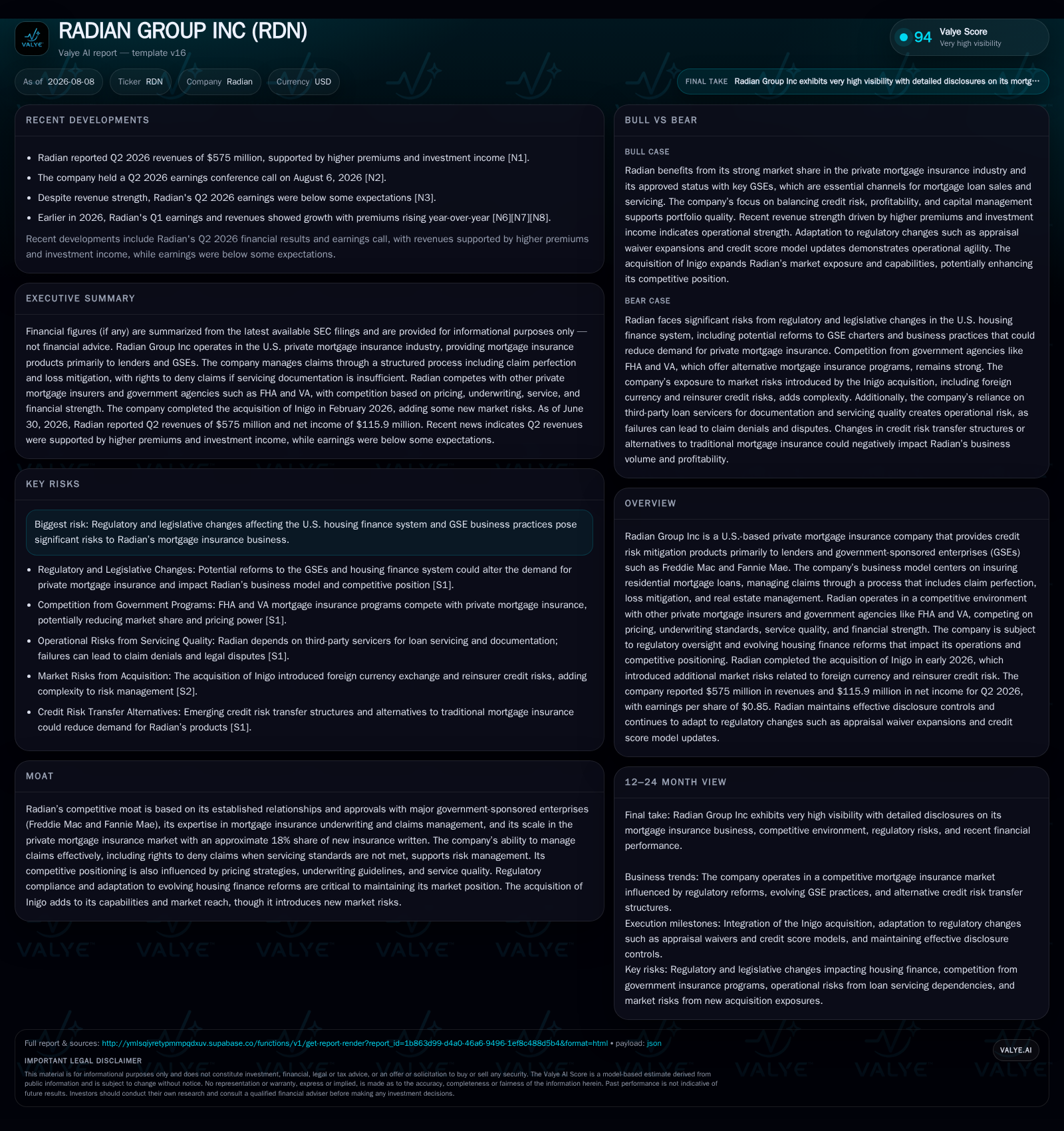
Radian Group Inc, a major private mortgage insurer serving GSEs and lenders, reported stable operational controls and ongoing integration progress following its early 2026 acquisition of Inigo. While the acquisition introduces incremental foreign currency and reinsurer credit risk, these remain immaterial as of mid-2026. The company operates amid heightened regulatory uncertainty due to potential U.S. housing finance reforms that could impact its capital requirements and eligibility with Freddie Mac and Fannie Mae. Radian’s competitive moat remains anchored in its scale, underwriting expertise, and established GSE approvals, though maintaining this position depends on adapting to shifting GSE policies and regulatory oversight.
Recent Operating Update: Acquisition Integration and Risk Profile
Radian Group Inc reported its latest quarterly filing on August 7, 2026 [S2], underscoring two key near-term developments shaping its operating environment. First is the completion of the Inigo acquisition on February 2, 2026 [S2,S3], which expanded the company's footprint but introduced foreign currency exchange rate risk and reinsurer credit risk previously absent from Radian's portfolio. While these incremental risks are currently deemed immaterial to the business as of mid-2026 [S2], they represent new variables in Radian's market risk landscape that require active management going forward.
The ongoing integration of Inigo's systems into Radian’s internal control frameworks is progressing, though management has excluded Inigo's controls from the year-end assessment for 2026 per SEC guidance [S2]. This cautious approach suggests a prudent tempo as the company aligns disparate operational processes following this strategic acquisition.
Business Model: Credit Risk Mitigation Through Private Mortgage Insurance
Radian operates primarily by issuing private mortgage insurance (PMI) policies to lenders financing residential mortgages with low borrower equity. Its primary customers include mortgage originators seeking to mitigate default risk as well as government-sponsored enterprises (GSEs) like Freddie Mac and Fannie Mae that purchase insured loans for their secondary market portfolios [S1].
Revenue streams derive mainly from mortgage insurance premiums earned over the life of insured loans, tied closely to loan volume growth, average loan-to-value ratios (LTV), and credit quality dynamics. Radian’s underwriting guidelines strive to balance expanding insured loan volumes with disciplined risk selection to preserve underwriting margins.
Claim management plays a pivotal role post-default, where Radian exercises contractual rights around claim perfection—requiring comprehensive documentation from loan servicers before claim payment—and may deny claims if servicing standards or documentation fall short [S1]. This capability helps control loss severity while enforcing servicing discipline critical for loss mitigation efforts. The company also manages real estate owned (REO) assets arising from foreclosures.
Reinsurance arrangements provide capital relief by transferring portions of credit risk to third parties, although this introduces counterparty credit risk requiring vigilant oversight.
Industry Structure and Competitive Positioning
The U.S. PMI industry comprises six active private insurers approved by the GSEs along with federal agencies offering government mortgage insurance such as FHA and VA programs [S1]. Radian ranks among these major players with an estimated ~18% share of new insurance written nationally—a scale rivaled by peers like Arch Capital Group Ltd. (including United Guaranty) and MGIC Investment Corporation.
Competition centers on pricing strategy calibrated against economic cycles; underwriting criteria designed to limit exposure to higher-risk loans while maintaining premium flow; claims management efficiency including timeliness of payouts; service quality spanning policy administration; and demonstrated financial strength signaled via credit ratings affecting GSE approval status [S1]
Crucially, maintaining seller/servicer eligibility with Freddie Mac and Fannie Mae hinges on meeting stringent capital requirements linked to outstanding insured loan pools or servicing volumes [S1]. Noncompliance can prompt remedial actions up to revocation of sales privileges.
The competitive moat thus blends proficiency in underwriting rigor and claims discipline alongside robust regulatory compliance frameworks supporting scale advantages.
Growth Drivers
Growth opportunities fundamentally tie to macro housing finance trends that increase demand for PMI products. These include rising mortgage originations featuring low down payments where government mandates require private credit enhancement unless FHA or VA insurance applies.
Additionally, evolving housing finance reforms may tilt policy towards more prominent PMI usage versus direct government coverage—benefitting private insurers like Radian if adapted effectively [S1].
Technological enhancements in underwriting utilize advanced analytics improving risk segmentation accuracy; further enabling expansion into underserved borrower segments without materially compromising loss experience.
Refinancing volumes contribute intermittent premium inflows by resetting loan terms under coverage. Geographic expansion into states or localities seeing increasing home purchases enhances addressable markets.
Finally, strategic acquisitions like Inigo broaden product offerings or market penetration, supplementing organic growth driven by core loan insurance volume gains.
Risks and Constraints
Radian faces significant regulatory uncertainty as legislative proposals continue debating reforming the housing finance system overseen by FHFA, HUD, Treasury, CFPB plus political influences impacting GSE mandates [S1]. Since reforms could alter capital requirements or permissible business practices abruptly, ongoing compliance adaptation is essential.
Housing market downturns amplify default rates elevating claim frequency and loss severity posing cyclical pressures on combined ratios. Servicer performance variability critically impacts claim perfection outcomes; poor servicing increases denied claims or delayed recoveries potentially worsening losses.
Reinsurer counterparty exposure introduced via Inigo acquisition carries concentration risks magnified during stressed environments requiring contingency planning.
Integration risks post-acquisition contribute operational strain reflected in exclusion of new control assessments this cycle [S2]. Talent retention amid organizational change adds execution uncertainty particularly for knowledge-intensive underwriting capabilities where continuity matters materially.
Interest rate volatility affects portfolio investment income—a meaningful earnings component—increasing income unpredictability alongside credit spread fluctuations influencing reserve adequacy assumptions.
What to Watch Next
Key upcoming milestones center on monitoring regulatory signals regarding U.S. housing finance reform timing and scope critical for anticipating shifts in PMI demand profiles or licensing criteria. Progress in fully integrating Inigo’s financial reporting controls will provide additional transparency around incremental risk exposures beyond mid-2026 commentary.
Tracking house price trends combined with delinquency rates on insured loans offers ongoing insight into potential shifts in loss experience requiring reserve recalibration. Metrics such as new insurance written volume evolution alongside earned premiums will indicate organic growth momentum.
Management commentary during earnings calls addressing navigations through legislative uncertainties or reinsurance partnership health would further elucidate strategic resilience.
Financial Profile Discussion
The company’s liquidity position appears sufficient for near-term obligations while accommodating the financial flexibility needed for continued investments in technology upgrades or potential bolt-on acquisitions. Operating income volatility historically reflects sensitivity to claim loss experience and investment returns rather than structural weaknesses; thus monitoring combined ratio trends remains essential.
Capital adequacy ratios underpinning Freddie Mac/Fannie Mae eligibility remain a watchpoint given changing regulatory capital stress scenarios. Maintaining these thresholds affects both operational continuity and market perception necessary for pricing power.
In sum, Radian has preserved functional financial strength while navigating integration-related expenses associated with Inigo along with a dynamic risk environment shaped by housing finance policy evolutions.
This analysis synthesizes recent SEC disclosures alongside sector context relevant for understanding Radian Group's evolving operating circumstances within U.S. private mortgage insurance markets. It does not constitute investment advice but aims to clarify business fundamentals driving near-term performance variability amidst regulatory complexity.
Disclaimer: This is research-only, informational analysis and not investment advice. It may include AI-generated interpretation and general industry context. Always verify important details using primary sources.

Comments