
Yelp’s Q2 Momentum: AI Integration and Advertising Resilience in a Challenging Market
Yelp’s latest quarterly results underscore its advertising revenue stability supported by trusted user content and growing AI-driven monetization despite persistent local economic headwinds.
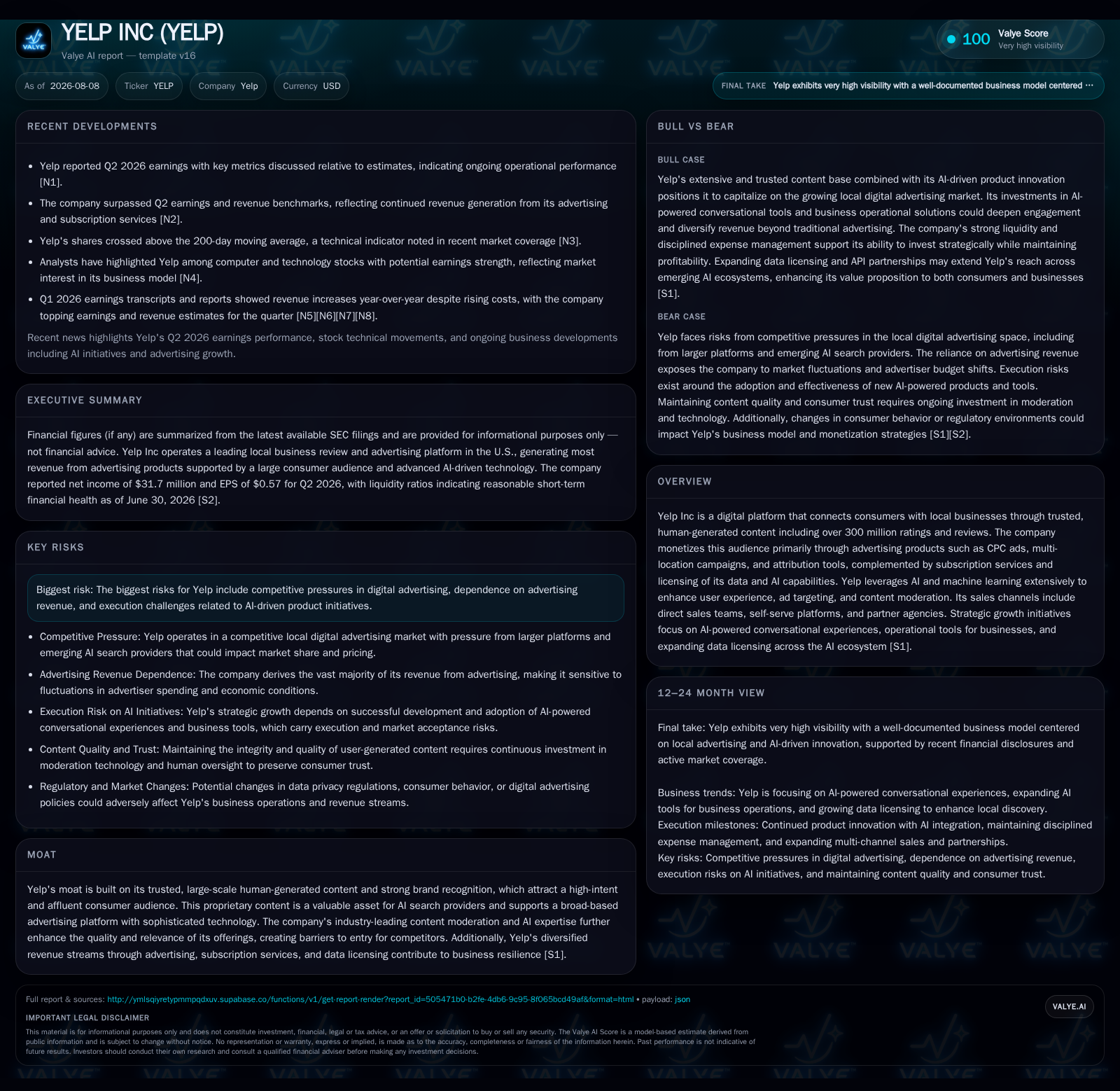
In its Q2 2026 filing, Yelp demonstrated stable advertising revenue and paying advertiser counts amid ongoing macroeconomic pressures impacting local businesses [S2][S3]. The company leverages its competitive moat of over 300 million trusted user-generated reviews to sustain consumer engagement and advertiser retention while expanding diversified revenue streams through subscription services and data licensing to AI search providers [S1]. AI enhancements in ad targeting, attribution, and content moderation improve advertiser ROI and platform trust. Key risks include the sensitivity of local advertising spend to economic cycles, execution challenges in scaling AI initiatives, and competition from integrated platforms such as Google Local Services. Monitoring advertiser growth, ARPU trends, subscription uptake, and AI adoption post-Q2 will be critical for assessing sustained momentum [S2][N1][N2].
Q2 Operating Update Highlights Stable Advertising Demand Amid Macroeconomic Challenges
Yelp’s Q2 2026 results reveal resilience in its core advertising business despite persistent headwinds from inflationary pressures and recession concerns impacting local economies. The company reported stable paying advertiser counts in its Restaurants, Retail & Other (RR&O) segments—areas historically sensitive to economic cycles—indicating steady advertiser retention even as overall market conditions remain cautious [S2][S3]. This stability contrasts with prior period declines attributed to economic uncertainty. Yelp credits its strong brand equity built over two decades through a vast repository of trusted user-generated content exceeding 300 million reviews for sustaining consumer engagement at low traffic acquisition costs. This enables consistent platform traffic that underpins advertiser confidence in campaign effectiveness.
Business Model Anchored on Trusted User Content and Diversified Advertising Solutions
At the core of Yelp’s value proposition is the monetization of its large-scale human-curated local business information. Its extensive network of authentic user reviews fosters consumer trust essential for high purchase intent across diverse categories [S1]. This proprietary content base acts as a competitive moat by reducing reliance on paid traffic sources compared to generalist search engines or less curated directories. Yelp’s advertising portfolio balances cost-per-click campaigns optimized for measurable response with multi-location offerings catering to businesses managing dispersed operations. Sophisticated attribution tools enable advertisers to link digital ads to offline outcomes, enhancing ROI visibility.
Complementing transactional advertising are subscription services providing operational tools such as reputation management and analytics dashboards. These recurring revenue streams diversify income sources while embedding Yelp into daily business workflows beyond marketing spend alone—strengthening customer stickiness and reducing churn risk.
Competitive Environment: Balancing Peer Platforms and Large-Scale Integrated Services
Yelp competes within a landscape that includes peer consumer review sites like TripAdvisor and Angie’s List, which also leverage user feedback to attract consumers and advertisers. Yelp distinguishes itself through advanced content moderation combining AI with human oversight to maintain review authenticity—a critical factor given industry risks around fake or biased submissions. Larger platforms such as Google Local Services and Facebook Marketplace offer integrated discovery experiences combining search, mapping, and social features. While these incumbents benefit from scale advantages, Yelp’s focused expertise in trusted review aggregation remains vital for validating purchase intent.
Adjacent competitors like The Trade Desk provide programmatic ad targeting but lack consumer-facing local listings; thus, Yelp’s integration of advertising technology within a trusted content ecosystem sustains a differentiated offering appealing to advertisers demanding accountability.
AI-Driven Enhancements Bolster Ad Effectiveness and Platform Trustworthiness
Yelp continues embedding machine learning throughout its platform to refine ad targeting accuracy and elevate user experience. Its proprietary research view algorithms analyze billions of data points across hundreds of signals to highlight "recommended" reviews that shape star ratings prominently displayed on business pages while filtering unreliable content [S1]. This selective curation preserves consumer trust crucial for advertiser reputations.
AI-powered attribution tools quantify the conversion path from digital impressions to offline actions—an increasingly important metric in justifying marketing budgets amid competitive spend environments. Beyond internal product innovation, Yelp has begun monetizing its unique verified local business dataset by licensing it to external AI search providers. As voice assistants and chatbots proliferate their reliance on granular local data grows; this diversification reduces dependence on traditional advertising cycles while capitalizing on emerging ecosystem opportunities.
Machine learning also enhances content moderation efficiency by augmenting human efforts without proportional cost increases—supporting operating leverage improvements.
Subscription Growth Supports Recurring Revenue Stability
Subscription offerings delivering operational efficiencies—such as reputation management tools—expand Yelp’s recurring revenue base beyond volatile ad spending [S1]. These predictable cash flows help cushion the impact of macroeconomic fluctuations affecting small- to medium-sized business marketing budgets. Embedding Yelp into daily operational workflows creates switching costs that improve customer retention during periods of cautious spend.
The strategic emphasis on subscription growth aligns with broader industry trends favoring margin-stabilizing recurring fees alongside transactional sales—a dual approach enhancing financial sustainability amidst uncertain economic outlooks.
Watchpoints: Economic Sensitivity, AI Execution Risks, and Competitive Dynamics
Key risks include ongoing sensitivity of local advertising revenues to economic conditions that influence small business spending decisions [S1]. Prolonged downturns could pressure paying advertiser counts or average spend per location.
Execution complexities inherent in scaling sophisticated AI-driven features pose operational risks; balancing automation efficiency with human oversight is vital for preserving brand trust through credible content moderation.
Competition intensifies as large tech firms integrate local discovery into expansive ecosystems offering bundled services that challenge Yelp’s market share.
Post-Q2 Indicators: Tracking Momentum Through Core KPIs
Monitoring monthly active users (MAU) will gauge consumer engagement quality; paying advertiser count trends reflect sales execution effectiveness; shifts in average revenue per advertiser signal pricing or product mix changes; subscription revenue growth indicates successful diversification; adoption rates for new AI-enabled features reveal innovation acceptance—all critical metrics for assessing momentum beyond Q2 [S2][N1][N2]
These KPIs collectively inform whether Yelp can navigate cyclical variability while progressing longer-term structural growth through technological differentiation.
Financial Profile Discussion: Strong Liquidity Enables Strategic Flexibility
As of June 30, 2026, Yelp held approximately $94 million in cash versus modest total debt near $17.6 million resulting in a current ratio around 1.75—a liquidity position providing comfortable short-term funding capacity [F1][S2]. This financial strength supports continued investment in product innovation including AI capabilities and subscription expansion without immediate refinancing concerns. Prudent expense management combined with steady revenue generation underpins confidence in weathering potential demand volatility while pursuing strategic differentiation.
Disclaimer: This is research-only, informational analysis and not investment advice. It may include AI-generated interpretation and general industry context. Always verify important details using primary sources.

Comments