
DaVita Inc. Leverages Network Scale Amid Shifting Dialysis Reimbursements
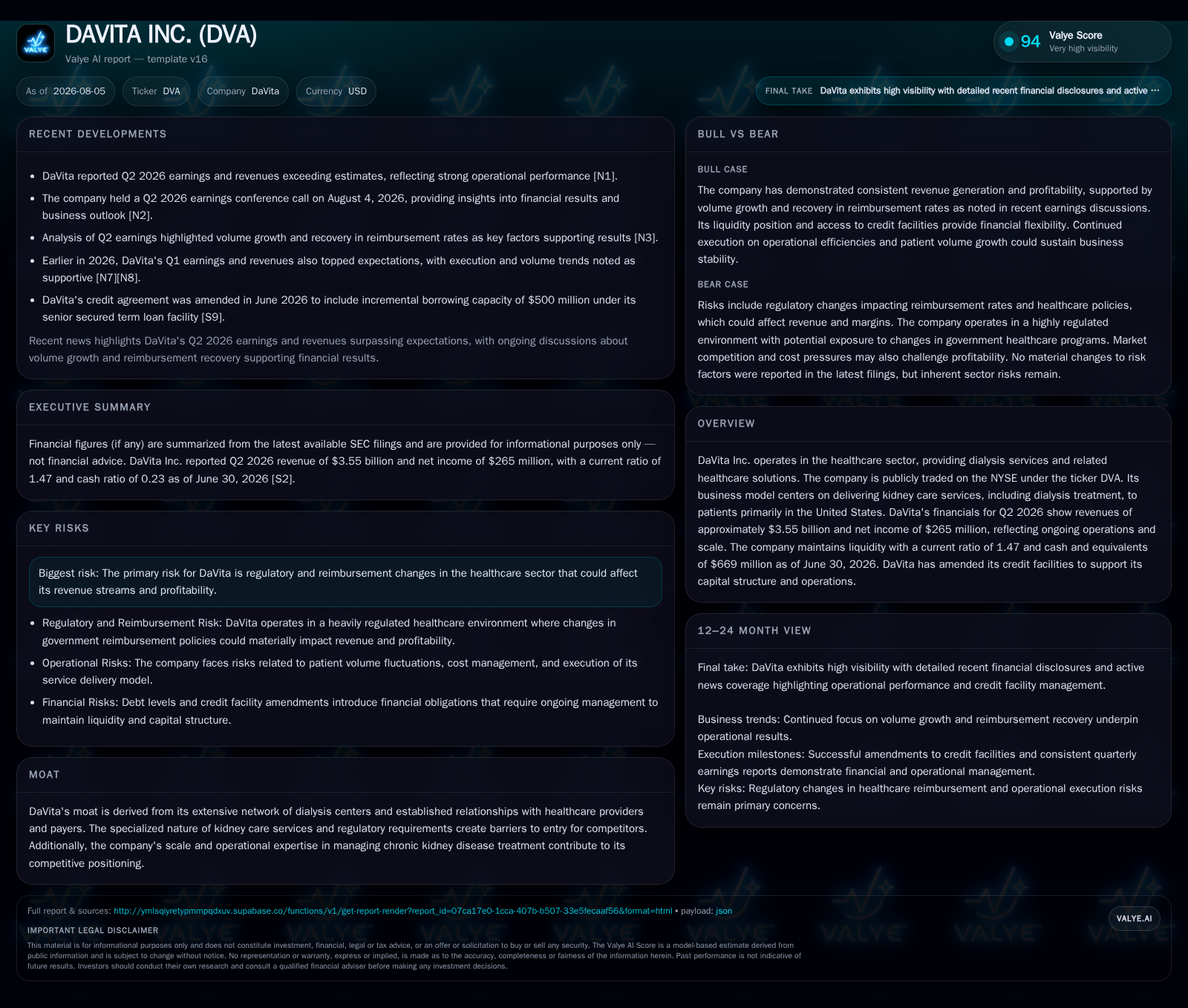
DaVita’s Q2 2026 results reveal stabilized patient volumes and improved reimbursement dynamics, reinforcing its competitive position within the highly regulated dialysis services sector.
In its latest quarterly filing, DaVita reported patient volume growth plateauing but with marked recovery in average reimbursement per treatment, highlighting the critical role of payer mix and operational scale in sustaining revenue momentum. The company’s extensive dialysis center network supports operational efficiency that cushions margin pressures from ongoing regulatory risks. Emerging adoption of home dialysis services presents potential growth avenues amid capital intensity constraints. Financially, DaVita maintains solid liquidity despite substantial leverage, underpinning continued investment capacity.
Second Quarter Patient Volume Stabilizes But Growth Remains Muted
DaVita's Q2 2026 Form 10-Q reveals that patient volume growth—measured by dialysis treatment sessions—largely stabilized after recent fluctuations but remains subdued relative to historical growth patterns [S2]. This plateauing reflects the chronic nature of end-stage renal disease (ESRD) prevalence trends where patient inflows are steady but not accelerating sharply. Given that outpatient dialysis centers rely heavily on consistent patient volumes to spread fixed costs and maintain utilization efficiencies, this modest volume stability underpins revenue resilience but constrains near-term top-line expansion potential.
Because ESRD treatment is a long-duration clinical necessity rather than elective care, patient retention rates remain high, though new patient acquisition is tempered by demographic factors and localized competition. Confirmation of volume recovery beyond current stability would require sustained increases in new ESRD diagnoses or expanded geographic coverage driving same-center patient growth. Conversely, any decline due to alternative therapies or policy shifts toward home dialysis could pressure overall session counts.
Reimbursement Environment Shows Signs of Improvement Driving Revenue Upside
Crucially offsetting muted volume growth, DaVita’s average reimbursement per treatment session improved notably in Q2 2026—primarily driven by incremental uplifts in Medicare reimbursement rates alongside enhanced commercial payer contracts [S2], [S3]. Since government healthcare programs represent a large portion of revenue given the high reliance on Medicare patients in kidney care, even marginal rate improvements translate materially into operating leverage for the company.
The payer mix further evolved positively with slight gains in higher-margin commercial insurance participation which generally reimburses above Medicare levels. This dynamic boosts revenue quality and contributes to margin expansion opportunities. Tracking future shifts in payer mix percentages and any new policy reforms impacting Medicare or Medicaid payments will be critical indicators confirming sustained revenue improvement.
This interplay between stable volumes and rising reimbursement effectively de-risks earnings volatility typically seen from regulatory changes in this sector.
Network Scale and Operational Efficiency Sustain Competitive Moat
DaVita’s substantial network scale—encompassing hundreds of outpatient dialysis centers across diverse U.S. geographies—affords it significant operational advantages versus smaller peers or fragmented providers [S1], [S2]. Economies derived from centralized management systems, standardized clinical protocols, bulk purchasing of expensive dialysis equipment and consumables, and optimized staff-to-patient ratios drive down operating cost per treatment.
This operational efficiency is pivotal because specialized dialysis treatments involve costly machinery that requires regular upgrades amid evolving clinical standards. Scale also enhances risk mitigation by broad geographic distribution minimizing local concentration risks and providing negotiation leverage with payers influenced by regional coverage capabilities.
In comparison to peers such as Fresenius Medical Care—also a large-scale provider—the interplay between DaVita’s network density and clinical quality metrics forms a defensible moat crucial for securing favorable contracts and maintaining patient referrals from nephrology groups.
Broader Industry Trends: Regulatory Risks And Peer Operating Benchmarks
The kidney care industry continues to face persistent regulatory uncertainty centered on Medicare reimbursement adjustments and evolving compliance standards affecting service delivery models [S1]. Proposed rule changes on bundled payment models or quality incentives could impact realized revenues if implemented unfavorably.
Within peer benchmarks, scale remains a dominant determinant for cost-containment ability and negotiating power over payers. Both DaVita and Fresenius invest heavily in care coordination initiatives aligning with broader value-based care trends aiming to improve patient outcomes while containing costs. However, any adverse regulatory shifts can compress margins due to limited pricing flexibility inherent in government program dependence.
Therefore, sustained focus on quality scoring improvements—such as infection reduction and hospitalization avoidance—that influence contract terms with payers is vital for competitive positioning.
Emerging Growth Drivers in Home Dialysis Adoption and Care Coordination
Recent industry developments show increasing traction for home dialysis modalities coupled with telehealth support services as important adjuncts to traditional network centers [S1], [N3]. This evolution addresses patient preferences for convenience and potentially lowers delivery costs but requires upfront capital investment into technology platforms and staff training.
For DaVita, accelerating adoption of home-based solutions expands addressable market share beyond physical centers without equivalent facility capex increases. Furthermore, integrating remote monitoring strengthens long-term retention through enhanced care coordination.
Monitoring the company's strategic investments or partnership announcements tied to home therapies will indicate how effectively it transitions within this changing landscape while managing legacy center operations.
Risks To Monitor: Regulatory Uncertainty And Reimbursement Pressures
Despite operational strengths, DaVita's performance remains vulnerable to external headwinds including potential downward revisions in Medicare payment policies—a principal revenue driver—coupled with competition emerging from novel therapeutic approaches reducing reliance on conventional dialysis services [S1], [S2].
Additional risks encompass labor market tightness elevating staffing costs essential for clinical operations plus compliance burdens raising administrative expenses. Any deterioration in payer contracts or slower-than-expected home therapy uptake could exacerbate margin pressures.
Maintaining rigorous regulatory surveillance alongside continuous clinical quality improvements will be necessary defensive tactics amid these sector-wide challenges.
Upcoming Milestones And Signals To Watch From Payer Negotiations And Patient Trends
Key near-term indicators include results from scheduled negotiations with major commercial insurers that could either solidify or disrupt improving reimbursement trends observed this quarter [S2], [N2]. Seasonal patterns influencing new ESRD diagnoses may also affect subsequent quarter patient volumes thereby altering operational throughput metrics.
Investor attention should focus on quarterly disclosures offering granular segmentation of payer mix changes, same-center patient growth statistics, and updates on home dialysis program expansions as confirmatory signs validating DaVita's strategic execution path.
Financial Profile Discussion: Capital Structure Strength And Liquidity Position
As of June 30, 2026, DaVita reported cash and cash equivalents totaling approximately $669 million juxtaposed against total debt near $10.85 billion resulting in net debt around $10.18 billion; these figures highlight elevated leverage characteristic of capital-intensive healthcare delivery enterprises reliant on durable operating cash flows for servicing obligations [F1]
A current ratio of 1.47 signifies sufficient short-term liquidity positioning for operating needs including working capital commitments related to clinical supplies and payroll [F1]. The recent amendment to credit facilities enabling an incremental $500 million tranche further supports financial flexibility amidst ongoing capex requirements driven by equipment upgrades across its dialysis network [S11], [S13].
While leverage remains material, the stable EBITDA generation capacity tied to recurring outpatient treatment sessions underpins manageable refinancing risk aligned with corporate strategy focused on balancing growth investments against prudent capital stewardship.
This analysis does not constitute investment advice or research views but seeks to provide a detailed industry-informed perspective based on published financial filings and sector knowledge.
Disclaimer: This is research-only, informational analysis and not investment advice. It may include AI-generated interpretation and general industry context. Always verify important details using primary sources.

Comments