
Fuel Tech's Proprietary Emissions Solutions Face Executive Shift Amid Industry Growth
Fuel Tech reports stable liquidity and pursues growth in flue gas conditioning and data center emissions amid CEO transition.
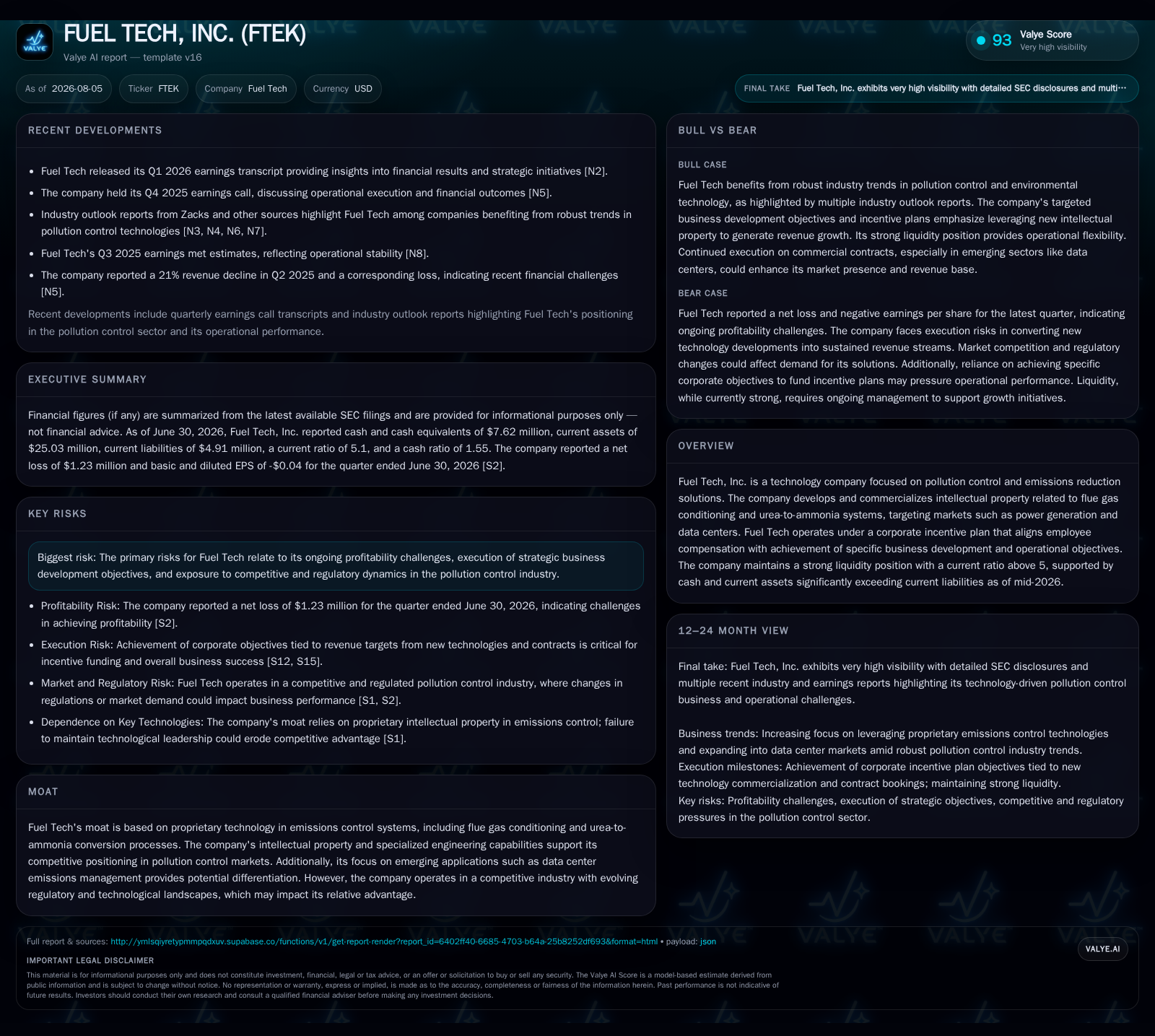
Fuel Tech, Inc. specializes in pollution control technologies including flue gas conditioning and urea-to-ammonia conversion systems for power plants and data centers. The company recently announced the retirement of its CEO, signaling a leadership transition aligned with strategic growth plans in emerging emissions markets. Fuel Tech maintains strong liquidity with a current ratio above 5, supporting ongoing technology commercialization and operational excellence initiatives. Growth hinges on advancing proprietary IP adoption, expanding contracts in data center emissions management, and executing on R&D-driven product development despite industry competitive pressures and regulatory risks.
Recent Operating Update
Fuel Tech’s latest quarterly filing dated August 4, 2026 reveals a noteworthy leadership change: Vincent J. Arnone has announced his retirement as CEO and President effective August 10, 2026 while remaining on the board [S3]. This marks a critical transition point as the company steers its growth strategy during a phase emphasizing commercialization of newly acquired intellectual property (IP) in flue gas conditioning and urea-to-ammonia conversion technologies.
Cash and equivalents stand at $7.6 million [F1], providing operational flexibility vital for funding R&D initiatives and scaling service capabilities in the capital-intensive pollution control market.
Simultaneously, Fuel Tech has formalized a corporate incentive plan tying employee bonuses closely to achieving specific business development milestones including revenue targets from innovation in emissions reduction systems and securing contracts in growing end markets such as data centers [S27]. These objectives underscore an aggressive push to monetize proprietary flue gas conditioning technology through both new project awards and aftermarket sales.
Business Model Overview
Fuel Tech operates primarily in the environmental technology sector focused on industrial air pollution reduction via engineered pollution control systems. Its product portfolio centers on flue gas conditioning equipment that optimizes emission scrubbing efficiency, alongside urea-to-ammonia systems which are integral to selective catalytic reduction (SCR) processes employed by power plants and industrial facilities aiming for regulatory compliance.
Revenue streams stem from direct sales of proprietary technology systems, licensing of underlying intellectual property, engineering design services to tailor solutions to customer specifications, system installation projects, and long-term aftermarket maintenance contracts ensuring performance continuity [S1]. This mix places Fuel Tech solidly in the technology development plus system integration stages of the value chain.
Customer segments include conventional power generation operators who face increasing regulatory scrutiny on NOx emissions as well as expanding new verticals like data centers where environmental footprint management is gaining strategic priority due to energy consumption profiles. Monetization depends on securing multi-year contracts that encompass upfront equipment sales followed by recurring service agreements – both critical for margin stability given project-specific pricing dynamics.
The company employs rigorous internal performance metrics aligned with this model: contract bookings signal pipeline health; order backlog tracks near-term revenue visibility; technology licensing revenues indicate IP monetization success; while customer retention rates reflect ongoing maintenance engagement quality.
Industry Structure and Competitive Positioning
The environmental technology and pollution control industry is shaped by stringent global environmental regulations driving persistent demand for advanced emissions reduction solutions. Fuel Tech’s niche is defined by specialized technical know-how embodied in patented flue gas conditioning technologies and urea-to-ammonia converters essential for SCR compliance frameworks – a moat that provides differentiation against commoditized equipment vendors.
Peers encompass several categories including industrial emissions control manufacturers (e.g., Babcock & Wilcox), environmental engineering service providers (e.g., Evoqua Water Technologies), technology licensors specializing in pollution treatment innovations, as well as chemical suppliers involved in emissions treatment processes. Competition tends to revolve around technological innovation capability, demonstrated regulatory compliance expertise, breadth of service offerings, geographic reach, and scale of installed systems.
Compared with larger peers with diversified end-market exposure or broader product portfolios, Fuel Tech’s specialized IP-focused approach allows targeted penetration but may limit scale advantages or bargaining power in price negotiations. Additionally, rapid technological evolution or tightening regulations could erode competitive advantage if the company fails to keep pace with R&D or certification demands.
Growth Drivers
Key structural growth drivers include increasingly aggressive environmental regulations worldwide that compel industrial operators to upgrade existing pollution control infrastructure or install new systems compatible with evolving standards. The rising carbon footprint awareness among data center operators creates an emergent market segment where Fuel Tech’s tailored emissions management solutions have notable application prospects.
Technological progress facilitating higher-efficiency flue gas conditioning alongside expanded commercialization of urea-to-ammonia conversion enhances the addressable market scope beyond traditional power generation into broader industrial ecosystems.
Government incentives promoting clean technology adoption combined with corporate sustainability commitments fuel replacement cycles of legacy pollution control assets – presenting recurring revenue opportunities through upgrades and aftermarket services. Expanding international presence especially in emerging economies undergoing electrification also supports long-term demand growth potential.
Fuel Tech reinforces these drivers by investing in artificial intelligence tools aimed at optimizing internal workflows across engineering designs and administrative functions [S22], potentially accelerating project turnaround times—a critical KPI given project installation cycle lengths impact how swiftly revenues translate after contract wins.
Risks and Constraints
Fuel Tech’s operating environment includes significant execution risks inherent to complex project installation timelines which could delay revenue recognition or inflate costs if supply chain or labor challenges arise. Regulatory shifts may lead to changes in required emissions standards or compliance deadlines undermining previously forecasted business volumes.
The company must continually innovate IP-based offerings to avoid technological obsolescence given competitor advances or substitutes entering the market. Profitability challenges persist stemming from historically negative operating income levels that highlight cost structure rigidity relative to revenues [F1]
Dependence on capital expenditure cycles within the power generation sector introduces cyclical factors particularly susceptible to macroeconomic downturn impacts reducing industrial activity levels or slowing new infrastructure investments.
Intellectual property litigation risk also remains given the niche technical domain while raw material price volatility (notably chemical inputs associated with urea processing) could pressure margins absent effective hedging strategies.
Customer concentration risks can emerge if key accounts represent outsized fractions of revenue given the bespoke nature of most contracts; thus diversification across end markets underpins sustainable growth profiles.
What To Watch Next
Upcoming milestones include quarterly financial disclosures revealing progress against stated corporate objectives such as achieving incremental revenues targeting $1 million from newly commercialized IP products and another $1 million from expanding data center contracts in 2026 [S27]. Metrics around order backlog evolution will provide early signals of sustained demand trajectory whilst monitoring new customer acquisition rates gauges market acceptance of technology offerings beyond incumbent segments.
Tracking execution efficiency improvements linked to AI tool deployments offers insights into scalability enhancements potentially unlocking operating margin expansion windows over time. Leadership transition effectiveness post-CEO retirement constitutes an organizational risk factor but also an opportunity depending on strategic vision continuity championed by successor executives.
Additionally, monitoring regulatory developments influencing SCR component requirements either domestically or internationally will impact opportunity size estimation essential for demand forecasting accuracy.
Financial Profile Discussion
Fuel Tech exhibits a conservative balance sheet stance with no significant leverage exposure evident currently; the closest proxy total debt reported stands below $1 million though last updated several years prior [F1]
While top-line development specifics remain sparse in recent filings owing to business mix complexity, operating income has remained negative indicating continued investment phase pressures [F1]. R&D spending aligned with stakeholding compensation schemes points toward a disciplined approach balancing innovation needs against cost containment mandates [S27].
Capital expenditures are likely modest relative to revenues considering the company's engineering-heavy rather than asset-heavy model emphasizing intellectual property licensing plus outsourced manufacturing integration rather than owning large-scale physical production facilities directly.
Monitoring future quarterly margins alongside cash flow generation trends will be critical evaluative criteria signaling pathway viability toward sustainable profitability consistent with peer benchmarks operating under similar environmental technology licensing models.
This analysis synthesizes publicly available filings through August 2026 without offering investment research views or price targets. It focuses exclusively on interpreting Fuel Tech's positioning within its sector dynamics supported by factual SEC disclosures.
Disclaimer: This is research-only, informational analysis and not investment advice. It may include AI-generated interpretation and general industry context. Always verify important details using primary sources.

Comments