
Booking Holdings Strengthens Financial Position and Platform Scale in Q2 2026 Amid Continued Travel Recovery
Second-quarter results highlight robust booking trends and a well-hedged financial structure supporting global expansion.
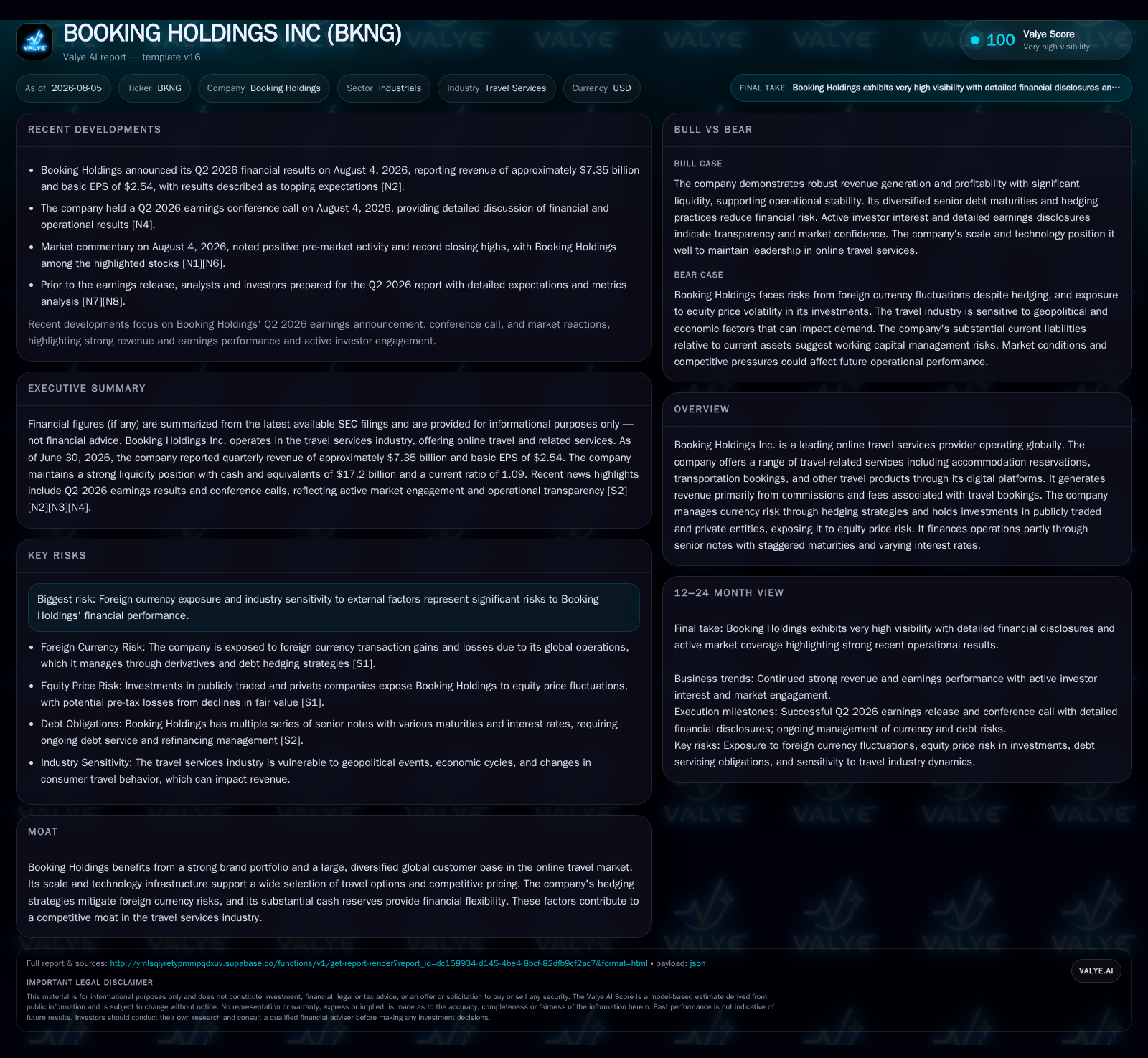
Booking Holdings reported strong second-quarter earnings, surpassing revenue estimates, driven by solid gross booking value growth and maintained take rates, reflecting resilience in travel demand. The company's marketplace intermediates between travelers and providers worldwide, monetizing via commissions on accommodation, transportation, and ancillary bookings. With a diversified debt maturity schedule and active currency hedging, Booking manages foreign exchange volatility while investing in platform technology and mobile capabilities to support customer acquisition and retention. Key risks include sensitivity to geopolitical events and competitive pricing pressures. Upcoming milestones focus on sustaining booking volume growth and margin expansion amid evolving travel patterns.
Latest Operating Update Highlights
Booking Holdings Inc.'s second-quarter 2026 results reflect a continuation of the post-pandemic recovery in global travel demand. Revenue surpassed analyst consensus driven chiefly by high gross booking value (GBV) across its accommodation reservations and transportation products segment [S2][N1]. Management emphasized stable take rates—commission percentages on bookings—and improved conversion rates on digital platforms during the quarter. This suggests that the company leverages its scale effectively to attract customers during competitive pricing pressures. Importantly, Booking reinforced its foreign currency hedging stance to insulate against exchange rate swings mainly related to Euro exposures, an ongoing complexity given its global footprint [S1].
The company's recent disclosures also show an extensive laddered debt profile spanning from senior notes maturing as soon as late 2026 through mid-2040s with fixed coupons ranging approximately from 0.5% to over 4%, underscoring strategic financing diversity that supports liquidity management without near-term refinancing pressure [S3]
Business Model: Intermediary Marketplace with Commission-Driven Revenue
Booking Holdings operates as a dominant intermediary in the online travel services sector by connecting travelers with suppliers including hotels, airlines (through partners), car rental firms, and other ancillary services via digital platforms like Booking.com. The business generates primary revenue from commissions embedded within booking transactions plus additional fees for value-added services. Revenue mechanics pivot on three KPIs: gross booking value (the total dollar value of all transactions), take rate (the commission percentage applied), and conversion rate (the efficiency of turning platform visits into paid bookings).
Scale advantages come from vast inventory aggregation that improves price competitiveness and choice diversity for consumers globally; this platform effect enhances customer acquisition at efficient costs while driving repeat usage through loyalty programs and tailored marketing. Mobile bookings represent an increasing share of volume reflecting consumer preferences toward convenience and instant access [S1]
Operating margins benefit from low incremental costs per additional booking once platform infrastructure is established but face pressures if marketing spending rises disproportionately or if new regulatory requirements increase compliance costs.
Industry Structure and Competitive Positioning
The online travel services industry is characterized by strong network effects where scale enables better supplier allocations and dynamic pricing capabilities. Booking competes alongside peers such as Expedia Group and Trip.com Group who offer similar OTA-centric models alongside metasearch engines like Trivago that focus more on traffic aggregation than direct bookings.
Booking Holdings’ competitive edge resides in its robust technology stack supporting seamless search-to-book flows, extensive global supplier relationships allowing attractive inventory breadth, strong brand portfolio enhancing trust, and sophisticated currency hedging mitigating volatile revenue impacts from geographic diversity.
The industry’s sensitivity to external macroeconomic variables—like geopolitical conflicts or economic downturns—impacts consumer confidence in travel plans; thus, maintaining flexible cost structures alongside growth investments is vital for sustaining competitiveness.
Growth Drivers
Driving future growth are several structural factors: accelerating adoption of mobile travel booking interfaces offers enhanced consumer convenience boosting conversion rates; continued geographic expansion into emerging markets creates untapped addressable segments; improvements in data analytics allow more personalized marketing increasing customer lifetime value; partnerships with travel suppliers expand ancillary service offerings augmenting wallet share per customer; finally, the rebound from prior travel disruptions establishes a higher baseline demand environment [S1].
Technological innovation remains central: investments to reduce platform latency enhance user experience directly impacting conversion rates—a critical KPI given the high visitor volumes. Increasing mobile penetration similarly correlates with higher repeat customer rates.
Risks and Constraints
Key risks facing Booking include travel demand cyclicality tied to macroeconomic shifts or geopolitical events that can abruptly reduce transaction volumes. Industry competition compels continuous innovation while putting pressure on take rates as OTAs compete on price-based commissions or lower fees negotiated with suppliers. Moreover, reliance on third-party suppliers introduces risks if supply chain disruptions or regulatory changes restrict inventory availability or alter pricing models.
Technological outages or cybersecurity incidents present operational hazards potentially impairing user experience or breaching consumer data protections.
Finally, although liquidity appears sufficient currently—with cash around $17.2 billion cushioning $20.3 billion total debt—the maturity profile requires ongoing monitoring especially for bonds maturing in the near term [F1]
What to Watch Next
Investors should track upcoming quarterly reports for signs of sustained GBV growth alongside stable or improving take rates as evidence of pricing power resilience. Conversion rate trends will reveal effectiveness of platform upgrades relative to growing competition. Currency translation effects tied to Euro exchange rates offer further insight into risk management efficacy.
Monitoring the evolution of mobile bookings penetration will indicate how well Booking adapts to shifting consumer behavior essential for long-term retention metrics. On the financial front, progress on operating margin expansion despite incremental marketing investment will be critical to validating scalability assumptions.
Financial Profile Discussion
As of June 30, 2026, Booking Holdings held approximately $17.2 billion in cash & equivalents against $20.3 billion in total debt resulting in net debt near $3.1 billion with a current ratio around 1.09 indicating adequate short-term liquidity [F1]. The company’s diverse senior notes issuance dates stretch out over two decades with fixed interest coupons offering predictability in interest expenses while mitigating refinancing risk over successive years [S3].
Foreign currency hedging practices closely match Euro-denominated net investments with corresponding denominated debt acting as a natural hedge limiting equity volatility caused by currency movement [S1]. This strategic capital structure balance contributes to overall financial stability.
Meanwhile, operating income recorded at year-end 2025 stood robustly at about $8.8 billion reflecting efficient business leverage within the online marketplace model though net income figures lag historical levels partly due to non-recurring expenses related to currency fair value adjustments and investment holdings marked at fair value fluctuations [F1][S1]
Overall financial flexibility appears strong supporting continued investments in technology platforms enhancing user experience while managing cyclical headwinds.
This analysis synthesizes recent quarterly filings and industry context without investment research views or projections beyond publicly available disclosures.
Disclaimer: This is research-only, informational analysis and not investment advice. It may include AI-generated interpretation and general industry context. Always verify important details using primary sources.

Comments