
Core Molding Technologies Faces Market Cyclicality and Customer Transition Headwinds in 2026
Q2 2026 results reflect ongoing demand shifts in medium/heavy trucks and power sports amid program transitions with major OEMs.
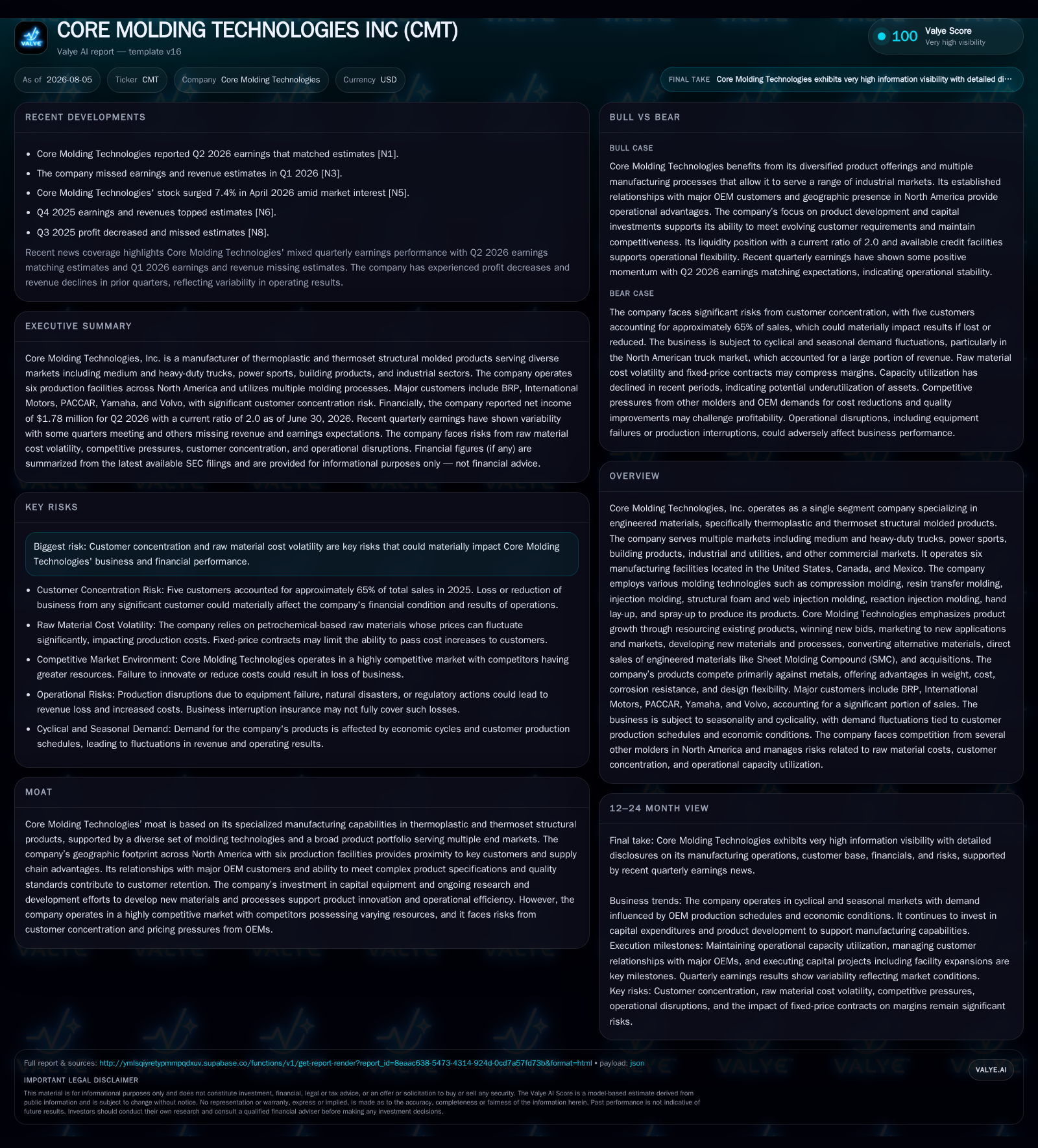
Core Molding Technologies Inc. reported Q2 2026 results in line with expectations but continues to navigate a challenging operating environment marked by the cyclical downturn in its largest market, North American medium and heavy-duty trucks, and customer program transitions notably with Volvo. The company’s broad set of molding technologies and geographic footprint support exposure to multiple sectors including power sports, building products, and industrial markets. While tooling project sales growth partially offset declines in product sales, the overall revenue contraction highlights the impact of fixed manufacturing cost leverage and raw material cost volatility. Core Molding's well-capitalized balance sheet and contractual raw material pass-through mechanisms provide some financial stability against cost fluctuations.
Recent Operating Update
Core Molding Technologies announced second quarter financial results for the period ended June 30, 2026, reporting earnings broadly consistent with analyst expectations despite a decline in net income compared to prior periods [S2][N1][N3]. The quarter’s performance reflects continued challenges stemming from softness in the company's largest market—medium and heavy-duty trucks—where demand remains cyclical and sensitive to broader economic conditions. Additionally, a notable transition of business away from existing programs with Volvo toward new programs that Core Molding does not support has materially impacted sales volumes [S1][S14].
Tooling sales surged significantly in 2025, rising to $41.6 million from $11.3 million the prior year due to new program launches; management anticipates tooling-to-product revenue mix will remain stable through 2026 amidst incremental one-time costs related to their Mexico operations expansion and succession planning initiatives primarily recorded in SG&A expenses [S1][S23]
Business Model Analysis
Core Molding Technologies operates as a single segment engineered materials manufacturer specializing in both thermoplastic and thermoset structural molded products tailored largely for OEMs supplying the medium/heavy truck, power sports, building products, industrial utilities, and other commercial markets [S1]. Revenue generation arises from two principal sources: recurring product sales of molded components made through various molding technologies (compression, injection, resin transfer) across six facilities strategically located in the U.S., Canada, and Mexico; alongside project-based tooling sales linked to new program launches involving molds, assembly equipment, and associated tooling assets.
The company's client base consists primarily of OEMs requiring engineered plastic parts that substitute metal components for benefits such as corrosion resistance, lighter weight, design flexibility, and cost advantages over metals. Sales contracts are typically structured around long-term supply agreements often accompanied by fixed-price or pass-through clauses addressing raw material cost fluctuations—a critical factor given resin price volatility inherent in plastics manufacturing [S1][S14]. Tooling projects constitute irregular but sizable inflows tied to engineering development cycles preceding production ramp.
Operational performance is strongly influenced by manufacturing efficiencies (scrap rates, on-time delivery), fixed manufacturing cost absorption relative to volume fluctuations driven by cyclic end markets (notably trucking), and success at launching complex new programs that feature intricate mold development sequences necessitating phased ramp-up periods characterized by start-up inefficiencies affecting margin profiles [S1][S23]
Industry Structure and Competitive Position
Operating within the engineered materials industry focused on structural plastics manufacturing, Core Molding competes among a cohort of firms leveraging a spectrum of thermoset/thermoplastic molding technology suites to respond flexibly to OEM product design needs across commercial vehicle and industrial sectors. Peer companies differentiate themselves through molding press breadth/capacity deployments, geographic proximity to key customers facilitating just-in-time supply dynamics, R&D investments fostering novel materials or processes (e.g., Sheet Molding Compound formulations), and tooling development expertise.
Core Molding’s geographic footprint—six manufacturing sites distributed across North America—facilitates servicing major OEM hubs while optimizing supply-chain resilience amid potential trade policy shifts or geopolitical disruptions. However, customer concentration remains pronounced with five clients accounting for approximately 65% of total sales; Volvo’s exit from legacy supply programs exemplifies the risk profile tied to reliance on a handful of large OEMs whose competitive bidding or product sourcing decisions can materially impact volumes [S11]
Raw material procurement exposes margin variability risks typical within plastics compounding industries due to resin pricing trends; however, contractual arrangements enabling price adjustments partially mitigate this volatility. Manufacturing fixed costs create operating leverage effects amplifying profitability swings during volume contractions or expansions—a salient factor given the trucking sector's cyclical nature which represented about 44% of product revenues in 2025 [S1], implicating sensitivity to economic cycles influencing freight demands.
Growth Drivers
Future growth catalysts for Core Molding likely stem from:
- Incremental wins on new structural plastic components replacing metal parts as OEMs emphasize weight reduction and corrosion-resistance initiatives enhancing fuel economy compliance.
- Expanding tooling/project sales aligned with new product introductions drives episodic revenue spikes complementary to recurring product volumes.
- Geographic expansion efforts including ongoing capacity investments within Mexico production facilities aim to enhance customer service capabilities while optimizing cost structures.
- Diversification into adjacent end markets such as building products and power sports may reduce cyclicality exposure blended into total revenue streams.
- R&D innovations around material formulations and molding process efficiencies facilitate deeper customer integration enabling differentiation against competitors reliant on more traditional technologies.
These drivers depend substantively on Core Molding’s operational execution during new program launches which inherently carry start-up risks but also provide opportunities for margin accretion upon achieving scale production efficiencies [S1]
Risks and Growth Constraints
Primary risk factors shaping Core Molding’s near-term outlook include:
- High customer concentration where loss or non-renewal from a top client could exert outsized impact on volumes given lack of broad diversification beyond five major accounts comprising nearly two-thirds of sales [S11].
- Ongoing raw material cost volatility that can compress gross margins if contractual pass-through mechanisms are delayed or partial amidst rapidly changing resin market prices [S14].
- Cyclicality endemic to the medium/heavy truck sector that exposes revenue streams to macroeconomic fluctuations affecting freight tonnage demand causing corresponding swings in OEM production levels.
- Operational challenges inherent in launching complex new production programs that could generate start-up inefficiencies negatively affecting margins until processes mature.
- Increased competition from alternative materials including metals suppliers or other engineered plastics firms which may reduce pricing power or contract renewals.
- Potential supply chain disruptions related to geopolitical events emphasized by monitoring tensions involving Iran which could raise input costs or constrain availability despite existing mitigation contracts [S1].
What to Watch Next
Investors and analysts should monitor several key developments moving forward:
- Quarterly bookings momentum particularly new program wins versus losses linked to transitioning OEM business such as Volvo’s legacy volume exit.
- Progress updates on Mexico expansion including capital investment pacing and impact on SG&A expenses as temporary lease overlaps conclude.
- Raw material cost trends relative to contract pricing adjustments reflected in gross margins indicating effectiveness of pass-through mechanisms.
- Manufacturing operational KPIs like scrap rates, defect incidence, capacity utilization, and on-time delivery rates reflecting efficiency improvements especially during early phase launches.
- Revenue mix evolution between tooling/project sales versus base product sales signaling program pipeline health.
- Balance sheet liquidity dynamics maintaining current ratio near 2 with ample cash reserves supported by zero debt as of latest quarter enhancing financial flexibility if downturns deepen [F1]
Financial Profile Discussion
As of June 30, 2026, Core Molding enjoyed a strong liquidity position highlighted by $12.13 million in cash with no outstanding debt recorded on its balance sheet. Current assets exceeded current liabilities approximately twofold yielding a current ratio near 2x which underscores adequate working capital coverage supporting ongoing operations amid volatile market environments [F1]. This liquid profile supports financing ongoing capital expenditure plans totaling approximately $25-$30 million projected for 2026 focused chiefly on expanding Mexican plant capacity alongside modernization efforts across sites. Incremental one-time costs related to facility relocations and overlapping leases during expansion contributed notably to SG&A expenses during early 2026 but are expected to normalize later within the year [S1][S23].
The company's ability to generate positive operating income despite revenue declines reflects disciplined cost management though full margin recovery depends heavily on cycling through major truck industry fluctuations while mitigating the impacts of raw material pricing anomalies via contractual pass through clauses. Continued cash flows derived from recurring product sales supplemented by episodic tooling revenues underpin steady financial footing enabling Core Molding to maintain investment-grade liquidity metrics despite external cyclicality headwinds.
This analysis integrates Core Molding Technologies' recent filings alongside industry dynamics pertinent to engineered structural plastics manufacturing serving cyclical industrial end markets. It refrains from forward-looking projections absent explicit guidance while contextualizing operating challenges tied to end-market volatility and customer transitions currently influencing corporate performance outcomes.
Disclaimer: This is research-only, informational analysis and not investment advice. It may include AI-generated interpretation and general industry context. Always verify important details using primary sources.

Comments