
Westrock Coffee Balances Vertical Integration and Innovation Amid Margin Pressures
Westrock Coffee’s latest quarter reveals margin challenges despite strategic supply chain integration and product innovation initiatives.
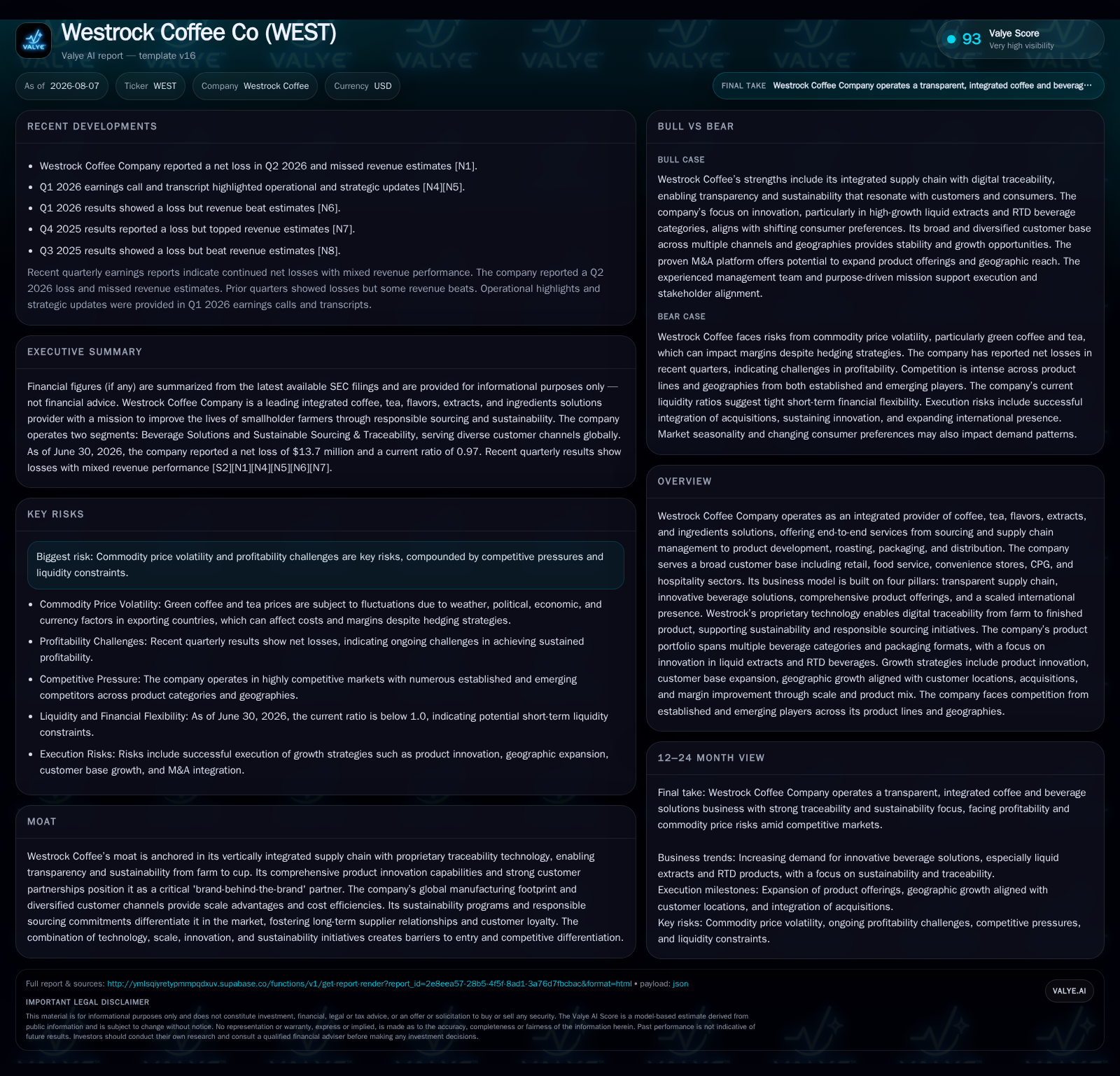
Westrock Coffee Company reported a Q2 loss and missed revenue estimates as it navigates commodity volatility and margin compression within the integrated coffee and beverage ingredients sector. The company leverages a vertically integrated model incorporating proprietary digital traceability technology to serve a diversified blue-chip customer base, but faces margin pressures intensified by rising input costs. Growth opportunities revolve around expanding its liquid extracts and ready-to-drink beverage offerings, geographic penetration alongside global customers, and sustaining innovation-driven private label relationships. Liquidity metrics reflect tight working capital management amid elevated leverage, underscoring the importance of operational execution and cost efficiencies going forward.
Recent Operating Update: Q2 Results Highlight Margin Pressures
Westrock Coffee Company disclosed its financial results for the second quarter ended June 30, 2026, reporting a net loss that also reflected missed revenue estimates relative to expectations [S2][N1]. This shortfall signals continued pressure on the company’s ability to navigate volatile commodity costs—primarily green coffee prices—and its effect on input costs during an intensely competitive food and beverage ingredients landscape. While exact revenue figures are not detailed here, the miss indicates challenges converting volume or pricing power into top-line growth.
Marginal pressures indicate that Westrock’s vertically integrated supply chain model—which includes sourcing raw materials directly from smallholder farmers through to roasting, packaging, and distribution—is currently contending with industry-wide inflationary trends impacting cost of goods sold (COGS). This underscores the importance of balancing sustainable pricing strategies with customer retention in key channels such as retail and food service [S2][N1]
Business Model: Integrated Coffee & Beverage Solutions With a Focus on Transparency
Westrock operates as an integrated provider spanning coffee bean sourcing, supply chain management, product development, roasting operations across North America and Asia (notably facilities in North Carolina, Arkansas, and Malaysia), packaging services including contract manufacturing of private label products, and distribution to diverse customer channels including CPG companies, convenience stores, hospitality groups, restaurant chains, and retail outlets [S1].
Revenue is generated primarily via sales of coffee (whole bean and ground), tea products (hot tea and iced tea), flavors/extracts used in beverages like cold brew or RTDs (ready-to-drink), alongside finished beverage products such as bottled or canned RTDs [S1][S19]. Importantly, Westrock is positioned as a 'brand-behind-the-brand' partner where it collaborates closely with leading brands throughout product conception—to align with consumer trends—through manufacturing roll-out and distribution logistics. Value-added services include customer-specific product innovation driven by proprietary consumer insights and end-to-end supply chain management providing traceable sourcing
A key differentiator is Westrock’s proprietary technology platform enabling digital traceability from farm origin through processing to finished goods. This capability bolsters sustainability commitments by confirming responsible sourcing practices—a material selling point for large brand customers sensitive to environmental social governance (ESG) concerns while also fostering loyalty among smallholder farmers who benefit economically from these programs [S1].
Industry Structure & Competitive Position
Within the broader Food and Beverage Ingredients & Solutions industry—a sector characterized by vertical integration from commodity sourcing to finished goods—Westrock competes with ingredient manufacturers like J.M. Smucker Company focusing on coffee segments; contract beverage manufacturers specializing in private label or RTD products; larger diversified consumer packaged goods companies like Nestlé; as well as private label specialists such as B&G Foods or TreeHouse Foods.
Westrock’s business model leverages vertical integration providing potential scale advantages in procurement costs and manufacturing efficiency while its traceability technology offers a competitive moat less easily replicated by peers dependent on less transparent supply chains. Its multi-segment customer reach—including retail grocery chains through private label contracts—enables it to capture diverse demand drivers from everyday coffee consumption to premium beverage trends. However, scale remains below some larger multinational peers which limits bargaining power somewhat in ingredient procurement amid commodity price swings [Industry Knowledge Layer; S1][F1].
Its manufacturing footprint supports this integrated capability with plants optimized for both extract concentrates (critical for RTD innovation) as well as full-cycle roasting/packaging operations enabling breadth of product formats (bags to pods to single-serve cups) meeting dynamic channel needs.
Growth Drivers
Key growth vectors stem from:
Product Innovation: The company places significant emphasis on developing new beverage solutions tailored to evolving consumer tastes—the liquid extracts category (e.g., cold brew concentrates) represents one of the best near-term expansion prospects due to accelerating RTD demand globally. Leveraging proprietary insights allows Westrock to nurture long-term collaborations feeding a steady pipeline of innovations at scale [S1][S19].
Customer Base Expansion: Westrock targets blue-chip brand customers present in multiple channels worldwide but notably has low penetration internationally compared to U.S. footprints. Following these customers into new geographic markets thus presents a substantial cross-selling opportunity leveraging existing relationships [S19].
Channel Diversification: Serving retail grocery private labels alongside foodservice operators allows dual growth avenues benefiting from rising specialty coffee consumption globally plus post-pandemic hospitality sector recovery.
Technological Leadership in Traceability: As consumers increasingly demand transparency about ingredient origins tied with sustainability practices, Westrock’s digital traceability system strengthens supplier partnerships internally while enhancing brand pull externally.
Acquisition Potential: Management notes a proven M&A track record intending to augment portfolio breadth strategically; though details remain undisclosed currently [S1].
Risks & Watchpoints
Several risk factors could impede growth or margin recovery: - Commodity Price Volatility: Fluctuations in green coffee prices have direct impact on raw material costs [S1][S11]. Although vertical integration provides purchasing advantages versus spot market exposure alone, sustained inflationary input costs threaten gross margins unless offset by raising prices without losing volume share
Supply Chain Disruptions: Global agricultural sourcing faces risks related to weather events or political instability that could disrupt raw material delivery schedules affecting order fulfillment lead times.
Competitive Dynamics: Intensified competition from large CPG players vertically integrating their offerings or expanding private label portfolios can erode pricing power.
Regulatory Compliance Burden: Operating under FDA Good Manufacturing Practices supplemented by GFSI audits implies ongoing compliance cost escalation amidst evolving food safety requirements.
Technology Adoption Risks: The efficacy of the company’s proprietary traceability tech depends on deployment success across suppliers/customers; failure could limit differentiation benefits.
Liquidity & Leverage Constraints: Capital investment demands for capacity expansions coupled with elevated debt levels may constrain operational flexibility during downturns or prolonged margin pressure periods.
What To Watch Next
Upcoming milestones important for validation of strategic path include:
- Monitoring quarterly results for improved margin trajectory supported by pricing initiatives or volume mix shifts favoring higher-margin liquid extracts/RTD beverages.
- Progress reports on international expansion efforts capturing additional locations of existing blue-chip partners.
- Announcements of new product launches or line extensions indicating successful market responsiveness.
- Supply chain resilience metrics such as inventory turnover or order lead times reflecting operational efficiency.
- Updates on sustainability program participation rates evidencing supplier engagement enhancements.
- Any refinements in credit facilities addressing leverage ratios or liquidity cushions relevant given recent covenant amendments.
Financial Profile Discussion
As of June 30, 2026,[F1] Westrock held approximately $38 million in cash and equivalents against current liabilities slightly above $341 million yielding a current ratio near unity at 0.97—indicating tight short-term liquidity conditions demanding vigilant working capital management. Total debt stood near $444 million as of December 31, 2025,[F1] implying significant leverage consistent with capital-intensive manufacturing operations invested in extract production capacity expansion.[F1]
The company recently completed Amendment No. 6 to its Credit Agreement extending maturity dates largely into late 2028 while reducing leveraged covenants back toward more normalized thresholds after an interim covenant relief period ended mid-2026.[S20] This reflects management’s focus on maintaining financial flexibility amidst cyclical earnings volatility inherent to commodity-linked industries.[S20]
Reported operating income was negative as of year-end 2025 at approximately -$45 million,[F1] mirroring pressures experienced across the quarter. Improvement will depend heavily on successful margin expansion through scale efficiencies paired with favorable product mix evolution towards higher-margin extracts segments.[F1][S2]
In sum, Westrock Coffee operates within a challenging but structurally attractive segment supported by differentiated vertical integration enriched by proprietary technology enabling sustainable sourcing transparency—qualities underpinning its moat against peers lacking such end-to-end control or innovation focus. The company must manage commodity cost volatility prudently while executing geographically distanced growth strategies alongside deepening client engagements through innovative beverage solutions tailored for evolving consumer preferences favoring specialty coffee formats like cold brew and RTDs. Financial leverage requires ongoing monitoring given tight liquidity ratios amid capital expenditure requirements.
Disclaimer: This analysis is provided solely for informational purposes without investment advice or research view.
Disclaimer: This is research-only, informational analysis and not investment advice. It may include AI-generated interpretation and general industry context. Always verify important details using primary sources.

Comments