
10x Genomics Advances Multiomics Ecosystem with Proteintech Acquisition Amid Stable Instrument Base Growth
Q2 results highlight consumable-driven revenue resilience and strategic expansion in proteomics capabilities.
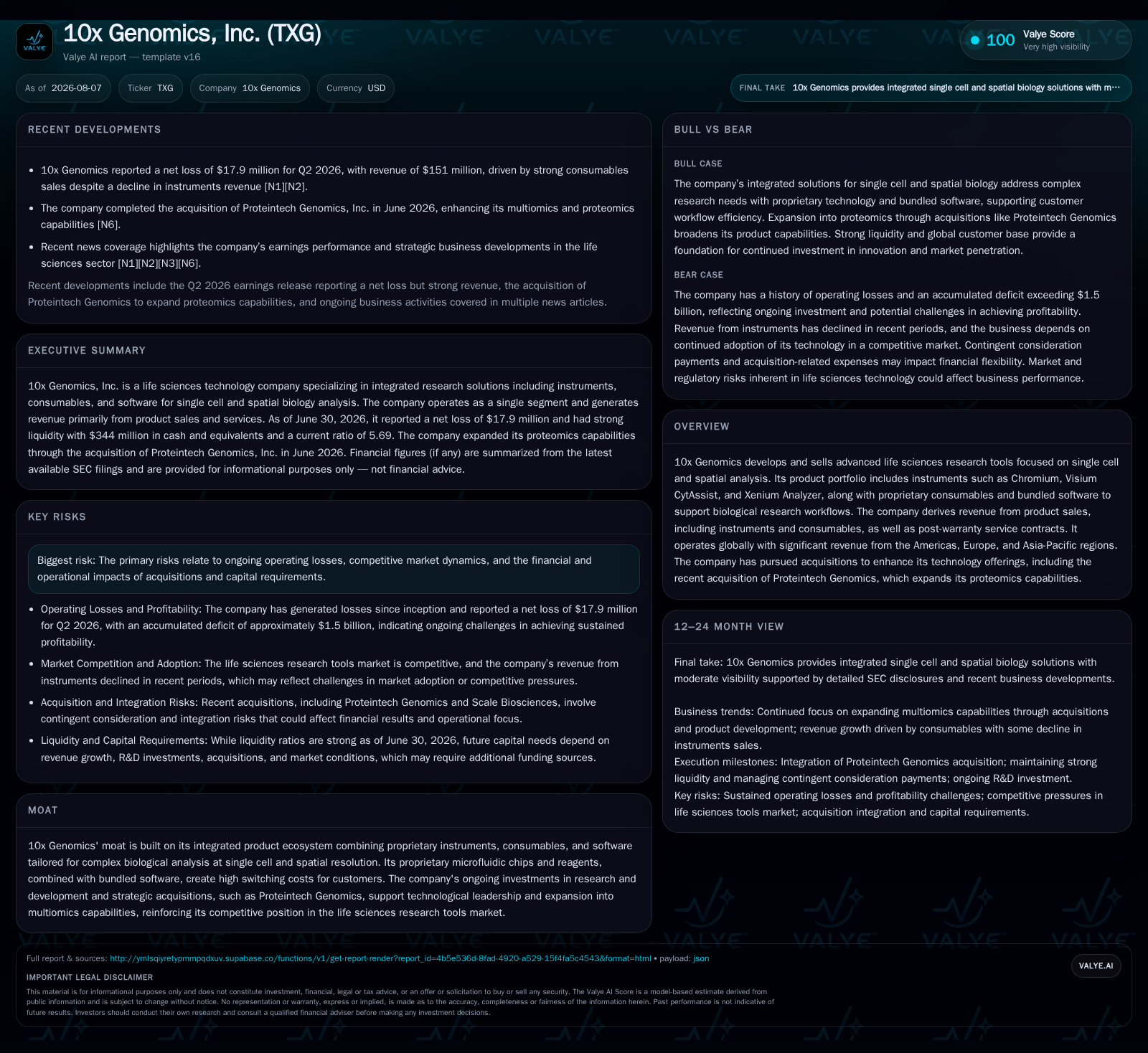
10x Genomics reported modest top-line growth in Q2 2026, driven by steady consumables usage despite declines in non-recurring license revenues from prior patent settlements. The company's integrated single cell and spatial analysis platform maintains a stable installed instrument base, supporting recurring consumables sales. A key development was the acquisition of Proteintech Genomics, expanding 10x’s multiomics offering into high-plex proteomic solutions, a strategic complement to its core microfluidics-enabled technologies. While operating losses persist due to continued R&D and integration costs, the company's financial position remains robust with strong liquidity. Navigating competitive pressures and sustaining innovation through acquisitions remain critical growth levers.
Recent Operating Update
Gross margin improved to approximately 74% in the quarter from 72% last year, mainly due to better product mix favoring consumables alongside reduced inventory write-downs and warranty costs [S2]. This margin expansion indicates operational leverage potential as the installed base stabilizes and consumables consumption grows. Operating expenses show typical R&D investment sustaining innovation efforts but at slightly reduced levels compared to prior periods.
A material corporate event during this period was the acquisition of Proteintech Genomics (PTG) for $6.1 million in cash, completed in June 2026 [S27]. PTG specializes in high-plex proteomic solutions compatible with 10x’s established single cell and spatial platforms — this acquisition strategically extends 10x Genomics' multiomics portfolio into proteomics workflows complementing its microfluidic and spatial transcriptomic offerings. Concurrent supply agreements with Proteintech further underscore a long-term partnership to integrate proprietary reagents into biological workflows spanning genomics and proteomics dimensions [S27],[S28].
Business Model Analysis
10x Genomics operates a vertically integrated business model focusing on high-resolution biological analysis through single cell and spatial platforms. Its revenue streams are primarily derived from:
- Capital instruments: The company sells advanced instruments including Chromium (single cell), Visium CytAssist, and Xenium Analyzer for spatial biology research.
- Consumables: Proprietary microfluidic chips, slides, reagents, and other disposables form the recurring revenue backbone through ongoing experiment cycles.
- Software: Bundled proprietary analysis software guides customers from sample preparation through data visualization.
- Service contracts: Post-warranty maintenance agreements add predictable recurring revenue.
This integrated instrument-consumable-software ecosystem builds substantial switching costs due to unique reagent chemistries combined with workflow-specific software analytics tailored for complex biological data interpretation [S1],[S27]. As instruments are typically long-term capital purchases by academic labs or pharmaceutical R&D centers, growth usually relies on expanding the installed base alongside rising consumable usage per instrument — effectively a "razor-and-blades" model common among research tool providers.
The recent entry into proteomics via PTG enhances this multiomics value proposition by broadening assay capabilities beyond transcriptomics into protein-level measurements within spatial contexts — an emerging priority for life sciences researchers seeking holistic cellular insights. Such technology acquisitions are instrumental in maintaining differentiation against competitors like Illumina (sequencing), Fluidigm (microfluidics), and NanoString Technologies (spatial biology).
Industry Structure and Competitive Position
Operating upstream in the life sciences research value chain, 10x Genomics targets academic institutions, biotech/pharma R&D laboratories, and contract research organizations requiring single-cell resolution analytical tools. This market segment is R&D driven with high technical complexity resulting in sustained demand for innovative solutions enabling novel biological discoveries.
Competition involves both instrument manufacturers offering single-cell or spatial platforms and suppliers of reagents/consumables plus software providers specializing in bioinformatics workflows. Unlike pure software or sequencing players, 10x’s moat centers on tightly integrated hardware-reagent combinations protected by patents on microfluidic chip designs and proprietary chemistries coupled with bundled software tailored for end-to-end biological workflows.
This multi-faceted differentiation discourages vendor switching common among academic users sensitive to new assay validation burdens. Additionally, recurring consumable attach rates provide volume visibility post-installation while licensing arrangements add incremental yet volatile royalty streams linked to third-party IP arrangements [S2],[S10].
Growth Drivers
Several structural factors underpin near-to-medium term growth prospects:
- Continued adoption of single cell sequencing and spatial transcriptomic techniques across biomedical research fosters steady instrument demand.
- Expansion into multiomics (proteogenomics) research applications driven by scientific trends emphasizing integrative cellular profiling aligns well with PTG acquisition gains.
- Pharmaceutical industry R&D expenditure growth sustains capital equipment budgets benefiting instrument sales.
- Geographic expansion opportunities exist in emerging markets within Asia Pacific where life science infrastructure development accelerates usage.
- Depth of integration across hardware/software/reagent offerings encourages prolonged customer retention and increased consumable consumption per installed instrument.
- Strategic acquisitions supplement technological capabilities reducing substitution risks.
Tracking KPIs such as installed instrument base size, consumable attach rates (consumables per instrument), software adoption levels, geographic revenue distribution shifts, and service contract renewals will be essential to assess execution effectiveness.
Risks & Watchpoints
Key operational risks include:
- Ongoing operating losses reflect sustained high R&D outlays necessary to keep pace with rapid technological change.
- Competitive pressure from incumbents like Illumina or fluidics specialists may challenge market share if newer technologies emerge.
- Integration challenges following acquisitions could disrupt focus or delay expected synergies.
- Legal proceedings related to patent disputes remain material given industry litigiousness impacting royalty streams.
- Reliance on academic budget cycles and pharma R&D spending could introduce cyclical volatility.
- Supply chain constraints affecting manufacturing inputs could limit capacity responsiveness especially amid global disruptions.
- Currency exposure due to broad international sales could affect reported results given geopolitical uncertainties.
Monitoring changes in licensing/royalty revenues post-litigation settlements will be important given their influence on profitability metrics [S2]. Furthermore, successful commercialization of proteomic assays developed via PTG acquisition will serve as an execution barometer [S27].
What To Watch Next
Investors should track quarterly updates on installed base expansion rates given their direct linkage to future consumable sales growth. Detailed disclosures around consumables attach rates per installed instrument will illuminate underlying customer engagement trends over time. Updates on integration milestones related to PTG proteomics products including initial revenues or pipeline assays signify progress in diversifying offerings beyond transcriptomics alone.
Additionally, new product introductions enhancing usability or throughput of existing Chromium / Visium / Xenium platforms could accelerate adoption if disclosed with compelling scientific validation data. Royalty revenue streams warrant attention for sustainability beyond one-off patent settlement windfalls. Lastly, any changes in selling/general administrative expenses or R&D intensity ratios may signal evolving cost structures as the company balances innovation with operational efficiency [N2],[N3],[S2].
Financial Profile Discussion
The company maintains a strong liquidity position with current assets of approximately $675 million against current liabilities near $119 million as of June 30, 2026, implying a current ratio of about 5.69x [F1]. Historical debt levels have been low, around $30 million, with no recent indications of material leverage increases [F1]. This conservative balance sheet reduces refinancing risks amid volatile capital markets.
However, the company continues to operate at a net loss consistent with ongoing heavy R&D investment, which was approximately $56 million in the latest quarter [S2]. Capital expenditures are guided between $10 million and $15 million for the next twelve months, focused primarily on manufacturing equipment upgrades and expanded R&D infrastructure [S20].
Overall, free cash flow generation remains challenged by negative net income, but improving gross margins and disciplined expense management post-acquisitions suggest potential for enhanced underlying economics as scale accelerates.
This analysis reflects publicly disclosed information as of August 7, 2026; it intends to provide an informed perspective about 10x Genomics' business model dynamics, industry positioning, recent operating developments including acquisitions, growth catalysts, risks, and financial standing without offering investment advice or price forecasts.
Disclaimer: This is research-only, informational analysis and not investment advice. It may include AI-generated interpretation and general industry context. Always verify important details using primary sources.

Comments