
Energy Transition Special Opportunities’ SPAC Model Hinges on Timely Acquisition Execution
ETSS, a Cayman Islands-incorporated SPAC focused on energy transition, recently completed its IPO and began warrant separations, positioning for a transformative de-SPAC event.
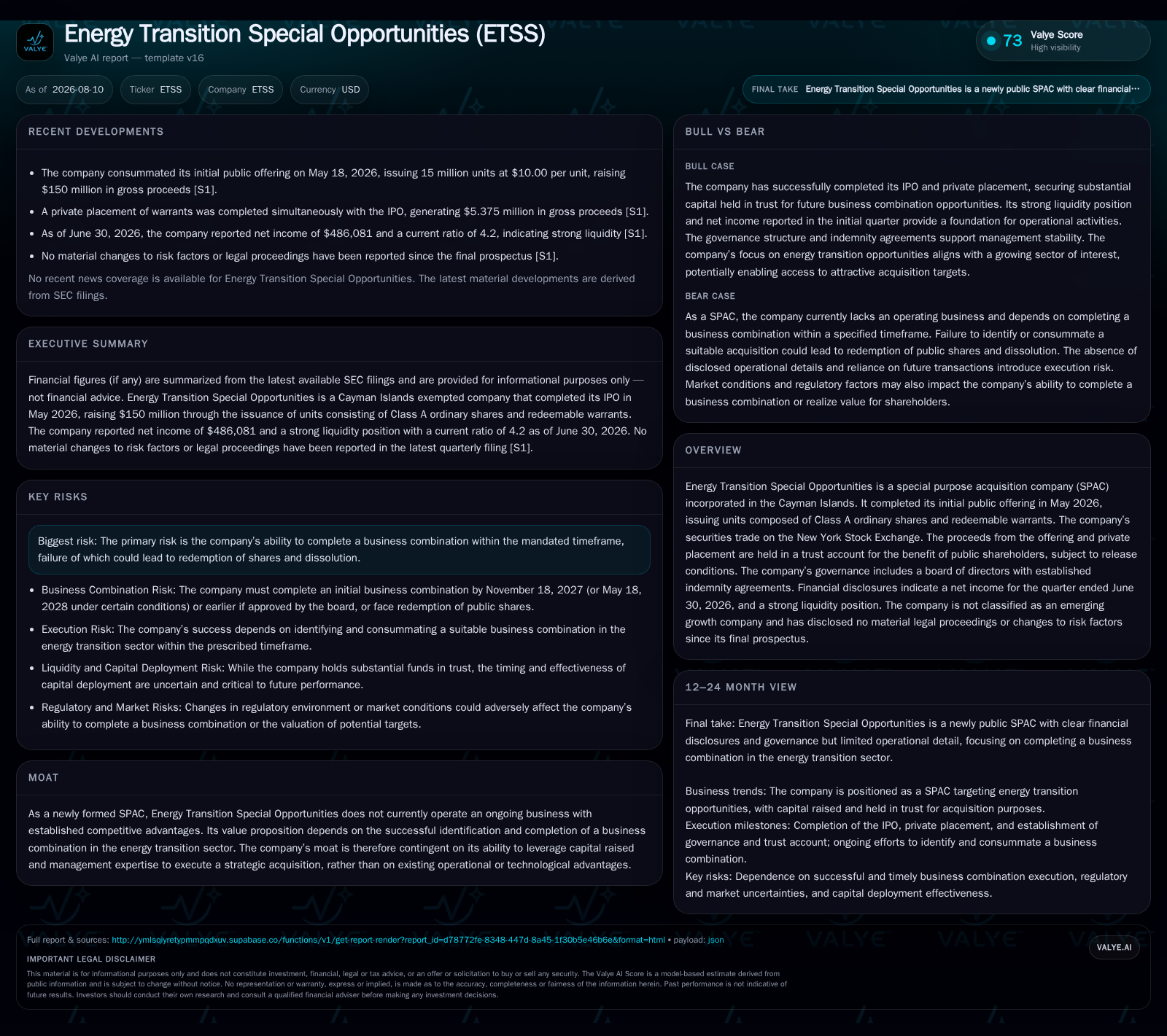
Energy Transition Special Opportunities (ETSS) completed its initial public offering in May 2026, raising over $150 million structured as units comprising Class A ordinary shares and redeemable warrants. The company’s latest 10-Q confirms stable risk factors and a sound liquidity profile centered on trust account proceeds. ETSS has commenced separate trading of underlying securities, a key milestone ahead of pursuing a business combination in the energy transition sector. As a SPAC, its value relies heavily on completing an acquisition within the contractual timeframe, with current financials reflecting typical pre-combination operating losses and minimal debt. The fund has broad leeway to seek suitable deals, but execution timing and shareholder redemption dynamics remain critical watchpoints.
Recent Operating Update: Post-IPO Developments
Energy Transition Special Opportunities (ETSS) executed its IPO in May 2026 raising net proceeds of approximately $150.75 million through the sale of 15 million units priced at $10 each plus a private placement of warrants to sponsors and underwriters [S8, S13]. Each unit contains one Class A ordinary share plus half of one redeemable warrant exercisable at $11.50 per share. On June 4, 2026, ETSS separated trading of these components commenced on the New York Stock Exchange under the ticker symbols ETSS (shares) and ETSS WS (warrants), reflecting an important liquidity event for investors who previously held bundled units.
The company’s latest quarterly filing dated August 7, 2026 marks the first comprehensive operational disclosure post-IPO. It confirms no material changes in risk factors relative to the prospectus filed earlier in 2026 [S2]. Financially, ETSS reported a net income of approximately $486,000 for Q2 2026 despite recording an operating loss of $142,444 attributable primarily to pre-combination expenses that are typical for newly formed blank-check entities [F1]. Total debt is modest at about $159,000 as of March-end, and current assets nearly quadruple current liabilities with a strong current ratio of roughly 4.2x indicating ample liquidity headroom funded mainly by trust account cash balances established from IPO proceeds [F1].
There are no ongoing legal proceedings to note as of the quarter-end filing date which helps maintain clarity on contingent liabilities [S2]. Board composition updates made concurrent with IPO closing saw several independent directors appointed along with indemnity agreements designed to protect directors against litigation risks — standard governance practices that promote sponsor credibility going forward [S9].
Business Model: SPAC Mechanics Focused on Energy Transition Targets
As detailed in its offering documents and reinforced by recent filings, ETSS operates as a special purpose acquisition company incorporated in the Cayman Islands primarily to raise public capital via an initial public offering (IPO). The proceeds from this IPO plus affiliated private placements are held securely in an interest-bearing trust account until used in completing a business combination or returned if no transaction closes within the defined period [S3,S8,S13].
Revenue mechanics are fundamentally different from traditional operating companies. ETSS currently does not generate revenue from operations or product sales but rather represents a financial vehicle whose value depends entirely on executing a merger or acquisition (“de-SPAC” transaction) involving an energy transition-focused private company. Monetization for shareholders materializes through post-merger equity appreciation if the acquired entity successfully transitions to public markets.
Money flows begin when retail and institutional investors purchase units comprising shares plus attached warrants during IPO at around $10 per unit. These warrants provide potential leverage but also introduce dilution risk depending on exercise rates post-acquisition. Proceeds less underwriting fees form the trust account base which essentially caps downside prior to deal announcement. Expenses during the blind-pool phase primarily relate to administrative costs borne by the entity before closing any transformative business combination.
Management sponsors play pivotal roles sourcing acquisition targets within the fast-evolving energy transition sector — encompassing renewables, decarbonization technologies, energy storage solutions, or related businesses supporting sustainable infrastructure development. The essence of value creation lies not in legacy assets but selecting high-quality private firms with growth trajectories aligned with global environmental mandates.
Industry Structure and Competitive Position
ETSS operates within the Special Purpose Acquisition Company (SPAC) ecosystem—a well-established capital-raising framework that surged globally during recent years as an alternative path for private companies seeking public listing outside traditional IPO channels. Unlike conventional operating companies competing through products or services, SPACs compete intensively for scarce quality target companies willing to merge within prescribed timelines.
Within this domain, ETSS distinguishes itself by its dedicated thematic focus on energy transition opportunities — a sector attracting heightened investor scrutiny due to accelerating climate commitments worldwide. This sector focus can serve as an advantageous filter aiding concentrated sourcing efforts amid widespread competition among other energy-focused SPAC sponsors.
Peer comparisons include other SPACs launched with sustainability or cleantech mandates as well as traditional IPOs targeting similar sectors—public listings often requiring lengthier processes and subject to volatile equity markets. Private equity firms and venture capital funds remain alternative sources backing companies in this space but typically operate downstream from public markets where SPAC activity positions itself upstream.
Investors should monitor early deal pipelines announced publicly along with shareholder redemption patterns that serve as real-time demand signals affecting execution feasibility.
What to Watch Next
Key milestones in coming quarters include:
- Public announcements marking selection of potential acquisition targets along with definitive business combination agreements signaling progression towards de-SPAC closure.
- Shareholder votes typically required post-announcement providing insight into redemption rates representing acceptance level among retail investors.
- PIPE financing commitments augmenting available transaction funding traditionally viewed positively enhancing deal viability.
- Post-merger integration planning especially around operational scale-up strategies relevant once target specifics emerge transitioning from shell entity status.
- Warrants exercise trends following commencement of separate trading which influence capital structure dilution considerations impacting investor economics.
- Regulatory comment letters or procedural updates from SEC potentially modifying timeline expectations or disclosure regimes governing such transactions.
Tracking these indicators sheds light on whether ETSS's strategic objectives frictionlessly advance versus motivating revaluation reflecting inherent uncertainties present in nascent SPAC cycles.
Financial Profile Discussion
At June 30, 2026 quarter-end — just over one month after IPO closing — ETSS reported total current assets near $912 million primarily representing cash secured in trust accounts earmarked for future acquisitions [F1]. Current liabilities stood modestly at about $217,000 resulting in a healthy current ratio exceeding four times safety threshold metrics [F1]. Total debt was negligible relative to cash holdings approximating $159,000 mostly consisting of routine operational accruals rather than financing obligations [F1].
Operating expenses delivered an expected small pre-combination operating loss close to $142k reflecting administrative setup costs offset partially by non-operating gains resulting in net income near half a million dollars primarily derived from interest income earned on trust balances or other minor items [F1]. This financial profile typifies early-stage blank-check companies emphasizing preservation of capital ahead of transformational de-SPAC events.
Liquidity sufficiency combined with conservative leverage profiles supports capacity deployment flexibility enabling management discretion when negotiating prospective mergers without immediate refinancing pressure [F1]. However, the ultimate economic outcome will depend extensively upon successful deal pricing disciplines minimizing dilution effects associated with warrants issuance alongside post-merger performance fostering investor confidence.
This analysis synthesizes SEC filings up to August 7, 2026 without investment research view or forecast certainty implied. Energy Transition Special Opportunities exemplifies typical late-stage SPAC structures emphasizing capital raise security while targeting high-growth thematic sectors notably energy transition technologies where investor demand remains robust but contingent upon rigorous execution discipline within narrowly defined windows.
Disclaimer: This is research-only, informational analysis and not investment advice. It may include AI-generated interpretation and general industry context. Always verify important details using primary sources.

Comments