
Maplebear’s Multi-Segment Platform Drives Marketplace Growth Despite Earnings Pressure
Maplebear’s Q2 results underscore robust marketplace expansion and advertising momentum amid margin challenges and regulatory uncertainties.
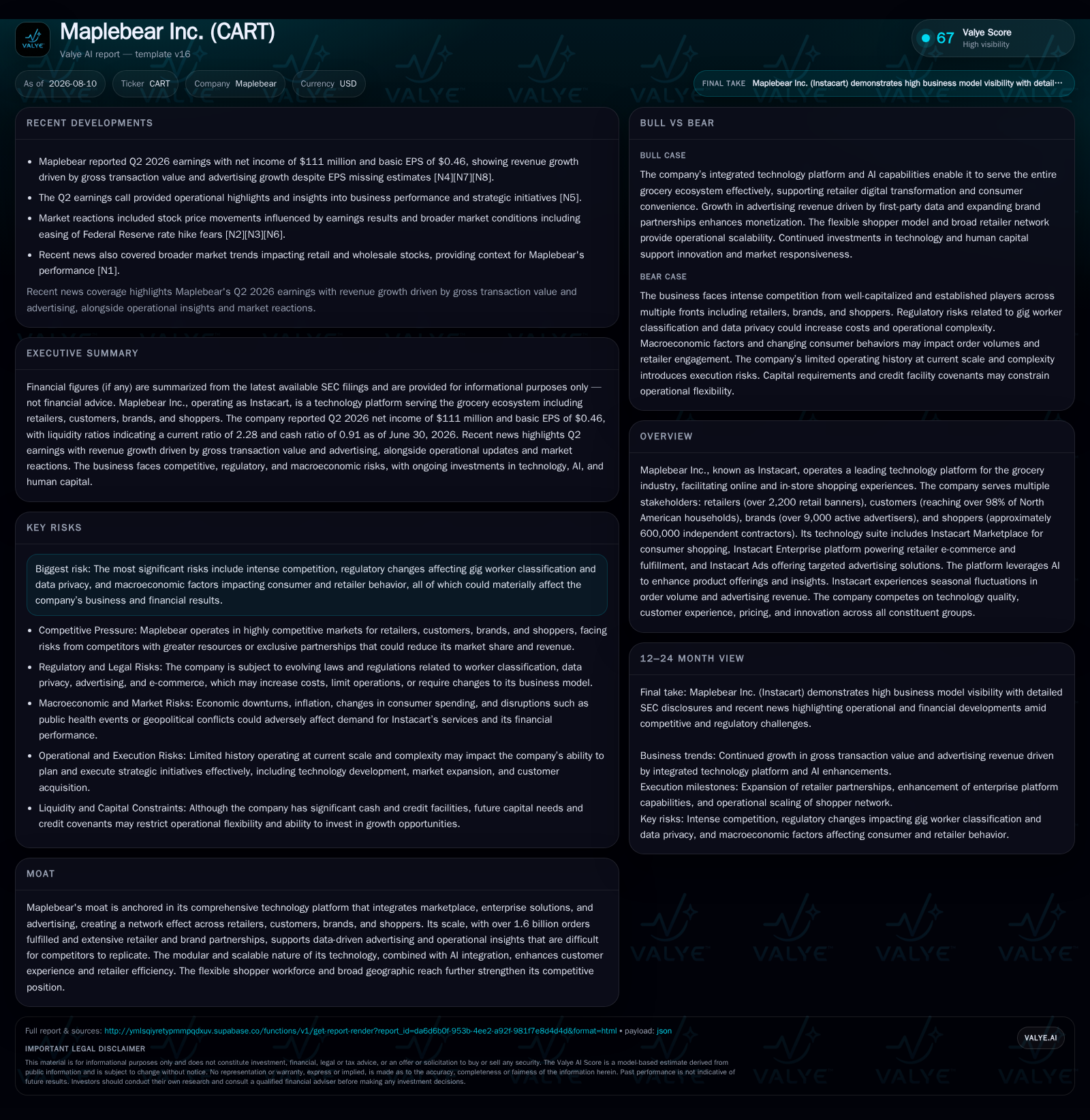
In its Q2 2026 filing, Maplebear Inc. demonstrated strong gross transaction volume growth and sustained gains in advertising revenue, reflecting the continued expansion of its integrated grocery ecosystem platform. However, profitability pressures persisted due to elevated fulfillment costs and investments, illustrating the complex balance between scaling its technology-enabled marketplace and managing gig economy labor expenses. The company’s competitive positioning is bolstered by a multi-pronged platform serving retailers, consumers, brands, and shoppers, though regulatory scrutiny on gig worker classification and intense competition from vertically integrated grocery players remain key risks. Looking ahead, AI-driven personalization and membership uptake provide levers for earnings improvement as Maplebear navigates evolving industry dynamics.
Q2 Operating Contrasts: Growth Versus Profitability Dynamics
Maplebear’s Q2 2026 disclosures reveal a nuanced operating performance where revenue exceeded consensus driven primarily by robust growth in gross transaction volume (GTV) across its marketplace business segment and accelerating advertising revenues through Instacart Ads [S2][S3][N2][N3]. This topline strength underscores the platform's ability to capture increasing consumer demand for digital grocery shopping experiences despite ongoing macroeconomic pressures. However, profitability fell short as fulfillment costs rose sharply amid tighter labor market conditions within its gig economy shopper base and investments to scale technology infrastructure continued unabated [S2]. Seasonal effects typical of the online grocery sector also contributed to fluctuating order volumes impacting operating leverage.
The divergence between strong top-line execution and earnings pressure is important because it highlights Maplebear’s strategic tradeoff: prioritizing scale expansion through deeper retailer partnerships and shopper availability at the expense of near-term margin compression. Confirmation of sustained margin improvement would hinge on visible reductions in fulfillment cost per order or demonstrable operating leverage from membership program growth.
Marketplace Engine and Retailer Platform Synergies Underpin Expansion
At the heart of Maplebear’s model lies a multi-faceted technology ecosystem serving key constituents — retailers, consumers, brands, and shoppers — which collectively drives value creation through network effects [S1]. The Instacart Marketplace app enables consumers to shop digitally from preferred local retailers powering more than 2,200 retail banners as of December 31, 2025 [S1]. These retailer partnerships form the backbone for expansive geographic reach exceeding 98% household penetration across North America. Meanwhile, the Instacart Enterprise platform offers modular e-commerce storefronts, fulfillment capabilities, connected store solutions, marketing tools, and data analytics that retailers adopt selectively based on their needs [S1].
This integrated infrastructure enables Maplebear not only to facilitate orders but also to generate deep data insights on buying behavior that feed back into improving user experience and inventory management for retailers. The interplay between front-end consumer demand via Marketplace orders and backend retailer enterprise customization enhances stickiness among partners and supports cross-selling opportunities within its SaaS-like technology offerings.
Advertising Revenue: Rising Leverage on First-Party Data Assets
Another pillar contributing to Maplebear’s growth trajectory is its Instacart Ads segment that leverages first-party transaction data collected from billions of past grocery orders to offer highly targeted advertising for over 9,000 active brands [S1][S2]. This data-driven targeting capability allows brands to improve product discovery at point-of-purchase with measurable sales lift — a critical advantage compared with generic digital ad outlets.
The deployment of AI-driven personalization further refines advertising effectiveness by tailoring promotional content dynamically based on real-time shopper preferences and behavior patterns [S1]. Although advertising revenue exhibits seasonality consistent with overall online grocery demand fluctuations, this segment now represents a material component of total revenues adding an incremental margin-rich revenue stream beyond order commissions [S2]. For Maplebear, sustaining advertiser growth rates will be essential to unlocking operating leverage given capital-intensive fulfillment cost dynamics.
Competitive Pressures from Evolving Tech-Enabled Grocery Ecosystem
Maplebear contends with powerful peers spanning multiple dimensions: Amazon commands scale with integrated logistics for online grocery; DoorDash competes intensely on gig economy shopper management; Walmart leverages massive brick-and-mortar plus omnichannel strength; Kroger invests heavily in digital transformation efforts; others like Ocado focus on advanced fulfillment robotics.
In this landscape, Maplebear’s competitive differentiation stems from its modular platform that blends marketplace operations with retailer technology enablement plus targeted advertising — providing a comprehensive solution versus more narrowly focused competitors [S1][S24]. However, this complexity also requires balancing diverse stakeholder needs while competing against vertically integrated rivals who may bypass third-party platforms altogether.
Interestingly, some competitors also serve as retail partners or customers simultaneously complicating bargaining power dynamics. The ability of Maplebear to maintain broad retailer engagement across multiple banners while enhancing exclusivity or incremental offerings will weigh heavily on future competitive outcomes.
Regulatory Overhang on Gig Economy Labor Model Remains a Watchpoint
A persistent risk highlighted in recent filings is evolving regulatory scrutiny related to labor classification for Maplebear’s approximately 600,000 independent contractor shoppers who fulfill orders [S1][S2]. Legal mandates or changes in jurisdictional definitions could force reclassification as employees increasing fixed costs through benefits requirements or minimum wage laws [S1][S8][S15]. Such shifts would materially affect fulfillment cost structures which already exert pressure on margins during peak periods.
Management notes ongoing compliance investments addressing risks from labor regulations alongside litigation exposure related to marketing practices [S1][S15]. The gig worker model remains a foundational element enabling flexible service supply responsiveness but carries inherent volatility reflecting policy changes that require continuous monitoring.
Future Growth Catalysts: AI Personalization and Membership Programs
Looking forward, Maplebear aims to deepen customer engagement by leveraging advanced AI-driven personalization across shopping experiences — enhancing product research views and speeding search discovery tailored locally [S1]. The company’s membership program Instacart+ drives recurring revenues with benefits such as unlimited free delivery over minimum orders that improve retention rates while optimizing order frequency metrics among subscribers [S1].
These factors are synergistic given household reach above 98%, providing scale effects where incremental improvements in average basket size or purchase cadence deliver outsized financial impact. Expanding categories beyond traditional groceries may also feature in long-term plans supporting diversified revenue streams.
What Investors Should Watch Next: Guidance, Partner Expansions, Cost Trends
Key near-term milestones include upcoming Q3 guidance updates focusing on GTV trajectory alongside advertising spend trends reflecting brand budget allocations post-pandemic normalization [N3][N4]. New retail banner integrations or contract renewals can serve as early indications of partner confidence amidst intensifying competition.
On cost control fronts attention should center on shopper engagement metrics including average hours worked per contractor that influence fulfillment expenses. Observing stability or decline in customer acquisition costs will indicate effectiveness of marketing spend efficiency efforts crucial for sustainable unit economics.
Financial Profile Discussion: Liquidity Cushion amid Profit Challenges
Maplebear maintains healthy liquidity with $757 million in cash & equivalents against current liabilities of $929 million yielding a current ratio of approximately 2.28 at June 30, 2026 [F1]. This balance-sheet strength provides operational flexibility despite recent earnings pressures stemming from elevated fulfillment costs.
Overall prudent liquidity management supports runway for strategic investments needed to maintain competitive positioning under evolving market conditions.
This analysis does not constitute investment advice or a research view but aims to synthesize recent operational disclosures within their strategic context amid complex industry forces shaping Maplebear’s evolving business model.
Disclaimer: This is research-only, informational analysis and not investment advice. It may include AI-generated interpretation and general industry context. Always verify important details using primary sources.

Comments