
Consensus Cloud Solutions Balances Core Cloud Fax Revenue with Healthcare Interoperability Expansion
The company’s Q2 report highlights stable cloud fax revenue amid ongoing investments and industry challenges in digital healthcare communication.
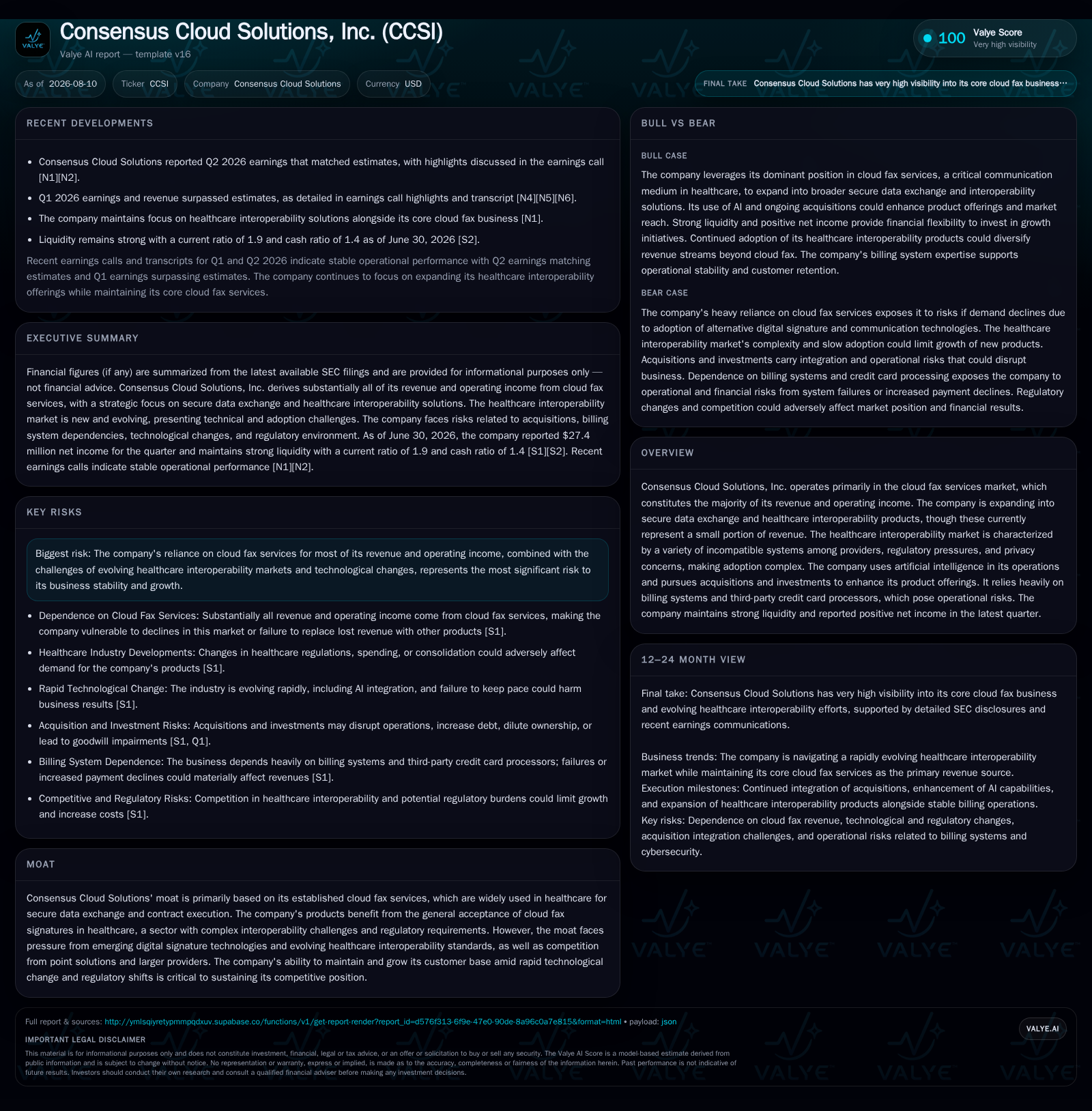
Consensus Cloud Solutions, Inc. (CCSI) remains primarily dependent on cloud fax services, which generate the bulk of its revenue and operating income. Recent quarterly results show positive net income and solid liquidity despite rising integration and acquisition risks tied to its strategic expansion into healthcare interoperability and secure data exchange. The industry's regulatory complexity and legacy technology reliance constrain growth but also create defensive barriers that support the company’s moat. Key risks include dependence on third-party telecom providers and evolving market dynamics favoring newer digital signature technologies.
Recent Operating Update
Consensus Cloud Solutions reported its second-quarter fiscal 2026 results on August 7, confirming continued reliance on its established cloud fax services for the vast majority of revenue and operating income [S2][S3][F1]. The company announced net income remained positive with a strong cash position nearing $99 million against total debt exceeding $558 million as of June 30, 2026, reflecting prudent liquidity management amid increased debt service requirements [F1]. Concurrently, Consensus reiterated that acquisitions remain a key element of growth strategy but also cautioning about the inherent operational risks such as integration difficulties, talent retention challenges, and leverage increase [S2][S4].
Business Model Overview
Consensus Cloud Solutions operates predominantly within the cloud-based healthcare communication sector, delivering subscription- and usage-based SaaS offerings with a focus on secure document exchange via cloud fax technology. This includes providing its users—mostly healthcare providers—with local and toll-free number-based fax capability hosted across integrated cloud platforms [S1][S26]. Revenues derive primarily from recurring fees based on volume usage measured by transmitted fax pages or endpoints secured.
Beyond its core fax services, the firm aims to scale its healthcare interoperability software suite targeting secure data exchange problems in electronic health records (EHR) workflows. These products attempt to bridge fragmented legacy systems challenged by diverse standards, stringent regulatory compliance demands such as HIPAA, and privacy concerns around patient data handling. Integration with billing systems is critical for monetization but also a source of operational dependency risk given recovery through merchant processing channels [S1][S22].
The macro sales process involves long enterprise selling cycles—typically spanning one to one-and-a-half years—reflecting the high-touch nature of healthcare IT procurement. Adoption ramps can be slow post-contract due to extensive testing, credentialing, and integration setup phases typical in regulated industries [S22][S27]. Customer retention revolving around seamless service uptime, privacy assurances, and regulatory compliance is essential due to sticky switching costs tied to phone number assignments and secure digital workflows.
Industry Structure and Competitive Position
Within the cloud communication ecosystem targeting healthcare, Consensus stands at a crossroads where traditional cloud fax services meet emerging digital signature technologies like those popularized by industry players such as DocuSign. While cloud fax remains entrenched due to regulatory acceptance of fax signatures within medical documentation processes, increasing pressure exists from evolving standards pushing toward more direct interoperability solutions [S17][S24].
Competitors range from specialized healthcare IT integrators (e.g., Epic Systems) offering broader EHR interoperability platforms to generalist cloud communication service providers like Twilio or RingCentral focusing on API-based integrations for multi-channel messaging. Consensus's moat relies heavily on licensing telecommunications infrastructure enabling scalable number provisioning—a complex access point that limits new entrants—and established customer trust, but faces margin pressure due to reliance on non-exclusive third-party carriers whose agreements may fluctuate in price or terms [S26][S29]
The company also leverages artificial intelligence within operational frameworks presumably for analytics or automation improvements; however, this introduces novel risks around technology maintenance and reputational exposure if AI-driven issues arise [S1][S2]. Moreover, cybersecurity threats prevalent in healthcare software necessitate continuous investment in system resiliency.
Growth Drivers
Key drivers fueling Consensus's growth trajectory include increasing regulatory mandates aimed at enhancing healthcare data interoperability that expand demand for compliant secure exchange tools beyond legacy fax models. Digital transformation momentum within hospitals, clinics, and insurers necessitates solutions capable of integrating disparate workflows while reducing manual overheads.
Shifts away from onsite hardware toward full-cloud communications underpin potential volume increases as providers consolidate vendors seeking simplicity combined with security. Further adoption of AI-enhanced features promises efficiency gains that may differentiate offerings.
The firm’s deliberate acquisition strategy seeks rapid capability build-out across adjacent areas such as enhanced interoperability products or AI-powered analytics suites. Successful integration here will be critical to accelerate product relevance beyond pure cloud fax reliance.
Growing telehealth utilization similarly stimulates demand for seamless document exchange platforms able to support remote patient management securely. Expansion into international markets with varying regulations also holds growth potential provided telecommunication number allocations remain accessible.
Risks and Constraints
Notwithstanding these prospects, Consensus confronts outsized risk concentration in legacy fax services constituting nearly all revenue—a structurally declining segment subject to disruption by superior e-signature technology adoption [S24]. The uncertain pace at which secure data exchange products gain meaningful commercial traction presents ongoing execution risk given current negligible contribution levels
Operationally, reliance on external telecommunications carriers exposes Consensus to pricing vagaries or service interruptions potentially reducing margins or undermining customer satisfaction. Similarly, billing system dependency introduces credit card processing decline risks affecting revenue collection efficiency.
Healthcare industry regulatory shifts could mandate protocol changes rendering existing solutions obsolete without swift adaptation. The lengthy sales cycles complicate forecasting precision while acquisition activity adds integration complexity risking distraction from organic growth initiatives.
Failure to generate sufficient operating cash flow increases refinancing uncertainties during volatile capital market conditions [S13][S20]
What to Watch Next
Important near-term indicators include updates on monthly recurring revenue growth particularly within healthcare interoperability suites—the degree of customer base diversification beyond cloud fax—and churn rate trends reflective of competitive pressures.
Monitoring system uptime statistics alongside key enterprise client onboarding milestones will shed light on operational effectiveness amid an elongated sales process. Progress in AI deployment outcomes without reputational damage is another critical observation point.
Financially, watch for improvements or deterioration in net income margins correlated with acquisition expense absorption plus leverage metrics tied to debt servicing capacity.
Regulatory developments impacting electronic health information protocols must be tracked closely as catalyst events altering product acceptance timelines.
Consensus’s ability to secure additional local telephone numbers domestically and internationally will influence addressable market expansion feasibility over medium term horizons.
Financial Profile Discussion
As of June 30, 2026, Consensus Cloud Solutions retains approximately $98.9 million in cash and equivalents against total debt summing close to $558.5 million equating roughly to net debt near $459.6 million [F1]
Nevertheless, this significant leverage entails ongoing material interest burden affecting free cash flow generation capabilities over time especially if sales momentum slows or acquisition financing escalates interest expense further [F1][S13].[S20]
In summary, the financial structure is sufficiently robust near-term yet demands disciplined capital allocation prioritizing organic growth investments balanced prudently against planned acquisitions given inherent integration risks highlighted by management disclosures [S2][S12].
This analysis synthesizes publicly available filings with industry insight without providing investment research views or opinionated forecasts. It is intended for informational purposes consistent with Valye News' internal research methodology.
Disclaimer: This is research-only, informational analysis and not investment advice. It may include AI-generated interpretation and general industry context. Always verify important details using primary sources.

Comments