
Aimco’s Plan of Sale and Liquidation Reshapes Multifamily REIT Wind-Down Dynamics
Apartment Investment & Management Co (Aimco) actively executes a comprehensive liquidation plan focusing on asset disposition and operational wind-down within the multifamily residential REIT sector.
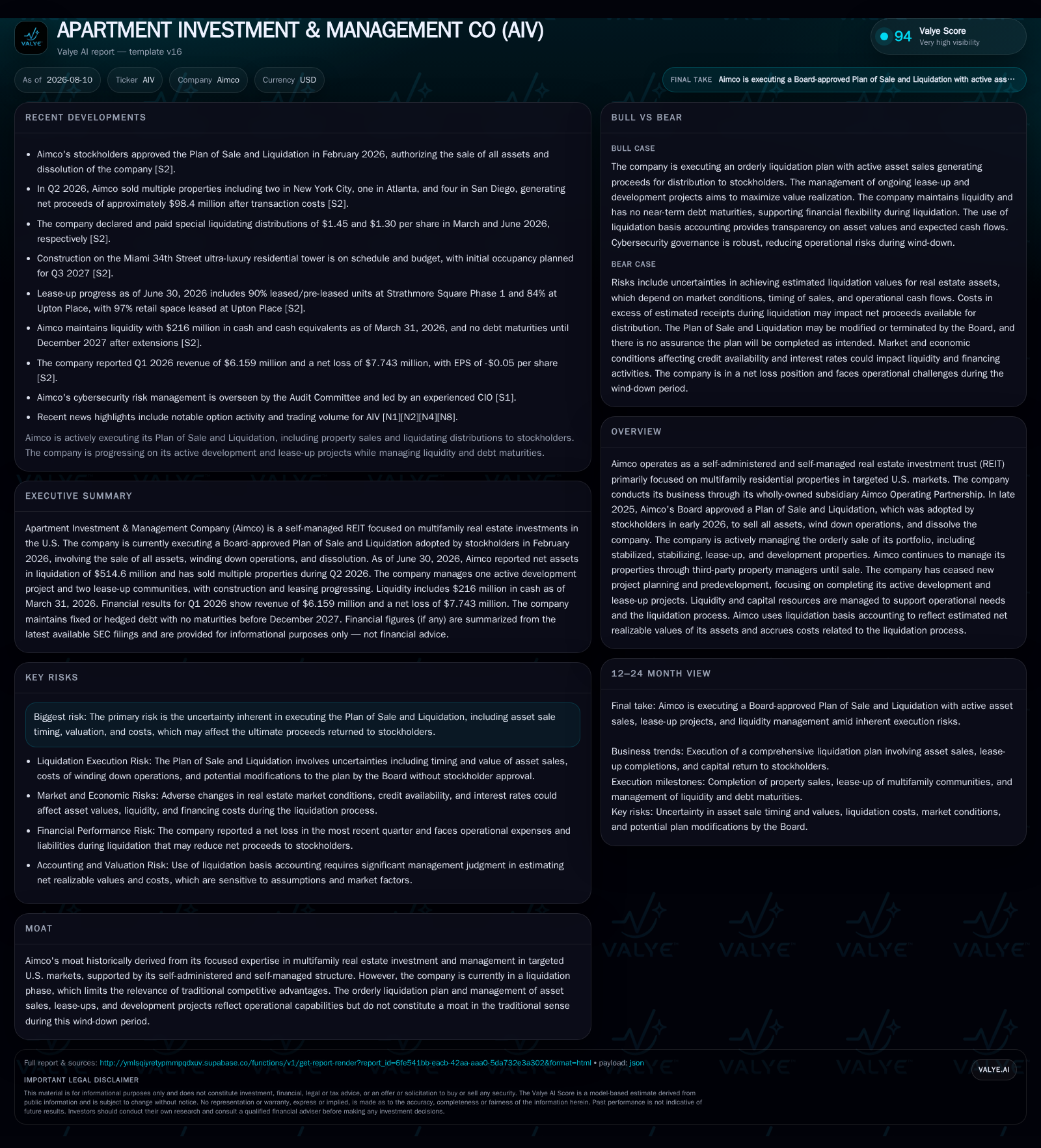
Aimco's latest quarterly filing confirms active execution of its Plan of Sale and Liquidation, under which it is selling all multifamily real estate assets and winding down operations. The company manages stabilized, lease-up, and development properties via third-party managers while ceasing new project developments. Critical liquidity and capital resource management supports both ongoing operations and the liquidation process, with much of the outstanding debt fixed or hedged to mitigate refinancing risk. Aimco’s shift from growth-oriented multifamily REIT to orderly liquidation introduces risks tied to execution timing, asset valuations, and costs that will ultimately shape shareholder returns.
Recent Operating Update: Transitioning to Liquidation Execution
Apartment Investment & Management Company (Aimco) confirms in its August 2026 quarterly disclosure that it remains fully engaged in executing the stockholder-approved Plan of Sale and Liquidation adopted in February 2026 after board approval in November 2025 [S1], [S2]. This pivotal strategic decision fundamentally alters the company’s operating profile from an active multifamily REIT pursuing growth and asset optimization to one focused exclusively on orderly asset disposition, operational wind-down, and returning capital to shareholders.
Throughout the second quarter of 2026, Aimco sold multiple properties across key U.S. markets including New York City, Atlanta, and San Diego with aggregate consideration exceeding $120 million net of transaction costs—demonstrating tangible progress in reducing portfolio exposure under the Plan [S10]. Concurrently, residential communities remain managed under existing contracts with third-party property managers ensuring controlled operations until sale closure.
One remaining multifamily development project—a luxury waterfront tower in Miami—continues construction on schedule with initial occupancy targeted for Q3 2027; lease-up completion is expected by late 2028. Additionally, two properties recently completed lease-up phases amidst stabilization efforts with sales activities underway. Notably, Aimco has ceased all new project predevelopment activities aligning with its liquidation mandate [S9], [S10].
Non-recourse construction loan capacity remains accessible at $75.9 million to fulfill remaining development commitments totaling roughly $57.4 million—affirming funding to completion without recourse to general corporate assets [S4], [S5].
Since commencement of the Plan’s implementation period through mid-2026, Aimco also authorized special liquidating distributions totaling $2.75 per share as proceeds from portfolio sales have materialized subject to operational reserves intended for estimated wind-down costs and liabilities servicing [S10]. The company's boards retain authority to modify or terminate the Plan if considered necessary but have stated no intentions to do so currently
Business Model: From Multifamily Operations to Controlled Liquidation
Aimco historically operated as a self-administered and self-managed REIT specializing in owning, developing, leasing, and managing multifamily residential communities primarily within core U.S. urban markets [S1]. Revenue traditionally derived largely from rental income generated by stabilized assets complemented by gains from proactive asset dispositions and value-adding redevelopment projects.
Under the liquidation posture dictated by the Plan of Sale and Liquidation, recurring operating income continues but is increasingly ancillary; total rental revenue flows while assets remain unsold nonetheless serve only to preserve net operating income (NOI) temporarily during transition rather than growth engines. Development pipeline activities have sharply contracted; new projects are halted except for legacy developments already underway or completing lease-ups to maximize sale valuations under current market conditions.
The monetization mechanics pivot toward liquidating value through outright sales often facilitated via asset-level non-recourse financing arrangements typical in multifamily real estate capital markets. Aimco’s use of property-level non-recourse debt provides flexibility by isolating refinancing risks within individual assets rather than on consolidated enterprise credit lines—a beneficial feature especially amid fluctuating capital markets during liquidation where secured lending demand may vary substantially.
Throughout wind-down execution, Aimco continues relying heavily on third-party property management firms for day-to-day operations—parking operational responsibilities externally reduces overhead complexity but requires vigilant oversight on leasing velocity, tenant retention costs, repair/maintenance expenses, and eventual turnover rates that affect final sale readiness.
Industry Structure and Competitive Positioning During Wind-Down
Multifamily Residential Real Estate Investment Trusts (REITs) broadly compete across acquisition targets by scale advantages, geographic specialization, brand reputation among tenants/communities, development execution proficiency, leasing velocity capabilities during lease-ups, operating expense control influencing NOI margins, and access to low-cost financing underwriting.
At scale prior to the liquidation decision—Aimco compared with peers such as Equity Residential (EQR), AvalonBay Communities (AVB), Essex Property Trust (ESS), or Mid-America Apartment Communities (MAA)—maintained a focused portfolio accented by self-management governance enabling nimble capital allocation decisions.
However, with management’s strategic shift away from ongoing ownership toward asset disposition plus a ceasefire on new acquisitions or development preplanning activities,[S2] Aimco cedes traditional competitive moats like organic rent growth capture or operational efficiency expansions seen in stand-alone REITs pursuing cyclical recovery or expansion phases. The predefined liquidation horizon imposes a finite time window to realize asset values limiting optimization latitude—turning competitive dynamics more transactional than operational.
Liquidity considerations amid macroeconomic interest rate environments reflect further constraints distinct from growth REIT peers; fixed-rate debt mix mitigates volatility risks but prolonged unfavorable capital market conditions could elongate disposition timing or value extraction detracting ultimate shareholder returns.
Growth Drivers in Liquidation Context
Structurally typical multifamily REIT growth drivers such as population growth in key urbanized metros supporting long-term rental demand or limited new supply constraining vacancy levels become secondary under liquidation focus. Instead:
- Completion milestones on ongoing developments create near-term value realization events enhancing prospective sale prices.[S9]
- Lease-up stabilization success directly impacts valuation multiples achievable by potential buyers adapting underwriting assumptions aligned with occupancy-rate normalization.[S9]
- Efficient management of ongoing operational expenses during transitional ownership reduces leakage against net portfolio cash flow supporting liquidity preservation.
- Flexible access to committed non-recourse construction loan capacity ensures project completions avoiding partial asset write-offs increasing liquidation proceeds potential.[S4]
- Strategic timing execution matching favorable market cycles optimizes exit multiples relative to cyclical headwinds affecting rental pricing power across comparable portfolios.
These factors cumulatively influence proceeds available for distribution after liabilities settlement.
Risks and Constraints Amid Liquidation Execution
Executional risks dominate Aimco's current profile:
- Market risk: Asset sale pricing depends on prevailing demand for multifamily properties which can be challenged by macroeconomic disruptions such as rising interest rates or economic slowdowns impairing buyer financing availability or valuation benchmarks.
- Timing risk: Delay(s) in completing sales contracts impose carrying costs that may diminish net returns benefitting shareholders directly.
- Lease-up risk: For properties still stabilizing occupancy levels (Miami tower construction through late 2028), underperformance could depress valuations requiring deeper discounts at disposition.
- Residual liability estimation: Precise calculation of projected wind-down costs including tenant improvements obligations or legal contingencies remains inherently uncertain potentially affecting final distributable amounts.[S14]
- Regulatory/zoning risk: Changes affecting property operations during transition could impose unexpected compliance costs diminishing net asset values.
- Liquidity constraints: Limited cash reserves necessitate disciplined spending controls during wind-down; adverse financing environment shifts could restrict bridge financing options if needed.
- Operational dependency risk: Continued reliance on third-party managers requires oversight robustness; misalignment risks could impact tenant satisfaction or maintenance outcomes impairing sale readiness.
- Cybersecurity risks remain present requiring active governance despite shrinkage in IT scope reflecting wider industry concerns over protecting tenant data throughout transition periods.[S1]
What To Watch Next
Key upcoming milestones include:
- Progress updates on sales completion schedules particularly for major lease-up projects such as the Miami luxury tower expected initial occupancy Q3 2027.
- Ongoing liquidity reports tracking cash flows generated from assets held versus sale receipts reported quarterly confirming sufficiency to meet operational needs without undue leverage buildup.[S4],[S10]
- Notifications of additional liquidating distributions clarifying quantum and timing providing visibility into realized net proceeds returned to shareholders.
- Updates regarding any board decisions modifying or amending the Plan of Sale given evolving market realities potentially impacting timeline or strategic pathway.[S1],[S2]
- Lease-up occupancy rates at key properties serving as proxies for market acceptance which influence ultimate exit pricing benchmarks among prospective buyers.
- Refinancing activity related announcements confirming capability to extend debt maturities without triggering liquidity strain ahead of final dissolution deadlines.
Financial Profile Discussion
Following adoption of liquidation basis accounting protocols early in 2026,[S2],[S22] Aimco discontinued use of traditional performance metrics such as EBITDAre reflecting shifting business operation priorities emphasizing cash flow management aimed at maximizing capital return versus growth-oriented NOI expansion strategies[S14].
Distributions executed year-to-date reflect concrete monetization successes but require cautious interpretation given residual liabilities including tenant improvement reserves,[S10],[S14] underscoring that not all receivables translate immediately into shareholder value until liabilities are fully discharged post-liquidation.
This analysis is based solely on publicly filed SEC documents as cited along with established multifamily REIT industry frameworks. It does not constitute investment advice or research views but aims to provide buy-side caliber insights clarifying how Aimco’s structural shift towards liquidation reshapes typical multifamily REIT business dynamics.
Disclaimer: This is research-only, informational analysis and not investment advice. It may include AI-generated interpretation and general industry context. Always verify important details using primary sources.

Comments