
Tradeweb Markets Expands Liquidity and Client Reach with Strong Q2 Execution and Strategic Growth
Tradeweb's Q2 2026 results underscore its leadership in multi-asset electronic marketplaces, driven by robust trading volumes and technological integration.
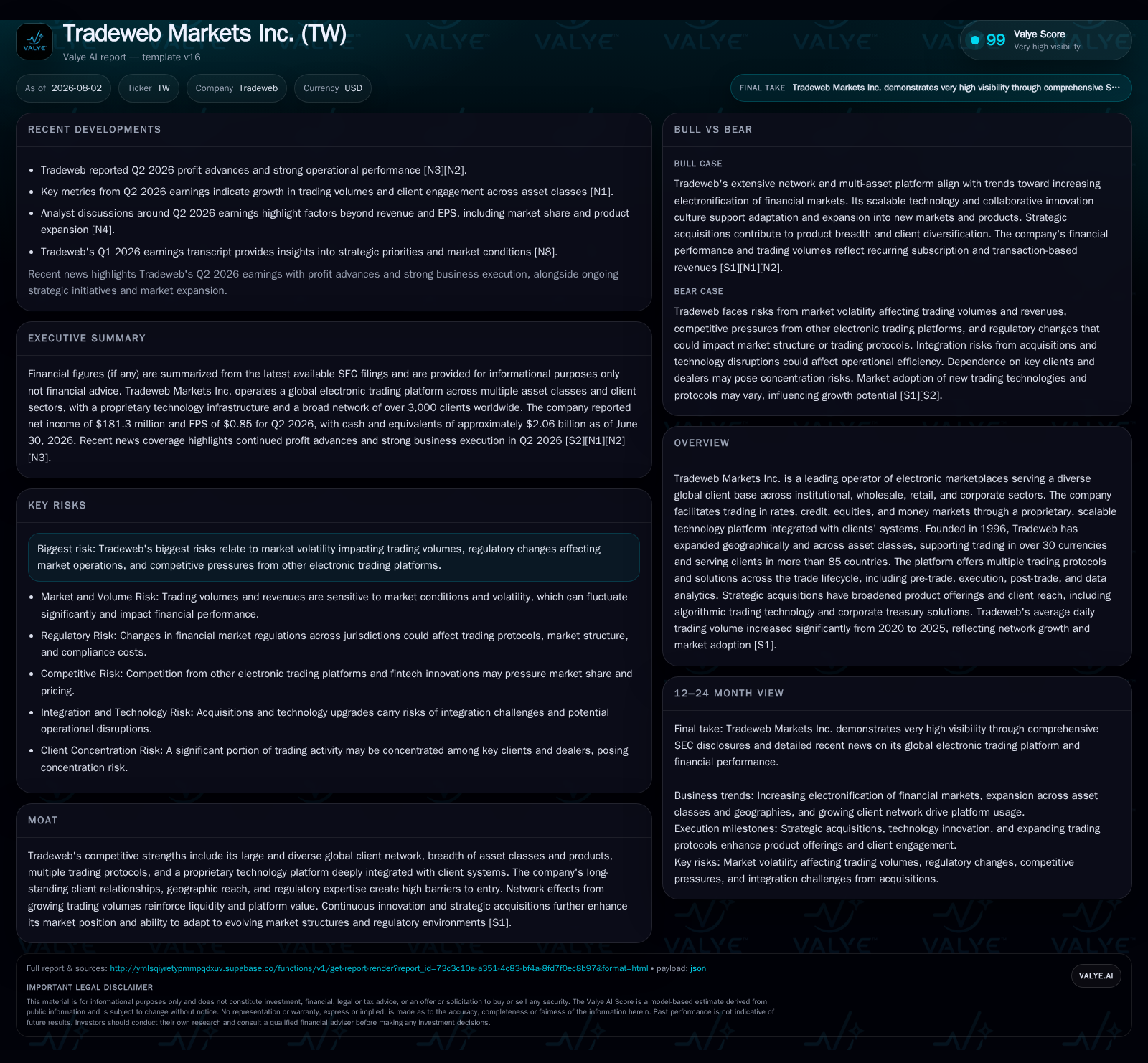
In Q2 2026, Tradeweb Markets Inc. reinforced its position as a global leader in electronic trading platforms by delivering strong operating metrics amid evolving market conditions [S2][S3]. Its proprietary technology supports a diverse client base across over 85 countries and multiple asset classes, enabling deep liquidity pools and network effects that sustain competitive advantage [S1]. Strategic share repurchases continue to optimize capital structure alongside investments in platform development and geographic expansion [S2][S12]. Market volatility, regulatory pressures, and technological innovation represent both challenges and opportunities for sustained growth in Tradeweb's multi-asset trading ecosystem.
Recent Operating Update
Tradeweb Markets Inc. reported its second-quarter results on July 30, 2026, emphasizing steady progress in transaction volumes and platform utilization despite macroeconomic uncertainties [S2][S3]. The filings detail significant repurchases of Class A common stock totaling over 1.9 million shares during the quarter through their ongoing share repurchase programs aimed at offsetting dilution and enhancing shareholder value [S12]. These buybacks reflect management’s confidence in the underlying business fundamentals and provide balance-sheet flexibility.
Platform activity remains strong across multiple asset classes—rates, credit, equities, and money markets—with client usage spanning institutional investors to corporate treasury clients in more than 85 countries [S1]. Tradeweb's technology architecture continues to demonstrate resilience and scalability by supporting complex trade workflows integrated deeply into client systems. This underpins stable revenue streams generated primarily from transaction fees complemented by subscription services such as data analytics tools.
Business Model Analysis
Tradeweb's core business revolves around operating electronic marketplaces that connect buyers and sellers of financial instruments across broad asset classes within a proprietary technology ecosystem. Its revenue model predominantly derives from transaction fees based on trade volumes executed via its platforms alongside recurring subscription fees for access to enhanced trading tools including algorithmic execution capabilities and post-trade processing solutions. The company’s proprietary platform facilitates multiple trading protocols tailored to different market segments, offering clients choice between request-for-quote (RFQ) models, open central limit order books (CLOBs), or hybrid systems depending on asset class conventions.
Clients range from large asset managers, hedge funds, insurance companies, banks, dealers to corporate treasuries utilizing the ICD Portal for money market fund research and execution [S1]. This diversification dilutes counterparty concentration risk and enables network effects whereby increased participation boosts liquidity depth—the most critical factor for electronic trading platform success. The ability to support over 30 currencies globally positions Tradeweb favorably against regional competitors with narrower geographic coverage.
The company invests heavily in integrating pre-trade analytics for better price discovery along with post-trade data services that help clients optimize compliance reporting and portfolio management. Such value-added features enhance client stickiness beyond simple trade execution metrics. Moreover, Tradeweb's regulatory expertise allows it to swiftly adjust offerings amid evolving market mandates.
Industry Structure and Competitive Position
Tradeweb operates within the highly specialized sector of financial technology focused on electronic trading platforms. Key peers in this space include MarketAxess (noted for credit market specialization), Bloomberg Tradebook (extensive equities franchise), IHS Markit (data integration strength), alongside broker-dealers enhancing their electronic capabilities. Relative to these peers, Tradeweb’s strength lies in multi-asset class coverage coupled with extensive global reach providing competitive moats through network size and liquidity aggregation.
The industry is rapidly evolving under pressures from regulatory changes promoting transparency (e.g., MiFID II in Europe), technological innovation particularly AI-driven algorithmic tools, and shifts toward automation replacing manual voice broking models. Platforms that foster high uptime with low latency benefit client retention amidst rising expectations for seamless digital workflows.
Tradeweb’s strategic acquisitions have broadened product scope into corporate treasury solutions and algorithmic execution technologies thus positioning it at the intersection of front office trading activity and back-office financial operations. Such diversification supports more resilient revenue streams less dependent on any single asset-class cycle.
Growth Drivers
Several secular trends underpin Tradeweb’s growth prospects:
- Increasing Electronic Trading Adoption: Financial institutions universally pivot towards electronic executions for improved cost efficiency, transparency, and speed across fixed income and equity markets.
- Asset Class Expansion: Inclusion of derivatives products and emerging digital assets reflects evolving client requirements; Tradeweb is augmenting offerings accordingly [S1].
- Geographic Penetration: Expansion into underpenetrated regions enhances customer base diversity while capturing cross-border trade flows.
- Network Effects: Enlarging active client counts bolsters liquidity pools creating virtuous cycles; each new participant potentially increases matching efficiency driving volume growth.
- Product Innovation: Advancements in AI-driven pre-trade analytics, sophisticated algorithmic tools for trade optimization cements competitive barriers.
- Regulatory Tailwinds: Mandates encouraging or requiring electronically executed trades naturally shift market share away from legacy venues toward compliant platforms like Tradeweb.
- Data Monetization: Post-trade data services offer higher margin recurring revenue streams complementing transactional fee income.
Risks and Constraints
Despite strengths, several risks merit close attention:
- Market Volume Volatility: Gross trading revenue is highly correlated with overall market activity; downturns or geopolitical shocks could depress volumes sharply [S1].
- Regulatory Uncertainty: Shifts in rules around order handling or capital requirements could necessitate costly platform adjustments or alter competitive dynamics.
- Competitive Pressures: Other electronic venues continually innovate; failure by Tradeweb to match or exceed could erode share.
- Technology Dependence: Systems failures or cyber incidents risk reputation damage as well as client attrition given reliance on platform availability.
- Client Concentration & Dealer Dependence: Although diversified broadly by sectorally described client base, reliance on functioning dealer liquidity providers remains fundamental.
- Integration Complexities: Growing breadth of products raises execution risk related to maintaining seamless interoperability within existing client ecosystems.
- Currency Fluctuations: Operating across multiple jurisdictions exposes results to FX translation effects affecting reported margins.
- Emerging Tech Disruption: Blockchain-based decentralized finance could pose long-term risks if widely adopted as alternative settlement/clearing mechanisms without intermediary marketplaces.
What to Watch Next
Key developments that will illuminate future trajectory include:
- Detailed average daily trading volume progress segmented by asset class reflecting demand intensity.
- Client acquisition metrics by sector evidencing penetration success especially corporate treasury clients leveraging new ICD Portal enhancements [S1].
- Execution quality improvement statistics including latency reductions or protocol adoption shifts indicating technical competitiveness gains.
- Regulatory updates impacting electronic marketplace compliance costs or structural changes in trading processes globally.
- Outcomes of announced or potential acquisitions broadening product ecosystems or expanding geographic footprint.
- Progress against share repurchase authorizations balancing capital return priorities with investment needs [S12].
- Cybersecurity incident disclosures or system downtime reports signaling operational resilience challenges.
Financial Profile Discussion
As of June 30, 2026, Tradeweb held approximately $2.06 billion in cash and equivalents providing substantial liquidity buffer to support ongoing investments in technology infrastructure as well as opportunistic capital returns [F1][S2]. The company's disciplined capital allocation is evident with board-approved share repurchase programs totaling up to $500 million authorized early in 2026 following exhaustion of prior programs [S2][S12]. These repurchases serve dual strategic purposes: offsetting dilution from equity-based compensation plans while optimizing capital structure without compromising operational flexibility.
Reported full-year operating income was $835 million at the end of 2025 with net income approximating $813 million illustrating healthy profitability aligned with scalable SaaS-like economics supported by growing transaction volumes [F1]. Cost control combined with increasing subscription revenues likely contribute favorably to margins but continuous reinvestment into R&D remains vital given rapid fintech evolution demands [S1]. The availability of revolving credit facilities subject to covenants introduces some financing discipline though no immediate refinancing concerns have been reported [S6][S9].
This analysis synthesizes recent SEC filings alongside industry context relevant to Tradeweb Markets Inc.'s evolving position within the financial technology electronic trading arena. It reflects current operating dynamics without extrapolating speculative future outcomes or investment research views.
Disclaimer: This is research-only, informational analysis and not investment advice. It may include AI-generated interpretation and general industry context. Always verify important details using primary sources.

Comments