
PennyMac Financial Services Navigates Interest Rate Shifts and Servicing Portfolio Dynamics in Q2 2026
Q2 2026 results reflect the challenges of interest rate volatility, evolving loan production, and servicing portfolio management within PennyMac's integrated mortgage platform.
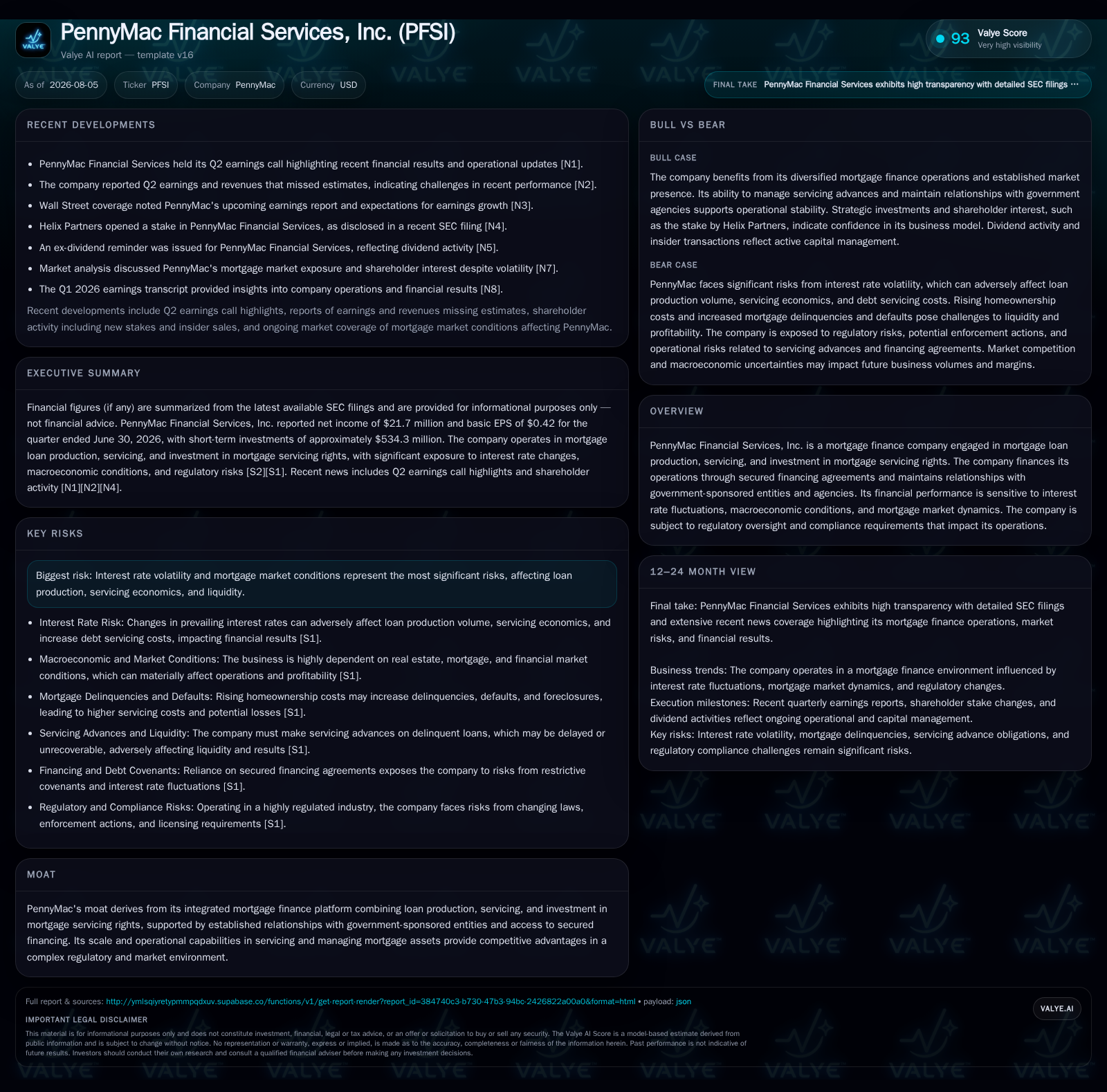
PennyMac Financial Services, Inc. reported Q2 2026 results highlighting pressure from lower loan origination volumes amid rising interest rates and a shift in the mortgage market. The company’s integrated model—combining loan origination, servicing, and mortgage servicing rights (MSR) investment—continues to face margin compression due to heightened prepayment risk and servicing advances tied to delinquency trends. Liquidity remains reliant on secured financing arrangements, with total debt outstanding at approximately $6.33 billion as of mid-2026. PennyMac's operational flexibility and established GSE relationships are pivotal amid a challenging macroeconomic backdrop marked by interest rate sensitivity and housing affordability concerns.
Recent Operating Update – Q2 2026 Highlights
PennyMac Financial Services’ latest quarterly filing for Q2 ended June 30, 2026 reveals a business contending with a prevailing elevated interest rate environment that has dampened refinancing activity and pressured loan origination volumes substantially [S2], [S3]. The company’s integrated mortgage finance platform—spanning originating loans, servicing those loans, and investing in mortgage servicing rights (MSRs)—exhibited mixed performance signals as a result.
Loan production saw contraction from previous quarters due primarily to rising benchmark borrowing costs that cooled borrower demand for refinancing given less favorable economics. The decline in production volume directly impacted loan sale gains which constitute a key revenue component under PennyMac’s business model. While certain home purchase segments showed resilience, overall volumes lagged expectations meeting resistance from macro factors influencing housing affordability [S3], [N1], [N2].
Simultaneously, the servicing portfolio—the aggregate balance of loans serviced—increased modestly reflecting both retention of existing customers and some organic growth. However, notable was a slight uptick in delinquency levels among serviced loans that intensified the requirement for servicing advances — funds advanced by PennyMac on behalf of delinquent borrowers pending collections or foreclosure processes. Elevated servicing advances heighten liquidity pressure and elevate credit risk exposure particularly if delayed recoveries extend beyond forecast horizons [S2], [S3].
MSRs faced valuation headwinds linked to accelerating prepayment speeds as fluctuating interest rates encouraged some borrowers to refinance or pay off early. This increased prepayment risk compresses expected future cash flows associated with servicing rights requiring valuation adjustments with direct P&L impact. Given the sensitivity of MSRs to interest rates and borrower behavior patterns, this segment contributes meaningful volatility even as it supplements diversified fee income streams for PennyMac [S1], [S2].
Business Model Analysis
PennyMac operates an integrated mortgage finance platform combining three tightly linked value propositions: loan origination through retail channels; ongoing loan servicing including collections and escrow management; and MSR investment capitalizing on fee income derived from managing these loans.
Revenue generation is multifaceted: the company earns net interest spread or gain on sale from originating mortgages financed via secured borrowing facilities; collects recurring fees for administering loans within their servicing portfolio; and realizes auction-type mark-to-market or amortization gains/losses on MSRs dependent on prepayment experience. Much of financing relies on secured funding agreements backed by loan collateral or MSR assets themselves.
This integration creates operational synergies—such as data continuity optimizing credit modeling—and diversified revenue buffers since downturns in one segment can be partially offset by others. Yet it also binds PennyMac's performance tightly to macroeconomic developments influencing mortgage demand, delinquency trends within serviced loans, and capital market appetite affecting asset valuations.
Operational efficiency in managing cost per loan serviced is crucial given thin servicing fee margins coupled with high upfront investments in technology platforms necessary for compliance with government-sponsored entities (GSEs) mandates. Maintaining strong counterparty relationships with GSEs like Fannie Mae enhances liquidity channels critical for continuous loan sales.
Industry Structure and Competitive Positioning
Operating within the U.S. mortgage finance industry places PennyMac alongside distinct peer sets including originators like Rocket Companies, servicers such as Mr. Cooper Group, government-sponsored enterprises (Fannie Mae/Freddie Mac), mortgage REITs investing principally in MSRs or MBS assets (e.g., Annaly Capital Management), and technology providers supporting operational efficiencies.
PennyMac's competitive moat arises from its scale as an integrated lender-servicer-MSR investor that leverages cross-segment expertise to manage credit risk more effectively than pure-play originators heavily exposed to volatile production cycles. In contrast to originators encountering margin compression solely from decreased volume or pricing competition, PennyMac’s sizable servicing portfolio provides recurring income somewhat insulated from immediate production downturns but sensitive to credit quality shifts.
However, PennyMac must continuously monitor cost structures amid tightening servicing fee spreads across peers where efficiency differentiators become vital. Delinquency management capabilities significantly impact cash flow stability through provisioning for advances or losses; firms proficient here demonstrate stronger resilience in cyclical stress.
Growth Drivers
The primary growth lever for PennyMac rests on stabilization or declines in prevailing interest rates which would reaccelerate refinance volumes lifting loan origination revenue and associated loan sale gains. Rising homeownership demand also contributes structural tailwinds if affordability conditions improve.
Simultaneously building the servicing portfolio via organic customer retention or selective acquisitions can underpin recurring fee income growth—a strategic defensive buffer against wholesale originations volatility. Expanding MSR investment selectively allows capture of residual upside from sustained low prepayment environments under stable rate scenarios.
Technological investments reducing per-loan service costs improve operating margins while enhancing borrower experience potentially leading to lower defaults and better retention rates—critical operational KPIs supporting sustainable profitability.
Risks and Watchpoints
Interest rate volatility remains paramount as upward pressure can simultaneously suppress new loan demand while accelerating costly prepayments eroding MSR valuations—compounding earnings pressure across segments.
Housing affordability deterioration risks rising delinquencies and foreclosures increasing provisioning needs and advancing liquidity strain triggered by servicing advance requirements on nonperforming assets.
Regulatory uncertainties may impose higher compliance costs or modify operational frameworks especially regarding securitization standards or borrower protections impacting product offerings.
Operational risks including technology failures or cybersecurity incidents threaten business continuity impacting reputation and financial outcomes.
Loan repurchase obligations intrinsically raise credit risk exposures demanding vigilant underwriting quality control across origination channels.
What to Watch Next
Upcoming quarters will reveal how PennyMac navigates ongoing higher-rate headwinds affecting quarterly loan origination volume trends reflecting consumer response to mortgage cost dynamics.
Delinquency metrics will indicate whether recent upticks signal temporary noise or early signs of broader credit quality deterioration impacting cash flow predictability.
MSR amortization rates serve as sensitive indicators of borrower prepayment speed changes informing forward earnings visibility on this key non-interest income line.
Any alterations in financing terms with lenders of secured facilities signal shifting liquidity conditions deserving close monitoring given their leverage implications.
Cost management initiatives' effectiveness will appear increasingly vital if headwinds persist necessitating operational discipline enhancements.
Financial Profile Discussion
Earnings remain sensitive not only to top-line variables like loan volumes but also bottom-line factors including provision for credit losses influenced by rising defaults or delinquencies amid economic cyclicality [S2]. Capital adequacy relies on balancing growth ambitions against conservative liquidity buffers especially when market disruptions in mortgage-backed securities arise.
While the company’s financial policy does not promise material changes from prior risk disclosures reported annually [S2], investors should focus on quarterly cash flow health driven by interplay among net interest margin fluctuations, servicing fee revenue stability, realized gains/losses on sale of loans, and effective expense control measures.
In a sector where regulatory requirements mandate rigorous reporting standards alongside frequent valuation adjustments driven by market dynamics, PennyMac’s transparent disclosures help contextualize financial performance within macro-financial conditions shaping industry fortunes today.
This analysis synthesizes publicly available SEC filings along with contemporaneous market commentary to provide an informed perspective on PennyMac Financial Services’ operating context without offering investment guidance.
Disclaimer: This is research-only, informational analysis and not investment advice. It may include AI-generated interpretation and general industry context. Always verify important details using primary sources.

Comments