
Starz’s Strategic Content Review and Distribution Dynamics Reshape Growth Outlook
Starz Entertainment reported a challenging quarter marked by declining content assets and restructuring, reflecting pressures from evolving streaming economics and competitive content markets.
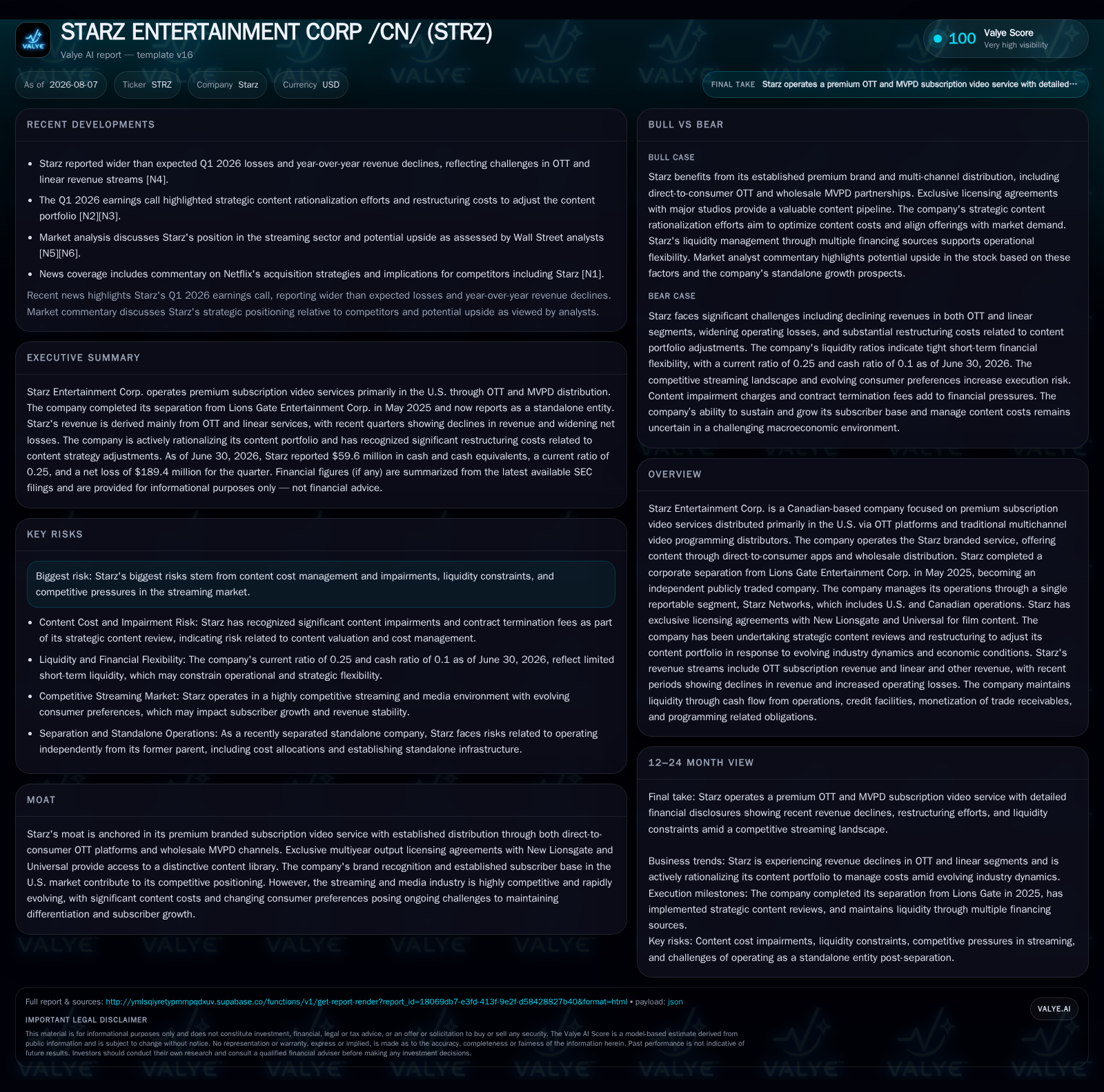
In its latest quarterly filing, Starz Entertainment Corp. highlighted key operational shifts including a significant reduction in programming content net assets and an intensified strategic content portfolio review, reflecting adaptation to changing subscriber behavior and cost pressures. The company continues to balance growth through its dual OTT direct-to-consumer and wholesale MVPD distribution model, supported by exclusive licensing agreements with Lionsgate and Universal. However, liquidity remains constrained with a low current ratio and substantial programming-related payables, underpinning the importance of cash flow management amid heavy content investment and impairment risks.
Recent Operating Update: Content Impairment and Strategic Portfolio Review
Starz Entertainment’s Q2 2026 disclosure outlined significant shifts in its operating landscape. The company’s programming content net assets decreased by nearly $130 million sequentially to $866 million by June 30, 2026, from nearly $994 million at the end of 2025 [S2]. This decline is primarily attributable to increased content amortization expense coupled with pronounced impairment charges recognized during the period—$129.8 million over the first six months of 2026 alone—that reflect ongoing adjustments to the content slate driven by strategic reviews responding to current market dynamics [S26]. These impairments highlight Starz's recalibration efforts aimed at aligning its offerings with evolving consumer preferences and cost-effective content deployment.
Meanwhile, operating losses expanded over the comparable period driven largely by these impairments alongside restructuring-related charges as Starz undertakes organizational realignment intended to enhance operational efficiency amid industry headwinds [S23]. This suggests that while subscriber traction is not detailed explicitly this quarter, margin pressure from high-cost content investments remains a critical challenge.
Business Model: Dual Distribution Through OTT and MVPD Channels
Starz operates a premium subscription video on demand (SVOD) service primarily distributed across two channels: direct-to-consumer (DTC) via OTT platforms and wholesale through multichannel video programming distributors (MVPDs). Revenue arises principally from consumer subscription fees collected directly for OTT access combined with licensing fees from MVPD partners who bundle Starz’s content within broader pay-TV packages. This dual model moderates reliance on any single distribution channel while leveraging Starz’s exclusive output licensing agreements with New Lionsgate and Universal that provide proprietary access to a deep library of films—a key subscriber retention driver given the competitive market for differentiated content.
The DTC segment offers higher ARPU potential but entails greater subscriber acquisition costs as Starz directly markets its streaming apps across devices. Conversely, wholesale contracts provide stable revenue streams through carriage fees but may be pressured by MVPDs’ overall subscriber erosion trends. Balancing these dynamics is essential to managing churn rates effectively in an industry where consumer choice proliferation heightens switching risk.
Industry Structure and Competitive Position
Post its May 2025 separation from Lions Gate Entertainment Corp., Starz has focused intensively on solidifying its position within the crowded media streaming landscape dominated by global players like Netflix, Disney+, Amazon Prime Video, as well as established cable networks now extending into streaming. While Starz does not disclose exact subscriber counts or growth trajectories publicly this quarter, its competitive moats lie in brand recognition within U.S. premium video entertainment circles and exclusive licensing deals that afford a unique film library offering not easily replicated.
The streaming industry is capital intensive with content spend constituting a significant portion of operating expenses; Starz’s ongoing impairments suggest challenges in optimizing this investment efficiently compared to larger peers that may scale original production better or command higher pricing power through diversified global subscriber bases.
Additionally, distribution breadth—accessibility across OTT devices plus carriage agreements with key U.S. MVPD operators—enhances Starz's reach but also exposes it to pricing negotiations typical in wholesale markets where bundling discounts suppress standalone pricing.
Growth Drivers
Growth prospects center on expanding the direct-to-consumer OTT subscriber base given consumer cord-cutting trends favoring flexible streaming options. Enhancements in user experience technology, cross-device availability, and tiered pricing strategies aimed at increasing average revenue per user (ARPU) are strategic levers Starz can pull to improve monetization without proportional increases in gross subscriber numbers.
Securing exclusive content output deals remains foundational; the company’s licenses with New Lionsgate and Universal confer distinct advantages in offering marquee titles which support subscriber acquisition and reduce churn.
Wholesale partnerships continue providing stable revenues albeit subject to industry MVPD contraction; nonetheless, selective expansion into new geographic markets or niche demographic segments could provide incremental upside if executed prudently.
Lastly, continued strategic portfolio optimization—pruning underperforming or costly content assets—helps manage programming costs while addressing evolving consumption patterns shaped by macroeconomic factors such as inflation impacting consumer discretionary spend.
Risks and Watchpoints
Starz faces several salient risks endemic to the media streaming industry compounded by its current financial posture:
- Content Cost Inflation & Impairments: Large-scale impairments highlight ongoing challenges to calibrate high upfront programming investments against unpredictable returns from audience engagement.
- Liquidity Constraints: With a low current ratio (
0.25) as of June 2026 despite modest cash reserves ($59.6 million), short-term obligations including nearly $213 million in programming payables represent liquidity pressure points requiring vigilant working capital management [F1], [S2]. - Competitive Pressures: Rival platforms invest aggressively in originals, raising barriers for subscriber growth. Without significant differentiation or scaling benefits seen among larger peers, retention rates could suffer.
- Debt Leverage: While currently compliant with covenants tied to its $300 million term loan facility maturing late 2028 and $325 million senior notes due 2029, any economic tightening or revenue softness could stress coverage ratios [S15].
- Consumer Behavior Shifts: Rapid adoption of alternative entertainment forms or changes in technology could render parts of Starz’s catalog less resonant without agile adaptation.
What To Watch Next
Critical near-term milestones include monitoring:
- Content amortization rates versus impairment trends in upcoming quarterly disclosures for signs of portfolio stabilization or further write-downs.
- Subscriber metrics if disclosed publicly or hinted through proxy indicators such as deferred revenue growth or churn commentary.
- Operating margin trajectory post restructuring initiatives for evidence of improved cost control.
- Liquidity developments including availability under revolving credit facilities or additional financing moves given sizeable current liabilities.
- Updates on exclusive licensing deal renewals or new output agreements which could reinforce content exclusivity advantages.
Financial Profile Discussion
As of June 30, 2026, Starz held $59.6 million in cash balanced against $150.6 million in current assets total versus substantial current liabilities of $596 million, resulting in a thin liquidity buffer evidenced by a current ratio around 0.25—a metric signaling tight short-term financial flexibility [F1], [S2]. Total debt reported last at approximately $614 million net of issuance costs encompasses both secured term loans due end-2028 ($300 million) and unsecured senior notes due 2029 ($325 million), representing moderate leverage levels contingent on stable operating cash flows [S24], [S25], [S15].
Despite generating subscription revenue streams through a combination of OTT direct-to-consumer fees and wholesale MVPD licensing contracts supporting deferred revenue balances around $53 million currently, Starz posted operating losses partially driven by elevated programming amortization expenses ($138 million quarterly) coupled with sizeable impairment charges that undermine near-term profitability prospects [S2], [S23], [S24].
Capital allocation remains focused on sustaining premium content libraries through licensed output deals while undertaking strategic restructuring measures encompassing workforce adjustments reflected in restructuring expenses disclosed recently at about $11 million YTD mid-2026 [S23], [S26]. Tight covenant compliance is maintained for leverage ratios as defined under existing credit agreements; however, monitoring free cash flow generation amid ongoing capital-intensive program acquisitions will be crucial for financial health going forward.
This analysis reflects information available as of August 7, 2026. It synthesizes company-reported data alongside general industry dynamics without speculative projections or investment advice.
Disclaimer: This is research-only, informational analysis and not investment advice. It may include AI-generated interpretation and general industry context. Always verify important details using primary sources.

Comments