
StandardAero Leverages OEM Authorizations and Long-Term Contracts Amid Capital Constraints
The company reports stable operational momentum in Q2 2026 while managing a significant debt burden within a complex aerospace aftermarket environment.
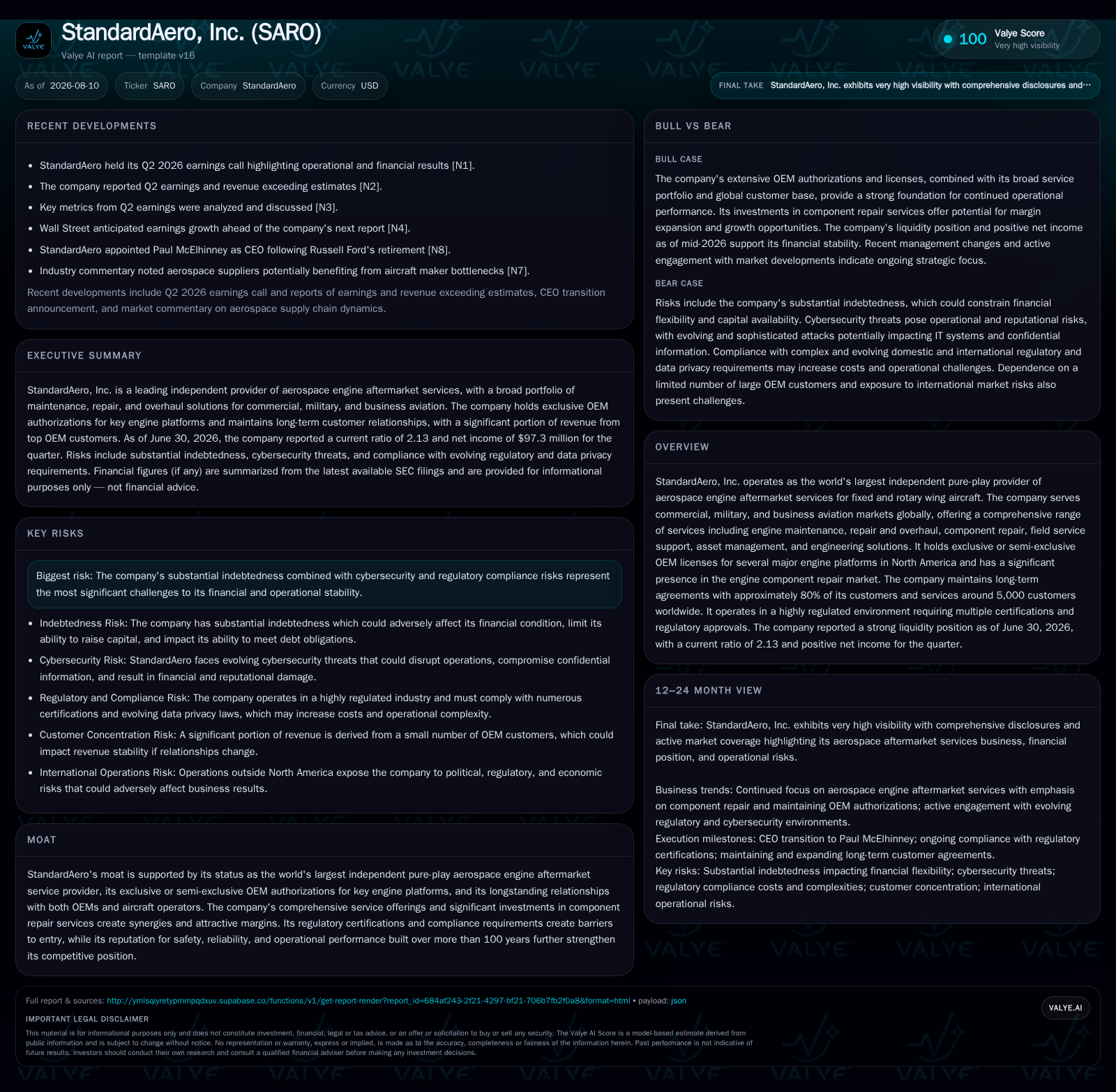
StandardAero, Inc. maintains its position as the largest independent pure-play aerospace engine aftermarket services provider through exclusive or semi-exclusive OEM licenses and long-term customer agreements. In Q2 2026, the company reaffirmed guidance and reported ongoing operational stability, with approximately 80% of revenue secured by long-term contracts supporting revenue visibility. However, a substantial debt load near $2.35 billion and associated credit covenant restrictions limit financial flexibility. The company's growth relies on expanding component repair synergies and capital investments in repair capabilities amid regulatory requirements and cybersecurity challenges.
Recent Operating Update
StandardAero’s Q2 2026 filing confirms continued operational steadiness with no material updates to risk factors since the previous full-year 10-K [S2]. The company issued financial results reinforcing its prior full-year guidance without revision [S3]. This consistency suggests stable demand conditions within commercial, military, and business aviation sectors served. The absence of new cybersecurity or regulatory compliance issues also indicates effective risk management programs remain in place [S1].
Business Model Overview
StandardAero operates as a specialized independent provider focused exclusively on aerospace engine aftermarket services — spanning scheduled and unscheduled Maintenance, Repair, and Overhaul (MRO), component repair, field service support, asset management, and engineering solutions [S1]. Its customer base includes approximately 5,000 global operators across commercial airlines, military fleets, and business aviation segments [S1], underscoring broad end-market exposure.
Revenue mechanics depend heavily on a mix of long-term service agreements and transactional business with repeat customers. About 80% of revenue is underpinned by multi-year contracts that provide predictable cash flows and client retention [S1], emphasizing revenue durability. Monetization occurs through fees tied to volume of engine/component repairs, service turnaround times, and contract-specific pricing structures.
Crucially, StandardAero holds exclusive or semi-exclusive original equipment manufacturer (OEM) authorizations for several major engine platforms in North America — including Rolls-Royce RB211-535 series engines, Honeywell HTF7000, Safran Arriel turboshafts, and early independent approval for CFM International LEAP-1 families [S1]. These licenses impose authorization fee payments plus royalties but confer meaningful competitive moats by limiting competitor access to high-value technical repair markets.
The company's growing Component Repair Services segment not only enhances margins through asset-intensive overhaul capabilities but also complements core engine service operations synergistically [S1]. This integrated approach enhances efficiency and creates cross-selling opportunities within client portfolios.
Operational strength further hinges on maintaining numerous regulatory certifications across FAA, EASA, military standards, and other national agencies that set high barriers to entry due to lengthy approvals and continuous oversight [S1]. Such compliance commitments increase fixed costs but reduce threat from new entrants lacking certification.
Industry Structure and Competitive Dynamics
The aerospace engine aftermarket services sector sits downstream from OEMs like General Electric Aviation or Rolls-Royce who tightly control authorized maintenance networks. Independent pure-play providers such as StandardAero must secure OEM licenses to remain relevant, making authorization count a critical KPI for competitive advantage.
Within this domain, companies compete on technical expertise breadth (number of authorized engine platforms serviced), turnaround efficiency (service cycle time), safety/compliance records, geographic service network coverage, and ability to provide integrated component repairs — which command superior per-unit economics.
Compared to peers that include OEM-affiliated MRO arms (e.g., GE Aviation MRO) or independent specialists (e.g., AAR Corp), StandardAero’s scale as the largest independent pure-play player coupled with important exclusivities in North America distinguish its market position. Extensive customer relationships foster stickiness given high switching costs tied to certification transfer and proven reliability records.
Growth Drivers
Several structural tailwinds underpin demand for StandardAero's offerings:
- Expanding global commercial aircraft fleet size increases absolute maintenance need.
- Aging fleets drive higher frequency of both scheduled overhauls and unplanned repairs.
- Growing trend among OEMs to outsource aftermarket services fosters third-party MRO volume growth.
- Regulatory mandates for safety assurance and emissions affect overhaul standards,
- Increasing business/regional aviation sectors expand total addressable market,
- Component repair services growth brings diversification into other industrial applications (marine/oil & gas) leveraging existing capacity,
- Long-term agreements with customers stabilize cash flows enabling investment planning.
These drivers collectively suggest that volume growth alongside improving mix toward higher-margin components will likely enhance operating margin potential over time if managed effectively.
Risks and Watchpoints
Key risks center first on StandardAero’s substantial indebtedness which stood at roughly $2.35 billion as of June 30, 2026 [F1]. While the company maintains a healthy current ratio above 2.13x supporting short-term liquidity [F1], heavy leverage places constraints on strategic flexibility due to restrictive covenant packages embedded in credit agreements [S4][S5][S6][S8]. These covenants limit acquisitions, asset sales, dividend payments, incremental indebtedness incurrence, and impose financial metrics thresholds which must be adhered to avoid default scenarios.
Interest rate exposure due to variable-rate borrowings could lead to increased interest expense if rates continue rising — partially mitigated by interest rate swaps though not guaranteed for full coverage [S8]. Maintaining compliance with debt covenants amid cyclical or macroeconomic downturns is an area warranting close monitoring.
Regulatory compliance risks remain prominent given the strict certification environment; any lapses could lead to payment withholding or sanctions impacting revenue recognition [S14][S15]. Additionally cybersecurity threats target proprietary information systems critical for operational continuity; evolving attack vectors necessitate ongoing investments in IT security controls [S1].
Customer concentration is another watchpoint: the top four OEM-related clients represent roughly one-third to two-fifths of total revenue historically [S1][S9], exposing the company to demand shifts among large operators or policy changes at these customers.
Finally technological obsolescence poses risk given rapid development cycles in newer engine designs. Failure to renew or secure new OEM authorizations would erode addressable market access long-term [S1].
What To Watch Next
Upcoming operational indicators include quarterly bookings data from long-term contract renewals and any announcements around expansion of OEM license rights beyond current platforms or geographies. Capital expenditure trends toward expanding component repair capacity will signal commitment to profitable niche segments.
Any commentary related to cybersecurity incident mitigation progress will also be relevant given industry-wide heightened risk profiles.
Finally industry-wide fleet utilization statistics tied to commercial airline schedules indirectly inform aftermarket demand trends; sustained growth in flight hours typically drives increased MRO volumes benefiting StandardAero’s business [N1][N2][N3]
Financial Profile Discussion
As of June 30, 2026, StandardAero carried total debt approximating $2.35 billion against current assets near $3.03 billion producing a current ratio above 2.13x — signaling manageable short-term liquidity despite significant leverage [F1]. The net debt figure coincides closely with total debt given limited cash equivalents held.
Overall credit discipline balanced with measured reinvestment in higher-margin component repair capabilities appears essential for long-term financial health.
This analysis synthesizes StandardAero’s latest SEC filings as of August 2026 with industry contextual insights specific to aerospace engine aftermarket services. No investment advice is provided herein; readers should perform their own thorough due diligence before engaging commercially or financially with the company.
Disclaimer: This is research-only, informational analysis and not investment advice. It may include AI-generated interpretation and general industry context. Always verify important details using primary sources.

Comments