
Praetorian Acquisition Corp. Capitalizes on Experienced Management and AI Focus in SPAC Space
A recently completed IPO positions Praetorian Acquisition Corp. to pursue business combinations targeting automation-enabled traditional industries.
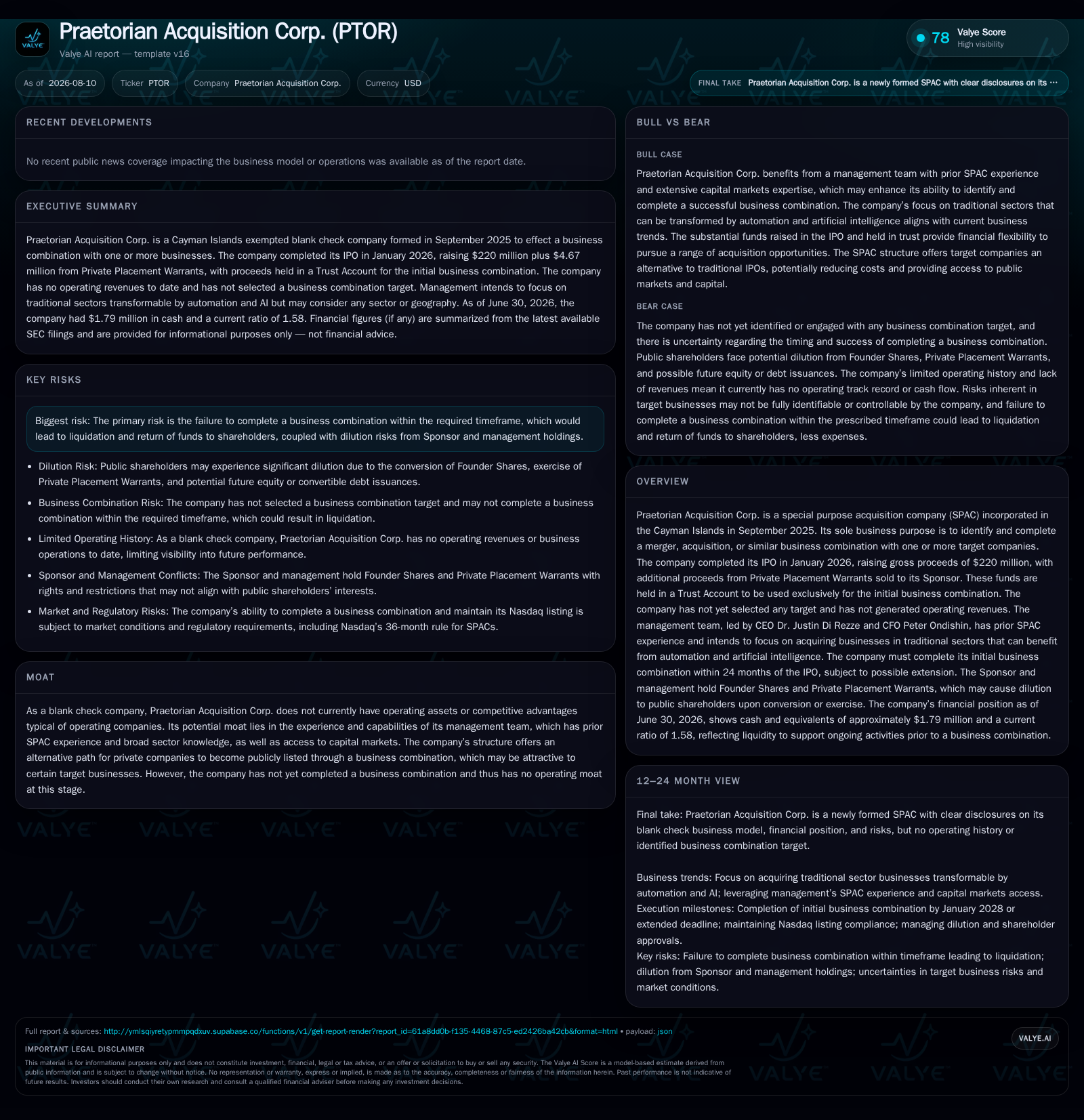
Praetorian Acquisition Corp. is a Cayman Islands-incorporated SPAC that raised $220 million through its January 2026 IPO, aiming to identify and merge with private companies primarily in traditional sectors benefiting from automation and AI. The company has no operating revenues as expected for a blank check company but holds substantial funds in a trust account, strictly invested per regulatory guidelines. Its management team's prior SPAC experience and broad capital markets access underpin its competitive positioning. Key risks include the pressure to complete a qualifying business combination within the mandated timeframe and dilution from warrants and founder shares. Near-term progress hinges on effective target evaluation and navigating redemption dynamics.
Recent Operating Update
Praetorian Acquisition Corp., incorporated in September 2025 as a Cayman Islands exempted company, successfully completed its initial public offering (IPO) on January 26, 2026. The IPO raised gross proceeds of $220 million through the sale of 22 million units priced at $10 each. Alongside this, the Sponsor purchased 4.67 million private placement warrants at $1 per warrant, adding approximately $4.67 million in gross proceeds [S1][F1]. These proceeds, net of underwriting fees totaling more than $9 million (including deferred underwriting fees), were placed into a trust account managed under strict SEC guidelines that allow investment only in U.S. government treasury obligations with maturities of up to 185 days or highly regulated money market funds [S1]. As of the quarter ending June 30, 2026, the company reported cash and cash equivalents of roughly $1.79 million with total current assets near $2 million against liabilities just above $1.25 million, yielding a current ratio of 1.58—signaling solid liquidity to support ongoing search activities ahead of any business combination [F1].
Business Model
As a Special Purpose Acquisition Company (SPAC), Praetorian's core business model revolves around raising capital via an IPO and holding such funds in trust until it identifies a suitable private company for merger or acquisition—effectively taking that target public without the conventional IPO process. The company does not produce goods or services nor generate operating income before the completion of this "de-SPAC" transaction.
Revenue generation will commence only after completing a business combination when Praetorian either receives consideration via cash or equity share exchanges involving the target entity's owners [S1][S14]. Its immediate revenue mechanics involve interest income earned on trust account investments (non-operating income) while incurring general administrative expenses related to regulatory compliance, due diligence efforts on prospective targets, and maintaining public company status
Praetorian’s management intends to focus acquisitions on traditional industries susceptible to transformation through automation and artificial intelligence technologies—a strategic angle meant to leverage both sector trends favoring digital integration and their own cross-border capital markets expertise [S25]. This selective approach aims to add value post-merger by bringing operational enhancements alongside public market liquidity.
Industry Structure and Competitive Position
In the broader SPAC ecosystem characterized by numerous blank check entities racing to identify viable merger targets before deadline expirations (typically within two years), Praetorian differentiates itself through a seasoned management team led by CEO Dr. Justin Di Rezze and CFO Peter Ondishin who previously engaged with similar vehicles. Their combined industry insights across various sectors and public market familiarity provide credibility crucial for sourcing quality deals [S1].
Praetorian operates within a crowded landscape featuring established large SPACs like Pershing Square Tontine Holdings that compete primarily by scale and brand reputation alongside investment banking firms underwriting traditional IPOs offering an alternative route for private companies seeking public listing. Unlike traditional IPOs prone to protracted preparation periods subject to volatile market conditions, SPACs like Praetorian offer accelerated timelines with upfront committed capital enhancing deal certainty—although at the expense of dilution risks inherent in sponsor-founder shares and warrants structure.
Growth Drivers
Growth potential stems principally from private companies' increasing appetite for alternative public listing methods beyond traditional IPO processes complicated by heightened regulation and market volatility. Innovation trends around automation and artificial intelligence bolster demand for capital infusion in traditional sectors poised for digital transformation—areas aligned with Praetorian’s targeted focus [S25].
The ability to raise considerable capital expeditiously via well-structured offerings including private placement warrants adds financial firepower not only accelerating deal closures but also providing optionality for structuring transactions encompassing cash plus equity swaps—attractive bargaining chips when engaging potential targets.
Prominent growth indicators include time efficiency toward completing an initial business combination before impending liquidation deadlines, retention of investor confidence reflected by shareholder approval rates for proposed mergers, balanced redemption behavior limiting excessive cash outflows at closing stages, and eventual warrant exercise rates signaling investor optimism post-deal completion.
Risks and Constraints
Praetorian faces significant execution risks typical among newly formed SPACs without revenue-generating operations or locked-in targets: foremost is failure to consummate a qualifying business combination within approximately two years commencing from IPO closure—triggering mandatory liquidation returning invested capital minus expenses thereby terminating growth prospects.
Dilution emanates from founder shares granted at nominal prices as incentives alongside private placement warrants held by Sponsor entities convertible into equity following de-SPAC transactions; these can substantially dilute public shareholders’ stakes depending on deal structures and warrant exercises post-merger [S1][S25]. Conflicts of interest may arise given management’s ability to sponsor multiple SPAC vehicles concurrently or pursue other ventures potentially diverting attention or deal flow opportunities.
Regulatory scrutiny intensifies as time progresses toward redemption windows where public investors decide whether to exit prior mergers impacting available transaction proceeds; adverse shareholder vote outcomes could imperil deal completion or financing feasibility forcing alternative arrangements introducing subordinated debt or equity raises which further dilute ownership stakes.
Monitoring these indicators provides insight into Praetorian’s operational momentum toward unlocking public market exposure for its eventual target while assessing shareholder alignment amid dilution trade-offs.
Financial Profile Discussion
Praetorian maintains a clean pre-business combination balance sheet characteristic of blank check companies: As of June 30, 2026, it held approximately $1.79 million in cash and equivalents amidst total current assets near $2 million with current liabilities at roughly $1.25 million culminating in a current ratio comfortably above one at 1.58—constituting adequate liquidity coverage during its acquisition search phase [F1]
Operating expenses mainly comprise general administrative costs incurred for compliance activities including legal fees, audit costs, SEC reporting requirements, due diligence processes on prospective transactions, plus monthly service payments under Administrative Support Agreements with affiliates aligned with Sponsor interests [S15][S26].
The trust account balance approximates over $220 million immediately following the IPO net fees; these funds are ring-fenced solely for deployment pursuant to consummation of an eligible business combination or returned upon liquidation ensuring principal protection subject only to minimal permitted withdrawals mainly related to tax payments and liquidation expenses [S1][S23]. This custodial arrangement ensures high cash conversion integrity as Praetorian advances through target evaluation stages.
Sponsor-related financial arrangements include Founder Shares issued at nominal value conferring substantial upside participation contingent on successful de-SPAC outcomes while private placement warrants provide incremental capital buffer potential albeit dilutive risks upon exercise requiring pragmatic monitoring as transaction timelines advance [S25][S28].
Overall financial stability supports sustained operational runway essential given typical early-stage SPAC cost burn dynamics before tangible revenue streams commence following completed mergers.
This analysis is based solely on publicly filed documents including recent SEC submissions up to August 7, 2026 ([S2],[S1]) along with company facts data ([F1]) reflecting latest balance sheet snapshots consistent with industry-standard assessment frameworks applied herein considering SPAC structural dynamics without speculative assumptions about unannounced deals or future performance.
Disclaimer: This is research-only, informational analysis and not investment advice. It may include AI-generated interpretation and general industry context. Always verify important details using primary sources.

Comments