
Quest Resource Holding Navigates Cash Constraints with Operating Losses in Q2 2026
Quest Resource Holding's Q2 results underscore operational losses and tight liquidity within a capital-heavy environmental services sector.
Quest Resource Holding Corp’s Q2 2026 quarterly filing reveals continuing net losses and constrained liquidity, reflecting the capital-intensive nature of waste management operations. The company’s revenue model relies heavily on tipping fees, recycling commodity sales, and contractual service agreements subject to renewal and pricing pressures. Facing competition from larger integrated firms with greater scale economies, Quest must improve operational efficiency and secure contract stability to support margin enhancement. Regulatory tailwinds offer growth potential, but current financial leverage and working capital limitations impose near-term risks.
Q2 Operating Results Show Persistent Losses Amid Tight Liquidity
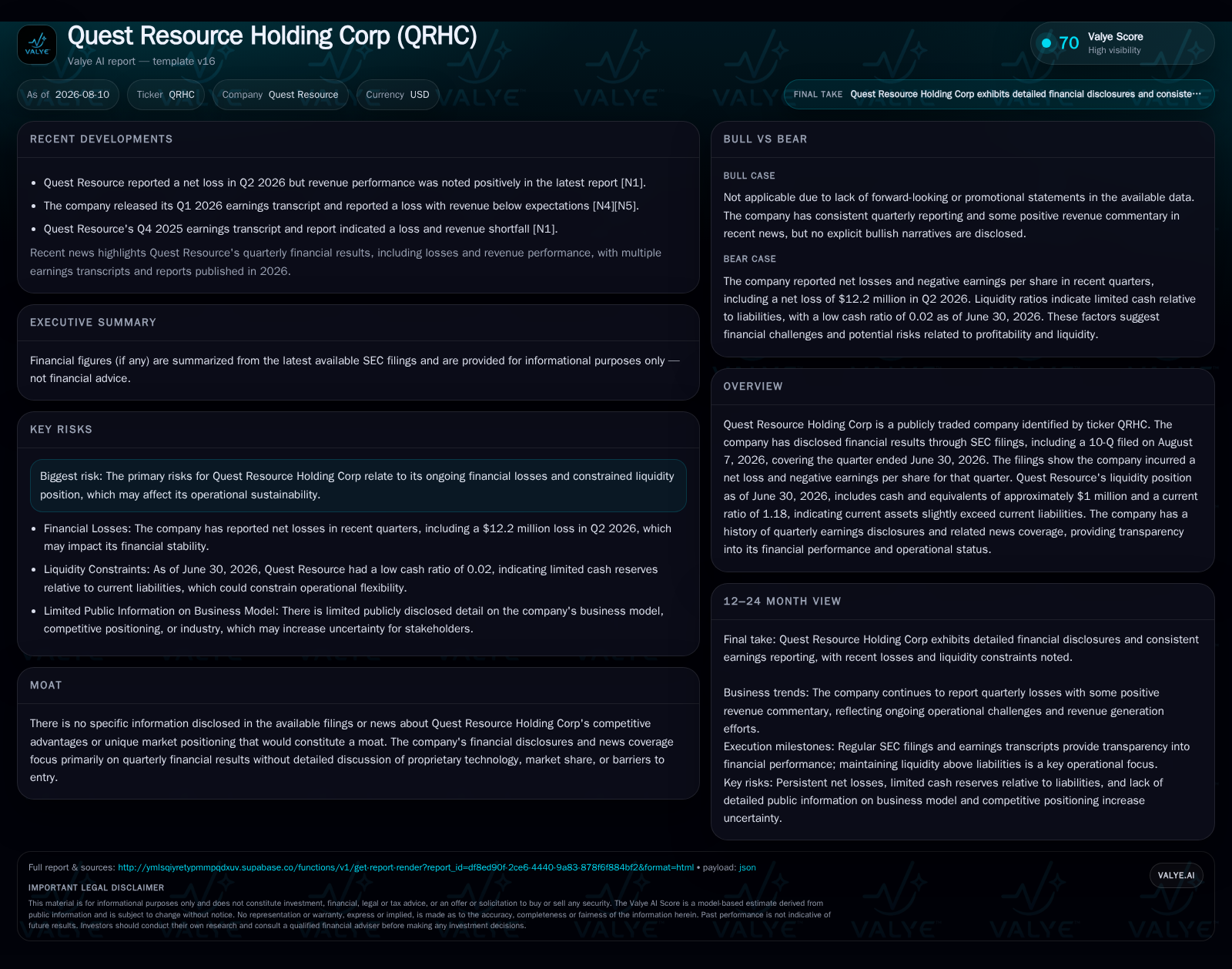
Quest Resource Holding Corp's latest quarterly report for the period ended June 30, 2026, filed August 7th, reveals a continuation of operating losses contributing to a net loss position alongside negative earnings per share [S2][S3][F1][N1]. The company disclosed cash and equivalents of roughly $1.02 million paired with total debt near $64.3 million as of quarter-end [F1], resulting in a current ratio modestly above parity at 1.18 [F1]. Persistent operating deficits exacerbate cash burn pressures, limiting flexibility in funding fleet maintenance, processing facilities, or working capital required to sustain efficient collection routes and processing throughput—a chronic challenge in midstream environmental service providers reliant on physical infrastructure.
Core Business Mechanics: Revenue Sources and Cost Structure in Midstream Waste Management
Quest operates within the environmental services sector primarily through municipal solid waste (MSW) collection, sorting, processing, recycling commodity resale, and landfill management services [S1]. Revenues stem chiefly from contractual service agreements including tipping fees levied per ton of waste handled—typically under multi-year municipal or commercial contracts—and proceeds from the sale of recycled materials collected through these flows [S1]. Contract terms influence pricing power; longer-duration arrangements provide steadier revenue but expose the company to renewal risk and variable price resets tied to commodity markets and regulatory changes.
Cost structure is heavily weighted towards fixed expenses related to facility capacity utilization and fleet management. Underutilization of processing plants inflates per-ton unit costs due to high fixed overheads, while inefficiencies in fleet deployment translate into elevated labor and fuel costs given the labor-intensity of collection routes [S1]. These factors suppress operating margins—as illustrated by losses recorded in recent quarters—while the volatile commodity pricing environment introduces additional margin pressure on recyclable sales.
Capital Intensity Meets Contract Risk: Competitive Positioning Challenges
In the context of industry peers such as Waste Management (WM) with extensive scale economies or Casella Waste Systems (CWST) focused on recycling efficiencies regionally, Quest faces inherently challenging competitive dynamics. Large integrated operators wield superior bargaining power in municipal tender processes due to broader geographic footprints and optimized asset bases enabling better cost spreads across capacity. Quest’s relatively constrained balance sheet precludes rapid capital investment into expanded or modernized processing facilities necessary to meet stringent environmental compliance standards.
The company's current ratio of approximately 1.18 showcases marginal ability to cover near-term obligations compared to peers who often maintain higher liquidity buffers under similar capital expenditure demands [F1]. Competitive pricing pressure in bid renewals combined with regulatory compliance cost escalation undermines Quest's negotiating leverage. Securing favorable contract renewal terms remains a pivotal hurdle as contracts constitute core recurring revenue channels.
Operational Metrics Spotlight: Tipping Fees, Capacity Utilization, and Contract Renewal Risks
Key performance indicators for Quest inherently reflect industry-standard focal points such as tipping fee revenue fluctuations sensitive to waste volume collected and commodity price trends. Capacity utilization rates of processing facilities materially impact cost efficiency; suboptimal throughput amplifies unit costs eroding operating margins further.
In addition to operational run rates, contract renewal rates represent critical revenue stability markers. Partial customer concentration typical among mid-tier regional operators can heighten vulnerability should key contracts not renew or face price concessions. Regulatory compliance incidents can impose additional financial penalties or remedial costs thereby increasing operational risks further.
Growth Opportunities Rooted in Sustainability and Regulatory Tailwinds
Demand-side growth drivers emerge from increasing global regulatory emphasis on sustainability mandates pushing municipalities toward zero-landfill targets and heightened recycling rate goals [S1]. These trends incentivize expanded service contracts covering advanced recycling solutions or waste diversion programs such as organics recovery. Corporate sustainability initiatives also propel demand for environmentally responsible disposal services beyond standard MSW treatment.
Government incentives supporting environmental infrastructure upgrades introduce an external catalyst potentially facilitating Quest's capacity expansions or process modernization projects if financial feasibility aligns. Urban population growth continues to feed incremental waste volumes requiring managed disposal flows—offering a fundamental volume growth underpinning if effectively captured amidst competition.
Nonetheless, Quest’s leveraged financial status tempers immediate growth execution prospects requiring prudent balancing of capital allocation between sustaining operational stability versus scaling new initiatives.
Headwinds: Financial Strains, Regulatory Exposure, and Market Competition
The company confronts multiple risk vectors including more stringent environmental regulations increasing operating compliance costs alongside volatile commodity markets pressuring recyclable material margins [S10][F1]. Debt servicing obligations approximate $64 million against very limited cash reserves (~$1 million), heightening refinancing risk especially without visible margin improvements or meaningful free cash flow generation [F1].
Operationally aging fleet assets pose potential downtime risks that can disrupt collection route adherence thereby decreasing capacity utilization adversely impacting financial results. Market rivalry from entrenched large-scale players exercises downward pricing pressure challenging Quest’s ability to maintain or grow footholds within contested municipal territories.
These factors collectively constrain the firm’s capacity to invest proactively in technology upgrades or pursue accretive acquisitions targeted at bolstering scale advantages.
Key Milestones Ahead: What Investors Should Watch Next
Upcoming indicators critical for assessing Quest’s operating trajectory include public disclosures related to contract renewal outcomes—key evidence of revenue durability—and margin trend shifts reported in subsequent earnings reports [S2][S3][N1]. Regulatory updates imposing new compliance requirements could materially affect cost dynamics either positively through incentives or negatively via mandated expenditures.
Monitoring capacity utilization trends for facility throughput provides leading insight into operational efficiencies being realized amid efforts to stabilize margins.
Financial Profile Discussion: Liquidity Tightness Amid Heavy Debt Obligations
At quarter close June 30, 2026, Quest held cash & equivalents totaling approximately $1 million juxtaposed against total debt nearing $64 million—a net leverage level indicative of substantial financial strain within its capital-intensive business model [F1][S2][S3]. The current ratio of 1.18 confirms a marginal working capital cushion barely sufficient for routine operational needs but inadequate against unexpected disruptions or capex spikes common in this sector [F1]. Negative earnings recorded compound pressure by accelerating cash consumption necessitating vigilant focus on operational improvement initiatives or equity/debt raises.
Without demonstrable progress improving operating income or securing extended contractual commitments reducing revenue variability risk, the company’s refinancing window remains narrow. As such, sustainable profitability improvements directly link to alleviating financing stress—the linchpin holding Quest’s near-term viability together.
Disclaimer: This analysis is based exclusively on publicly available SEC filings dated up through August 7, 2026, supplemented by industry-standard environmental services sector insights. It does not constitute investment advice but aims to provide an informed perspective on Quest Resource Holding Corp's operating context.
Disclaimer: This is research-only, informational analysis and not investment advice. It may include AI-generated interpretation and general industry context. Always verify important details using primary sources.

Comments