
FMCB Sustains Regional Banking Strength Through Personalized Service Amid Regulatory and Competitive Challenges
Farmers & Merchants Bancorp leverages its California branch network and SMB focus to navigate a complex regulatory landscape and intensifying competition.
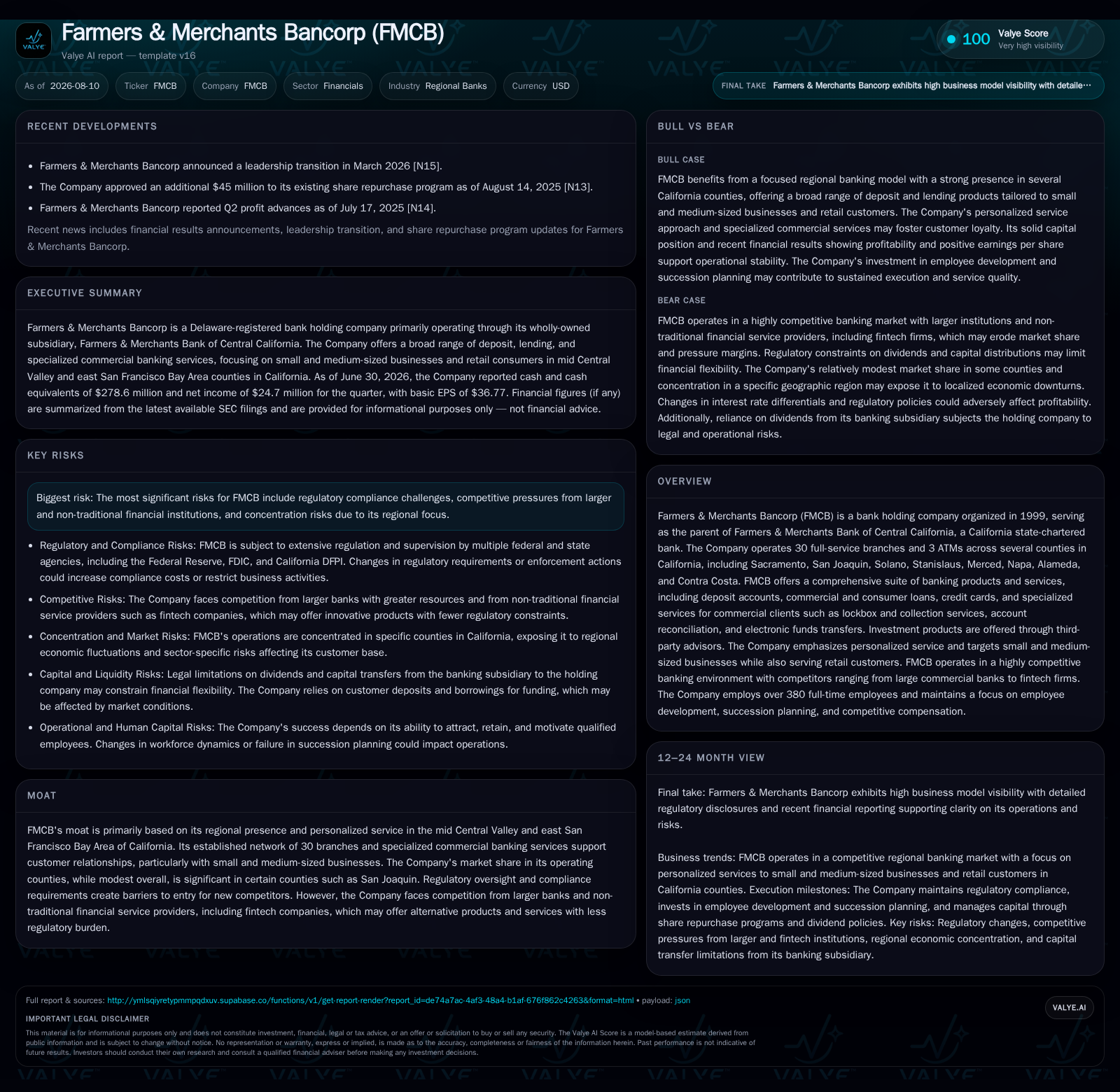
Farmers & Merchants Bancorp (FMCB) continues advancing its position as a regional bank serving California’s Central Valley and Bay Area with a focused network of 30 branches and specialized commercial banking products. The company’s business model concentrates on net interest margin from commercial and consumer lending complemented by fee-based services targeting small- and medium-sized businesses. Recent quarterly disclosures show no material risk factor changes, reflecting stability but ongoing exposure to interest rate volatility, credit risk in real estate-related loans, and regulatory pressures. FMCB’s competitive moat stems from personalized relationships in mid-sized markets but faces increasing pressure from larger banks and fintech entrants. Key growth drivers include local economic activity, potential loan portfolio expansion, and fee income growth, while risks center on geographic concentration and evolving compliance demands. Monitoring loan growth rates, deposit trends, asset quality metrics, and regulatory capital levels will be essential to assess operational momentum.
Recent Operating Update
Farmers & Merchants Bancorp (FMCB) filed its latest quarterly report on August 7, 2026 [S2], reiterating the previously disclosed risk factors without material changes and confirming steady operating conditions. The company draws primary attention to regulatory compliance costs during an evolving environment shaped by federal agencies including the FDIC and California Department of Financial Protection and Innovation (DFPI). No new adverse developments or major shifts in asset quality or liquidity were reported, indicating operational consistency quarter-over-quarter. FMCB also released an investor presentation on July 23, 2026 reaffirming its strategic focus areas [S3].
Business Model Overview
FMCB functions as a bank holding company headquartered in Delaware but wholly serving California through Farmers & Merchants Bank of Central California. With origins dating back to its state-charter in 1916 under a non-Federal Reserve regime [S1], FMCB manages a modestly scaled footprint of approximately 30 branches complemented by three ATMs across diverse counties such as Sacramento, San Joaquin, Solano, Stanislaus, Merced, Napa, Alameda, and Contra Costa [S1]. This localized branch network supports traditional banking engagement in community banking style.
Revenue generation primarily hinges on net interest margin earned from lending activities—commercial loans targeting small- and medium-sized business clients form a cornerstone of the loan portfolio structure augmented by consumer loans. Deposit accounts provide stable funding sources insured through the FDIC framework up to legal limits [S1]. Fee income derives from ancillary commercial services including lockbox arrangements, collection services, electronic funds transfers, account reconciliation solutions plus third-party investment product referrals [S1]. The firm emphasizes personalized relationship management leveraging local knowledge to differentiate versus both national banks and fintech providers.
Dividends paid by the bank subsidiary represent the main source of cash for the holding company while legal limits on dividend payments reflect capital adequacy priorities [S13]. The bank maintains no outstanding Federal Home Loan Bank (FHLB) advances or Federal Reserve borrowings at present [S5].
Industry Structure and Competitive Position
Operating within California's mid Central Valley extending into eastern San Francisco Bay Area gives FMCB tailored regional exposure rather than broad national scale [S1]. Its moat centers on intimate client relationships fostered through physical branches which remain relevant for SMEs requiring bespoke financing options alongside operational support. Regulatory barriers in this sector—driven by FDIC deposit insurance safeguards coupled with state-level oversight—restrict new entrants but pose compliance cost burdens even for incumbents like FMCB [S6], [S16].
Competition is multifaceted: large national banks bring breadth of products but may lack intimate local ties; community banks share geographic market but possibly differ in service sophistication; emerging fintech companies compete on convenience offering alternative credit solutions with lighter regulation [S19]. FMCB’s strategy of emphasizing service personalization positions it distinctively but necessitates vigilance given industry innovation dynamics especially given the rising regulatory scrutiny around AML/BSA compliance obligations [S27].
Key Growth Drivers
Local economic health remains critical for loan demand particularly from sectors such as agriculture-related businesses prevalent in certain counties served by FMCB—this segment's vulnerability to economic cycles directly impacts credit performance [S14]. Modestly rising interest rates seen recently support net interest margin improvement potential as lending yields may increase faster than funding costs under controlled deposit pricing.
Expanding fee-based services offers diversification away from pure interest income; enhancements in digital banking channels could augment customer acquisition and retention beyond purely physical branch dependence. Incremental branch network optimization or acquisitions could incrementally raise market penetration though regulatory approvals remain an important gating factor [S15]. Maintaining sound credit underwriting amidst sector-specific risks like construction loans requires disciplined portfolio management.
Risks and Watchpoints
Geographic concentration places FMCB at risk if macroeconomic conditions deteriorate disproportionately within its service area. The loan portfolio's significant exposure to commercial real estate (CRE) loans including acquisition, development, and construction (ADC) segments notably requires ongoing management since these can exceed advisory guidance ratios set by regulators—heightened supervisory scrutiny would trigger remedial actions such as raising capital or reducing concentrations if thresholds breach current levels [S14]
Regulatory compliance risks are paramount given intensifying reviews especially concerning anti-money laundering statutes and fair lending laws; failure could result in penalties or restrictions impacting growth initiatives. Additionally, interest rate risk presents dual threats to margin optimization if funding costs outpace asset yields or vice versa.
Competitive disruption from fintechs offering non-traditional banking services may erode customer wallet share particularly among digitally savvy segments unless digital experiences improve sufficiently within FMCB’s offerings. Lastly, changing federal policies around banking oversight add uncertainty regarding future operational constraints.
What to Watch Next
Monitoring the company's quarterly updates for trends in loan growth rates relative to local economic indicators will signal demand momentum. Deposit base size and composition shifts provide insights into funding cost dynamics relevant for sustaining net interest margins. Asset quality metrics including non-performing loans ratio and provision for credit losses are critical gauges of portfolio resilience especially within CRE sectors.
Regulatory capital ratios tracked against Basel III minimums should confirm ongoing surplus capacity ensuring unencumbered dividend flow while maintaining buffer against adverse cycles [S12], [S17]. Progression of digital channel investments or any branch expansion plans announced in investor communications merit examination for scalability impact.
Upcoming regulatory developments from bodies like the FDIC on rules defining "unsafe or unsound practices" could materially affect compliance landscape affecting day-to-day operational expenses.
Financial Profile Discussion
As of June 30, 2026, FMCB held $278.6 million in cash and equivalents providing solid liquidity to fund operations or buffer market shifts [F1]. The bank maintains no outstanding Federal Home Loan Bank (FHLB) advances or Federal Reserve borrowings at present [S5].
This analysis aggregates recent regulatory filings combined with industry-contextual framing pertinent to regional banks operating within competitive Californian markets focused on commercial SMB clientele. It highlights FMCB's steady execution balancing personalized service delivery with prudential financial management while navigating evolving macroeconomic uncertainties alongside technological disruption pressures.
Disclaimer: This analysis does not constitute investment advice or research views. It aims solely to provide a detailed operating overview grounded in the latest disclosed information subject to future developments beyond current public filings.
Disclaimer: This is research-only, informational analysis and not investment advice. It may include AI-generated interpretation and general industry context. Always verify important details using primary sources.

Comments