
AMN Healthcare Leverages Strategic Acquisitions and Technology Amid Staffing Market Volatility
AMN Healthcare’s 2026 Q2 results highlight ongoing integration of acquisitions, technology divestiture impacts, and resilience in demand for healthcare staffing services.
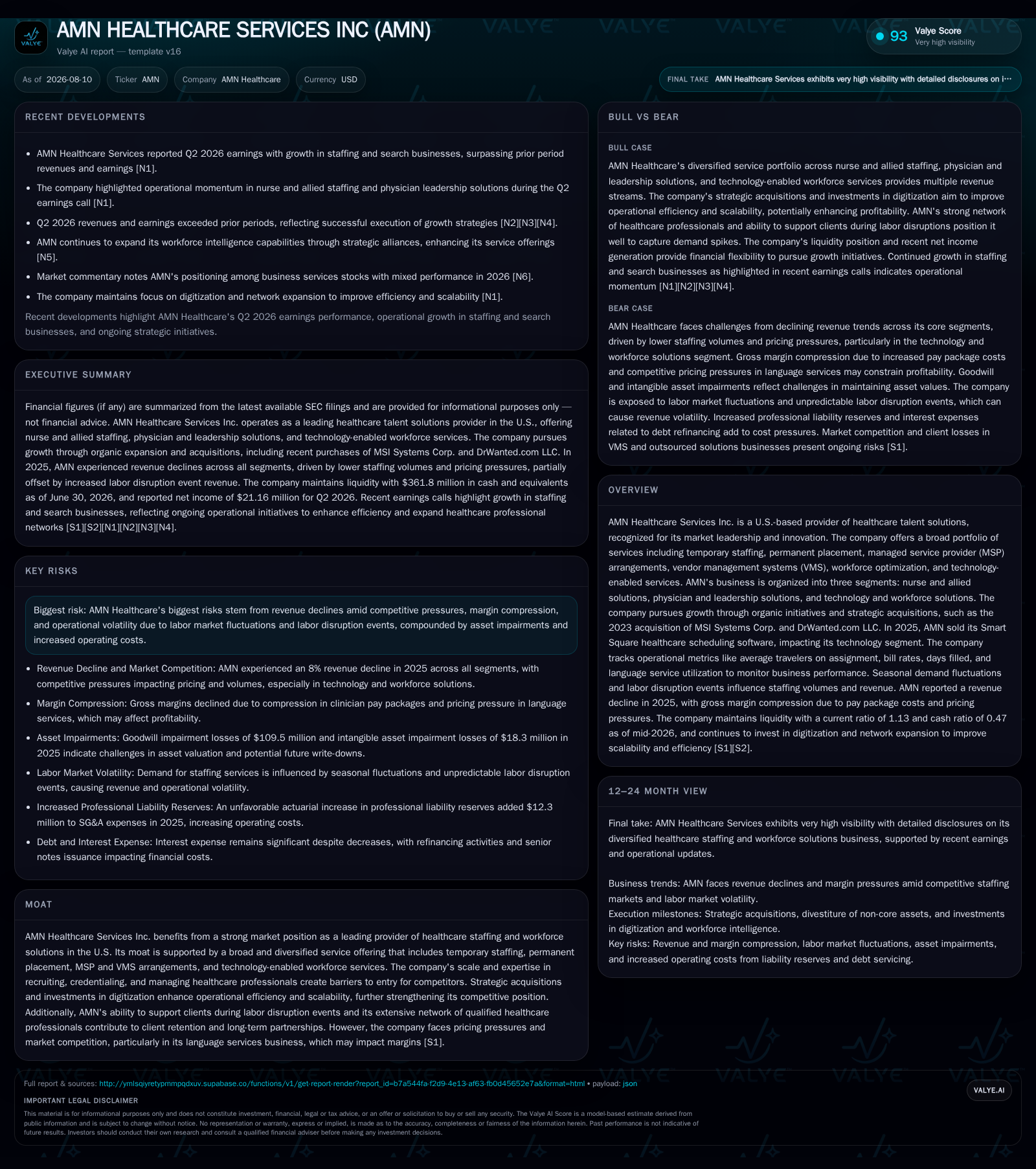
In Q2 2026, AMN Healthcare Services continued to solidify its position as a leading U.S. healthcare staffing and workforce solutions provider, driven by broad service offerings across temporary staffing, permanent placement, MSP/VMS contracts, and workforce optimization services. The company is managing a transition following the 2025 divestiture of its Smart Square scheduling software while integrating its 2023 acquisitions. Operational metrics such as traveler assignments and bill rates point to market stabilization despite pricing pressures. AMN’s capital structure remains supported by strong liquidity and manageable debt, enabling ongoing investment in growth initiatives. Key risks include labor market tightness and margin compression from competitive dynamics.
Recent Operating Update: Q2 2026 Performance Overview
AMN Healthcare Services’ latest quarterly filing for the period ending June 30, 2026 reveals continued operational resilience amidst an evolving healthcare staffing landscape [S2][S3]. The company reported ongoing growth in its core nurse and allied solutions segment alongside momentum in physician and leadership staffing services. This reflects successful integration of strategic acquisitions made in late 2023 — notably MSI Systems Corp. and DrWanted.com LLC — which have broadened AMN’s footprint particularly in locum tenens and advanced practice placements [S1][S11].
The divestiture of the Smart Square healthcare scheduling software concluded mid-2025 has led to a recalibration of the technology segment focus toward higher-value recurring revenue streams from managed service provider (MSP) arrangements, vendor management systems (VMS), workforce optimization services, and other tech-enabled offerings [S1][S24]. While the sale reduced direct technology product revenues, it allows AMN to concentrate resources on integrated technology platforms that support large-scale client workforce programs.
Operationally, key metrics such as average number of travel nurses on assignment and stabilized bill rates indicate moderated demand swings compared to prior years marked by labor disruptions [S29]. Bill rates have remained relatively flat or slightly higher sequentially across nursing assignments despite price sensitivity pressures prevalent industry-wide. AMN’s ability to supply qualified clinicians promptly during labor dispute spikes remains a competitive advantage fostering durable client relationships.
Business Model: Hybrid Staffing Solutions with Technology Enablement
AMN operates a hybrid healthcare talent solutions business combining traditional temporary staffing with permanent placement services alongside more strategic managed programs encompassing MSP/VMS contracts paired with workforce optimization technologies [S1]. Revenue derives primarily from bill rates charged per hour or shift for deployed healthcare professionals, fees from permanent placements, recurring contract-based fees under MSP agreements, and subscription or usage charges for software platforms embedding workflow efficiencies.
The nurse and allied segment encompasses travel nursing—often including international placements—and allied health specialties such as revenue cycle management [S16]. Physician and leadership solutions cover locum tenens staff filling temporary physician shortages plus interim healthcare executives’ placements. The third segment focuses on technology-driven workforce solutions including language services, outsourcing models, VMS adoption facilitating client-controlled vendor ecosystems, and performance analytics enabling client cost containment.
AMN’s monetization mechanics rely heavily on maintaining large credentialed pools of healthcare professionals while retaining key client accounts via customized workforce programs able to absorb fluctuations due to patient volume or labor disputes. Recurring fees from managed programs afford more predictable income than purely transactional staffing revenues but require upfront investments in systems integration and service delivery scale.
Industry Structure & Competitive Positioning
Within the U.S. healthcare staffing industry—a fragmented market increasingly favoring integrated MSP/VMS arrangements—AMN stands out for combining extensive recruiter networks with proprietary technology enabling scalable programmatic workforce management. Peers such as Cross Country Healthcare also pursue this combination; however, AMN’s scale benefits both candidate sourcing depth and breadth of credentialing capabilities.
Market entrants face high barriers related to compliance complexity (credentialing healthcare professionals meets stringent regulatory hurdles across states), labor union relations where present (with unionized markets valuing AMN’s proven labor disruption support), and technological sophistication demands embedded in next-generation vendor management platforms [S1]. Competitive differentiation hinges on client retention through consistent staffing fulfillment rates (“days filled”), pricing power on bill rates per hour driven partly by specialty supply scarcity (e.g., CRNAs), and ability to expand into adjacent services such as permanent executive search.
Margins on traditional staffing services typically oscillate mid-20% to mid-30%, while technology-enabled segments often command higher-margin profiles. AMN’s approach balances these by leveraging cross-segment synergies—technology bolsters program delivery scale while broad staffing networks generate volume-based operating leverage.
Growth Drivers
Fundamental structural growth drivers for AMN include:
- Healthcare professional shortages: Persistent nurse shortages amplify demand for flexible temporary staffing models that AMN supplies through travel nurses and allied roles.
- Healthcare providers’ need for scalable workforce solutions: Increasing complexity of labor regulations coupled with cost-containment pressures drives provider adoption of MSP/VMS frameworks that outsource vendor selection efficiency to specialists like AMN.
- Technology adoption: Rising use of digital workforce optimization tools presents incremental upsell opportunities beyond pure staffing execution.
- Labor disruption-induced demand spikes: While unpredictable in timing, strikes or union actions generate episodic surges benefiting agile providers equipped for rapid deployment.
- Strategic acquisitions: The MSDR acquisition expanded specialist clinician placements; further buying opportunities can deepen vertical market penetration or geography.
- Growth in outpatient/specialty care settings: These sectors require diverse staffing mixes aligning well with AMN’s cross-specialty capabilities.
Monitoring KPIs such as MSP contract count growth, VMS adoption rate improvements among legacy clients, fill rates for open shifts, revenue per billable hour trends across specialties, traveler network size expansion, and client retention metrics will indicate execution strength against these drivers.
Risks & Watchpoints
Key risks facing AMN encompass:
- Revenue volatility: Dependent largely on fluctuating demand for temporary staff driven by macroeconomic cycles and episodic labor events.
- Margin pressure: Pricing competition intensifies as new vendors enter or existing clients renegotiate contracts amidst budget constraints.
- Operational challenges: Tight labor markets constrain availability of credentialed clinicians impacting fill rates.
- Regulatory compliance: Credentialing errors or delays expose reputational risk; evolving state regulations require process agility.
- Labor disruption unpredictability: Although a source of incremental revenue during strikes/union actions, sudden resolved disputes can leave capacity underutilized.
- Acquisition integration risks: Failure to realize synergies from recent deals could strain costs without corresponding returns.
- Technology risks: Slow adoption of new platforms or cybersecurity vulnerabilities could hamper service continuity or client confidence.
- Concentration exposure: Dependency on marquee clients creates revenue concentration risk if contracts lapse unexpectedly.
- Economic pressures: Reduced healthcare spending during downturns could restrict client budgets for supplemental staffing.
- Reputational damage: Poor quality placements erode trust essential for repeat business retention.
Close tracking of monthly fill rates against targets, changes in bill rates relative to peers signaling pricing elasticity shifts, MSP contract renewal cadence deviations versus historical norms, credentialing turnaround times, recruitment funnel health indicators (active candidates), technological platform user engagement statistics, along with margin trajectory will help flag emerging headwinds early.
What to Watch Next
Market participants should observe:
- Quarterly updates on average travelers on assignment within nursing versus physician segments highlighting demand durability post-acquisition.
- Bill rate trajectory especially across specialized roles like CRNAs indicating market pricing power or compression trends [S29].
- Recurring revenue contribution mix evolution emphasizing gains in MSP/VMS managed contracts versus one-off placements clarifying shift toward steady cash flows [S1].
- Client retention rate disclosures underpinning lasting partnerships critical under competitive talent sourcing conditions.
- Announcements of further M&A activity targeting niche specialty providers or innovative workforce tech players enhancing ecosystem breadth.
- Progress reports on digitization investments delivering operating leverage measured through improving gross margin percentages amid revenue growth periods.[S1]
- Impact assessment from recent regulatory developments affecting credentialing or labor relations detailing compliance cost implications [S10].
Financial Profile Discussion
As of June 30, 2026, AMN Healthcare holds approximately $362 million in cash and equivalents with current assets totaling about $869 million against current liabilities near $770 million, resulting in a current ratio around 1.13—reflective of adequate short-term asset coverage [F1][S2]. Total debt was approximately $775 million as of December 31, 2025, with net debt around $413 million after accounting for cash balances [F1].
Overall financial health underscores capacity to fund innovation-led expansion while absorbing near-term margin variability associated with integrating new businesses amid sector cyclicality [F1][S2]
Disclaimer: This analysis is provided solely for informational purposes based on publicly available filings dated through August 7, 2026. It does not constitute investment advice or research views regarding securities transactions.
Disclaimer: This is research-only, informational analysis and not investment advice. It may include AI-generated interpretation and general industry context. Always verify important details using primary sources.

Comments