
ARKO Corp. Advances Dealerization and Subsidiary IPO as Fuel Retail Faces Volatility
Second quarter results highlight progress in ARKO's transformation plan amid competitive fuel retail and wholesale dynamics.
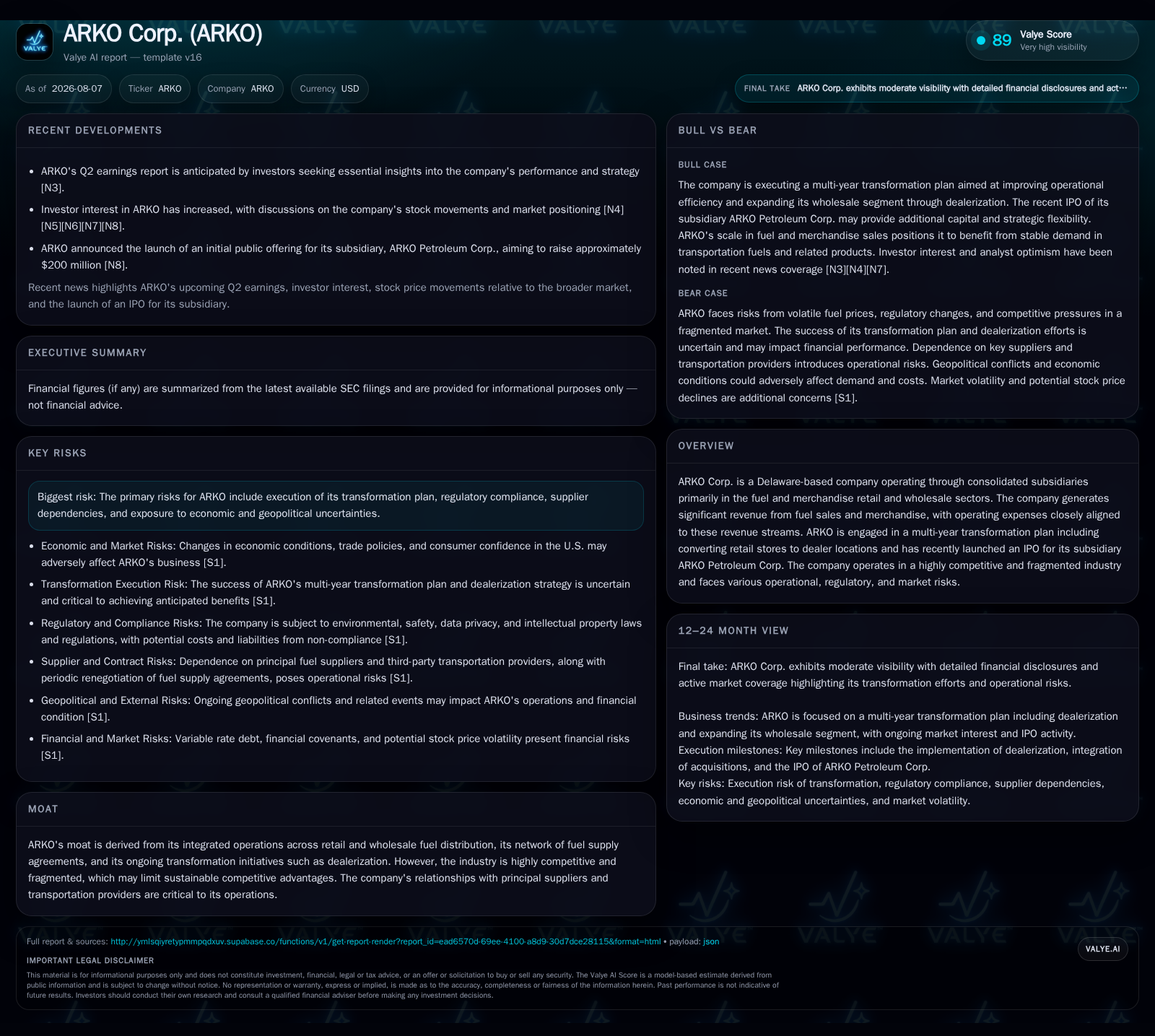
ARKO Corp.'s latest quarter reflects ongoing execution of its multi-year dealerization strategy, aiming to shift retail locations into dealer-operated sites to enhance capital efficiency. The company also completed a minority IPO of its ARKO Petroleum Corp. subsidiary, affecting capital structure and operational focus. Despite facing fuel price volatility and a fragmented market, ARKO leverages integrated wholesale and retail fuel supply agreements, with growth supported by fleet fueling services. Key risks include execution risks of dealerization, supplier dependencies, and regulatory compliance.
Recent Operating Update: Q2 2026 Performance Anchors Transformation Progress
ARKO Corp.'s second quarter filing for the period ended June 30, 2026 reveals a critical inflection point in its multi-year strategic transformation [S2],[S26]. The company moved to an operating income of $30.4 million, a rebound from previous losses, highlighting execution gains amid a highly fragmented and competitive fuel retail and wholesale sector. Total revenues rose substantially driven by both fuel and merchandise sales volume improvements balanced against tighter cost controls across site operations.
A headline development is ARKO’s continued push on "dealerization", converting company-owned retail convenience stores into dealer-operated sites within the wholesale segment. This strategy aims to improve capital efficiency by shifting working capital off the balance sheet associated with inventory ownership at these retail outlets. While this model reduces direct inventory risk and enhances free cash flow potential, it poses execution complexity including dealer relationship management and price setting control challenges—a watchpoint for durability of benefits realized [S2]
The quarter also marked a milestone with the initial public offering (IPO) of a minority interest in ARKO Petroleum Corp., the primary operating vehicle for wholesale fuel supply, fleet fueling services, and GPM Petroleum LP (GPMP) segments [S2],[S3],[S5],[S6]. This transaction injected liquidity facilitating substantial repayment of revolver balances under lines of credit such as Capital One’s $800 million facility (expandable to $1 billion), thereby optimizing financial flexibility for acquisitions or capital expenditures focused on store conversions and fleet network expansion.
Business Model: Integrated Fuel Retail-Wholesale Operations with Dealerization Leverage
ARKO operates through multiple complementary segments: retail stores that sell motor fuels and convenience merchandise; wholesale fuel distribution supplying dealers, sub-wholesalers, bulk purchasers; proprietary fleet fueling services via cardlock networks; plus GPMP managing inter-segment fuel provision including cost-plus pricing arrangements [S4]. The retail segment maintains inventory on the balance sheet while wholesale revenue is generated by selling fuel on fixed-fee or consignment terms where ARKO retains inventory risk but shares gross profits with dealers.
Dealerization reforms reshape this traditional model by transitioning select retail stores into dealer-operated outlets where inventory ownership shifts downstream. This transition lowers working capital tied in inventory at stores, decreases site operating expenses borne directly by ARKO, but relies heavily on effective dealer partnerships controlling site-level pricing under fuel supply agreements. Fuel margins remain volatile given exposure to fluctuating wholesale prices; thus cost-plus contracts with fixed fee structures provide partial margin protection but require periodic renegotiation—a notable operational risk factor [S2],[S4].
Merchandise sales at retail locations present higher-margin revenue streams than fuel alone but depend on effective inventory turnover management and customer foot traffic. Fleet fueling expands ARKO’s reach into commercial transportation clients who use proprietary cardlock locations unstaffed for efficiency; this segment generates transactional fees plus volumetric fuel sales leveraging nationwide card network access.
Industry Structure and Competitive Positioning
ARKO operates within the larger U.S. fuel retail and wholesale distribution industry characterized by high fragmentation among operators ranging from large integrated retailers like Pilot Flying J or Casey’s General Stores to independent dealers and regional wholesalers. Pricing power is constrained due to commoditized product offerings subject to market price fluctuations influenced by refinery outputs, geopolitical events affecting crude oil prices (e.g., ongoing Russia-Ukraine conflict), and transportation demand cycles from trucking sectors [S2]
Competitive differentiation arises from ARKO’s integrated value chain spanning procurement through retail/fleet sales combined with strategic initiatives like dealerization enhancing capital returns. However, achieving scale advantages over peers requires continuous acquisitions integration—each bearing execution risks including legacy liabilities—and supply agreement stability given dependency on principal fuel suppliers and third-party logistics providers critical for transportation reliability.
Environmental regulations related to storage tank compliance, emissions controls at sites, and federal/state safety laws impose ongoing cost pressures requiring active operational safety compliance programs. These regulatory factors can influence site operating costs materially alongside episodic litigation risks related to tobacco product sales noted in filings but less central against core fuel merchandise mix [S2]
Growth Drivers
Growth momentum centers on three pillars:
Dealer Conversion Rate: Accelerating store transitions from company-owned retail locations to dealer-operated sites reduces working capital intensity while unlocking incremental profitability if dealer partnerships maintain volume growth – a key KPI tracked internally by ARKO management.
Fleet Fueling Network Expansion: Proprietary cardlock location growth paired with increasing transaction volumes taps rising commercial vehicle demand benefiting from higher utilization efficiency compared to traditional staffed sites.
Targeted Acquisitions: Strategic inorganic growth through integrating additional wholesale or retail assets optimizes footprint density allowing economies in transportation logistics, improved route planning for bulk deliveries, and expanding branded convenience merchandise offerings aligned with consumer trends.
Supporting growth are operational enhancements around inventory turnover improvements minimizing holding costs alongside supply contract renewals designed to lock favorable terms mitigating margin compression during volatile commodity pricing cycles.
Risks and Watchpoints
ARKO’s sizeable exposure to volatile fuel prices remains integral risk impacting gross profit margins directly correlated with timing mismatches between purchase costs and retail/wholesale selling prices. The need for regular renegotiation or replacement of fuel supply agreements injects uncertainty around future fee structures potentially compressing returns especially if prompt pay discounts shrink under tighter credit conditions.
Execution risks in the dealerization strategy pose notable concerns—success depends on recruiting quality dealers willing to operate profitably under prescribed consignment terms without sacrificing customer experience or local competitiveness. Failure here could revert profitability gains or lead to increased site operating expenditures.
Supplier dependency includes concentration risk related to principal motor fuel suppliers whose disruptions could impair inventory availability or elevate costs unexpectedly; logistics provider reliability also forms a critical link in maintaining consistent deliveries across diverse geographic regions.
Additionally, environmental regulatory compliance poses latent cost risks including remediation liabilities tied to underground storage tanks or other operational safety-related events that historically generate episodic charges industry-wide.
Geopolitical developments affecting crude oil markets remain an exogenous variable influencing input costs unpredictably.
What to Watch Next
Investors should closely observe upcoming disclosures addressing pace of dealer conversion completions alongside fleet fueling transaction volume growth metrics as leading indicators of transformation effectiveness. Fuel supply agreement renewal outcomes will signal margin trajectory sustainability given their direct impact on cost structures.
Capital expenditure trends focusing on store conversions versus maintenance capex will reveal commitment levels toward long-term strategic shifts versus short-term preservation expenditure.
Financial milestones include monitoring debt leverage ratios post-subsidiary IPO repayments verifying sustainable liquidity buffers supporting acquisition drives or debt refinancing given industry cyclicality.
Financial Profile Discussion
ARKO held approximately $246 million in cash and equivalents as of June 30, 2026 against reported total debt near $921 million (year-end 2025 basis) implying net debt around $675 million [F1]. Current assets of $745 million and current liabilities of $464 million as of June 30, 2026 imply a current ratio near 1.6x [F1].
Operating cash flow generation ($19 million for Q1 2026) supports moderate capex spend ($30 million quarterly) aligned with ongoing retailer-to-dealer conversions while maintaining maintenance investments across network assets [S20],[S21].
This analysis synthesizes recent SEC filings alongside current industry context for ARKO Corp., grounding all financial/operational assertions in documented evidence without speculative forecasting or comparative claims without explicit support. The sector remains dynamically challenged yet opportunities linked to transformation strategies merit active observation relative to execution milestones.
Disclaimer: This is research-only, informational analysis and not investment advice. It may include AI-generated interpretation and general industry context. Always verify important details using primary sources.

Comments