
Canopy Growth’s Renewal Efforts: Operational Resilience Amid Compliance Hurdles
Canopy Growth addresses material internal control challenges while leveraging its brand and licensed operations to navigate complex regulatory and market dynamics.
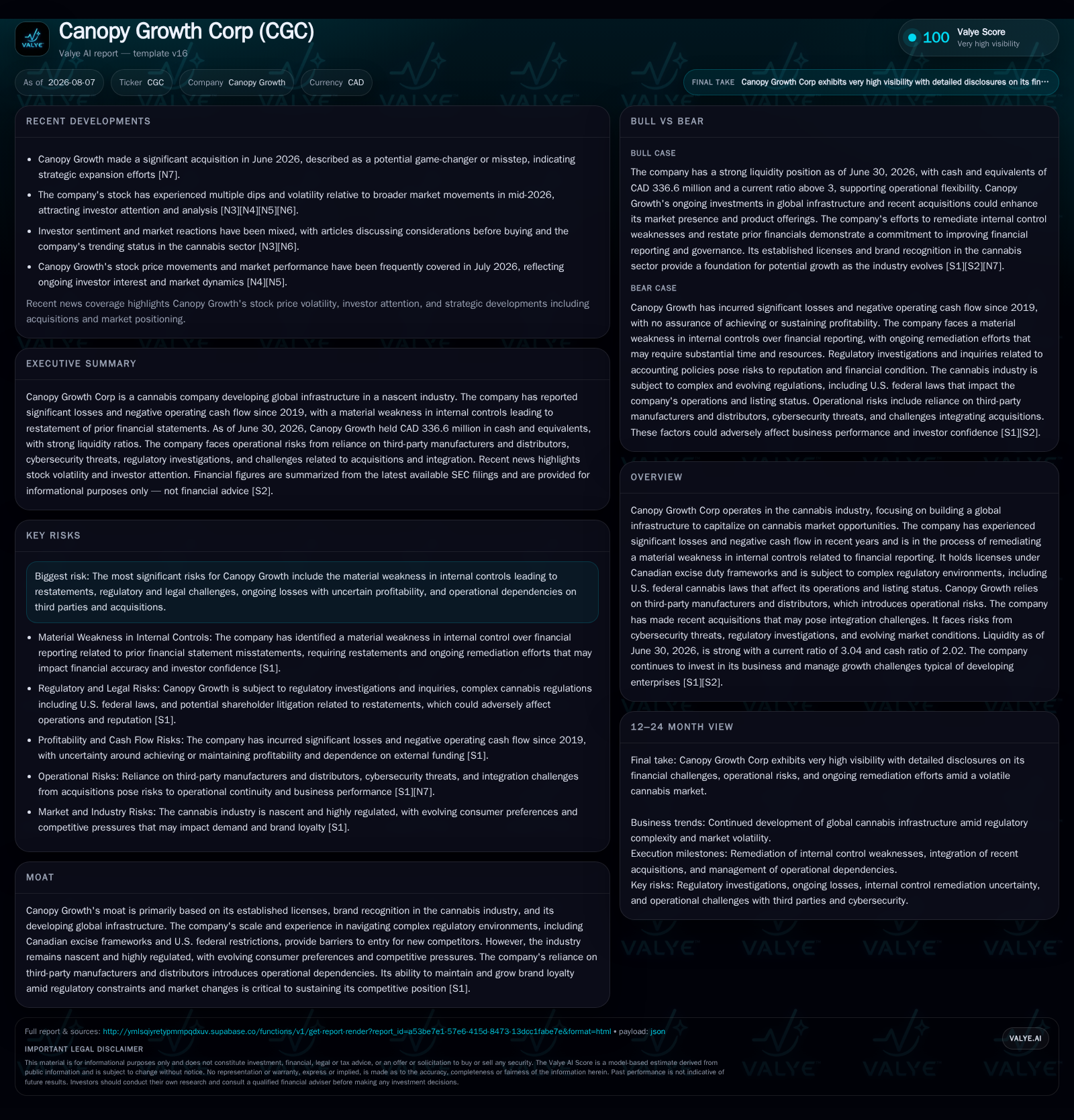
In its latest quarterly 10-Q filing, Canopy Growth Corp details ongoing remediation of a material weakness in internal controls over financial reporting, a critical factor shaping investor confidence and operational transparency. The company maintains strong liquidity, supported by a current ratio of 3.04 and cash reserves exceeding CAD 336 million, which provides stability amid persistent operating losses. Canopy Growth's multi-faceted cannabis business spans licensed cultivation, processing, and distribution networks, yet it faces risks from regulatory complexity, integration of recent acquisitions, and third-party dependencies. Its competitive position benefits from established licenses and brand recognition in regulated markets, but execution on control remediation and market expansion will be pivotal to reversing historically negative profitability trends.
Latest Quarterly Disclosure Illuminates Control Remediation Progress and Persisting Risks
Canopy Growth's August 7, 2026 quarterly filing reveals ongoing efforts to remediate a material weakness in its internal controls over financial reporting—a legacy issue that led to extensive restatements of prior fiscal years' financial statements. The company acknowledges the costly nature of this remediation process due to audit, legal, and professional fees incurred in correcting past disclosures, which have impaired stakeholder confidence and triggered multiple class action lawsuits alleging misrepresentations related to financial results [S1], [S14]. The latest disclosures indicate no material change in risk factors but reaffirm management’s commitment to implementing recommended control measures. Successful remediation is critical; failure would prolong reputational damage and could restrict Canopy’s access to capital or favorable counterparties for business partnerships. Verification through external audit opinions confirming control effectiveness will be an essential near-term milestone for restoring trust [S2], [S3].
Operational Footprint: From Licensed Cultivation to Third-Party Distribution Dependencies
Revenue flows primarily from product sales regulated under stringent excise frameworks mandating compliance with packaging, marketing restrictions, tax remittance, and product tracking—a cost-laden overhead reducing gross margins typical across this nascent sector. Product sales volumes along with geographic distribution reach serve as critical operating KPIs underpinning revenue growth; any discernible gains in these metrics would signal improving market penetration underpinned by product acceptance or license expansions.
Regulatory Framework as a Double-Edged Sword: Barrier to Entry and Source of Risk
Operating within Canada’s regulated cannabis regime confers Canopy Growth with valuable licenses that establish significant barriers to entry yet simultaneously expose it to substantial compliance burdens that constrain operational flexibility. Regulatory compliance includes ongoing audit inspections, strict batch testing protocols for quality assurance, marketing limitations that reduce promotional effectiveness relative to conventional CPG brands, plus evolving mandates on environmental safety—all contributing to elevated operating costs [S1], [S5]-[S6]. Moreover, U.S. federal cannabis prohibition creates additional complications: although Canopy holds non-voting shares in its U.S. affiliate (Canopy USA), federal restrictions impact banking access for U.S.-related operations and contribute uncertainty over listing eligibility on major stock exchanges such as NASDAQ or TSX [S1], [S19]. These factors collectively increase costs of capital and slow path-to-market expansions outside Canada.
The company's risk disclosures flag potential outcomes ranging from penalties due to inadvertent non-compliance to license revocations that could severely impair revenue streams. The multi-jurisdictional nature of their footprint necessitates constant navigation between conflicting regulations across provinces or countries—one failed license renewal or adverse inspection finding could trigger broader enforcement actions given increasing coordination among regulators internationally. Thus regulatory complexity remains a structural challenge impacting margin sustainability.
Competitive Benchmarks: Learning from Peer Execution in Brand Building and Scale-Outs
Within the licensed cannabis producer peer set, Tilray Brands exemplifies multinational scale complemented by diverse branded product lines extending from dried flower to beverages—offering lessons on geographic footprint expansion while maintaining compliance standards applicable across markets. Green Thumb Industries prioritizes branded consumer products crafted for recreational segments with acute focus on retail-level partner engagement—enabling higher average selling prices per unit due to differentiation rather than commodity positioning.
Aurora Cannabis demonstrates diversified cultivation coupled with processing innovation at scale akin to Canopy's model but has similarly contended with regulatory headwinds causing periodic downshifting of capex expenditures. By comparison, Canopy Growth's entrenched licenses within Canada provide foundational strength but require acceleration in building broader distribution reach comparable to these peers' footprints. Indicators such as number of retail partners served or share-of-shelf metrics at provincial dispensaries would illuminate whether Canopy is gaining commercial traction relative to peers' stronger branding approaches.
Growth Vectors Anchored in Product Innovation and Geographic Expansion Attempts
Recent acquisitions aim to broaden Canopy Growth’s geographic presence and penetrate adjacent product categories; however, integration risks noted include cultural assimilation challenges and systems harmonization that can delay synergy realization while inflating operating expenses short term [S1]. The company’s product portfolio continues evolving amid growing consumer demand for differentiated formats like edibles, beverages, wellness-focused extracts alongside traditional flowers.
Cannabis product innovation within strict regulatory confines emphasizing safety claims without health treatment assertions restricts marketing freedom yet remains vital for consumer engagement given changing preferences toward wellness-oriented offerings that blend recreation with functional benefits. Medical cannabis segments represent steady demand zones though often with lower margins necessitating balancing against faster-growing recreational categories offering premium pricing potential.
The interplay between expanding production capacity and enhancing innovative extracts or infused products pipeline represents the crux of growth opportunity—evidenced by periodic announcements touting new product launches targeted at emerging sub-segments within regulated markets.
Emerging Headwinds: Internal Controls, Compliance Costs, and Integration Uncertainties
Remediation expenses tied to the internal control weaknesses continue absorbing management focus and cash resources with potential for further cost escalations should additional deficiencies emerge or audits detect further anomalies [S2], [S14]. Regulatory investigations stemming from voluntary self-reports (including around BioSteel Sports Nutrition revenue recognition) present litigation exposure amplifying uncertainty around cost containment trajectories [S4], [S17]. Such inquiries may also dampen investor appetite extending financing costs beyond industry norms.
Reliance on third-party manufacturers/distributors exacerbates operational risk especially if those third parties face inspection sanctions or supply disruptions—highlighting necessity for robust supplier auditing processes frequently referenced as maturing yet not fully bulletproof based on risk factor disclosures [S1], [S22]. Furthermore acquisition integration delays underscore need for disciplined project governance ensuring swift realization of efficiencies crucial for margin improvement amid ongoing pricing pressures common across the sector.
The combination of these headwinds constrains free cash flow generation potential thus making strategic prioritization across capital allocation toward control remediation versus organic growth investments a complex balancing act.
"What’s Next": Milestones in Compliance, Market Access, and Consumer Demand Signals
Key upcoming catalysts include completion confirmation of internal control remediation efforts validated through external auditor attestations providing crucial transparency enhancements that underpin restored confidence among investors and creditors alike [S2], [S3]. On regulatory fronts timely license renewals without adverse findings will be pivotal signaling stable market access facilitating planned production scale-ups.
Commercially measurable improvements such as expanding retail partnerships driving incremental product sales volume together with improving gross margins attributable either to cost efficiencies or favorable price/mix shifts remain central indicators reflecting success in operational restructuring initiatives. Continued monitoring of litigation developments related to past restatements also impacts risk-premium assessments regarding future capital raising activities.
Financial Profile Discussion: Liquidity Cushion Meets Cash Drain Realities
At quarter-end June 30, 2026, Canopy Growth reported cash & equivalents totaling CAD 336.6 million coupled with current assets of CAD 506.4 million against current liabilities near CAD 166.8 million yielding a healthy current ratio approximating 3.04—signaling adequate liquidity buffers supporting near-term operational requirements amidst ongoing losses [F1]. Total debt stood at approximately CAD 281 million creating a net debt negative position when offsetting cash balance—implying manageable leverage relative to asset base despite negative operating income trends reaching CAD -161.7 million (most recent quarter) highlighting ongoing cash burn pressures exacerbated by investment spending tied partly to acquisitions requiring continued discretionary capital pacing decisions consistent with the broad capital-intensive profile seen industry-wide.
This financial posture affords Canopy some runway while pursuing strategic initiatives contingent upon successful resolution of control issues enhancing creditor comfort levels; however sustained negative profitability underscores urgency around delivering tangible operational improvements promoting cash flow generation required for long-term business sustainability absent frequent external financing rounds.
This analysis incorporates information extracted from Canopy Growth Corporation's latest SEC filings dated August 7, 2026 ([S2],[S3],[S1]) supplemented by financial data ([F1]). It avoids speculative projections absent clear evidentiary support; readers should consider this as descriptive insight without investment advice.
Disclaimer: This is research-only, informational analysis and not investment advice. It may include AI-generated interpretation and general industry context. Always verify important details using primary sources.

Comments