
HA Sustainable Infrastructure Capital Expands Portfolio with Strong Recurring Cash Flows and Enhanced Capital Facilities
HA Sustainable Infrastructure Capital reported robust second-quarter operating results, expanding managed assets and enhancing capital structure to fuel growth in sustainable infrastructure investments.
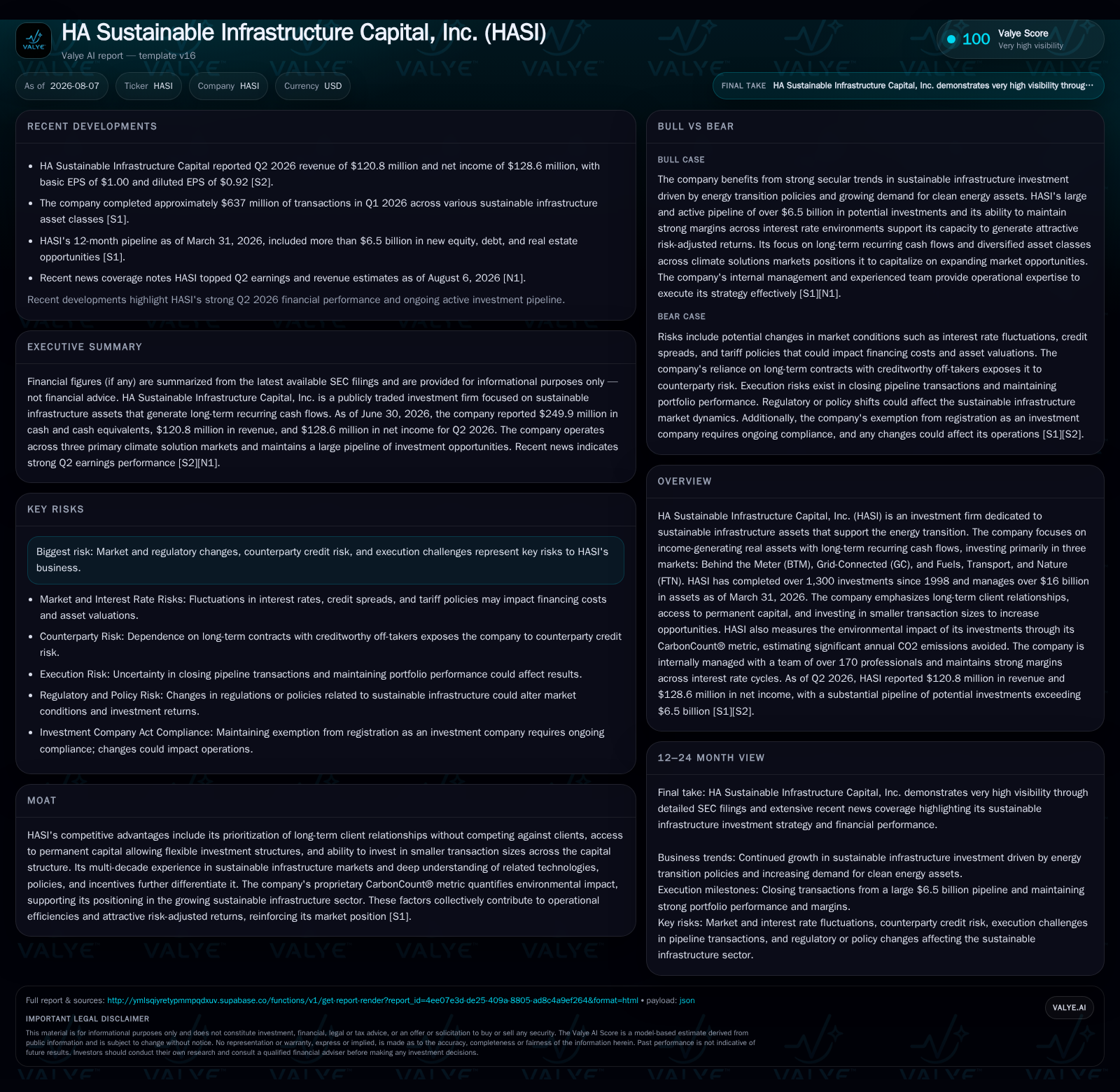
HA Sustainable Infrastructure Capital, Inc. (HASI) confirmed its leadership in sustainable infrastructure investment through a strong Q2 2026 operating update showing significant asset growth and transaction activity. The company focuses on income-generating real assets supporting the energy transition across behind the meter (BTM), grid-connected (GC), and fuels, transport, and nature (FTN) categories. HASI leverages permanent capital with a diversified financing strategy that recently included upgrading its revolving credit facility and term loan, expanding liquidity and flexibility. Its proprietary CarbonCount® metric quantifies substantial carbon emissions avoided annually, underpinning investment quality amid increasing regulatory support for decarbonization. Key risks remain market, regulatory, and counterparty credit factors, while growth is driven by expanding U.S. power demand and broader ESG commitments.
Recent Operating Update
HA Sustainable Infrastructure Capital reported strong operational momentum in its latest quarterly filing for Q2 ended June 30, 2026. During the quarter, HASI completed approximately $637 million in investment transactions broadly diversified across sustainable infrastructure sectors. RNG (renewable natural gas) assets accounted for 43% of new transactions, while grid-connected solar and storage contributed an additional combined 35%, reflecting ongoing demand for decarbonization technologies and energy storage solutions [S25]. This sustained deal activity underscores a healthy pipeline exceeding $6.5 billion for the forthcoming year with a balanced mix between BTM, GC, and FTN sub-sectors [S25].[N1]
Managed assets stood at about $16.4 billion as of March 31, 2026—an increase representing a five-year CAGR of approximately 17%, demonstrating HASI's successful scaling of its portfolio through disciplined capital deployment across small to mid-sized transactions that provide recurring cash flows [S26]. This asset base combines balance sheet holdings, securitized off-balance sheet portfolios held by institutional investors via trusts, and co-investment structures that generate fee income on partner capital [S26].
Business Model Analysis
HASI operates as an internally managed investment firm focusing exclusively on sustainable infrastructure real assets that enable the energy transition consistent with global sustainability goals [S1]. The firm invests primarily in three strategically distinct markets: Behind the Meter (BTM) systems targeting distributed generation close to consumption points; Grid-Connected (GC) assets such as utility-scale solar and wind projects; and Fuels, Transport & Nature (FTN), encompassing renewable natural gas production and other climate-positive fuel solutions
Revenue mainly derives from stable recurring cash flows from long-term contracts or regulated tariff structures granted to underlying project owners/operators. HASI monetizes these investments partly through directly held equity method investments on its balance sheet along with fee income generated from managing co-investment vehicles backing these projects [S1][S26]. The company's competitive advantage includes access to permanent capital allowing it to fund smaller transaction sizes frequently overlooked by larger institutional players without competing directly with clients but partnering alongside them programmatically for sustained deal flow [S1].
A noteworthy differentiator is HASI's proprietary CarbonCount® metric that quantitatively estimates the annual avoided carbon dioxide equivalent emissions of its portfolio investments.
The monetization mechanics leverage diversified funding sources including debt issuance—both secured and unsecured—with embedded sustainability-linked pricing adjustments based on CarbonCount® performance metrics to optimize cost of capital while reinforcing commitment to environmental outcomes [S12][S24]
Industry Context and Competitive Position
Within the sustainable infrastructure investment landscape—which includes peers such as Brookfield Renewable Partners, NextEra Energy Partners, Hannon Armstrong Sustainable Infrastructure Capital (a related entity), Pattern Energy Group, and Algonquin Power & Utilities—the sector's hallmark is stable cash flow generation from regulated or contracted projects backed by long-lived physical assets that align with the global energy transition agenda.
HASI stands out due to its extensive experience dating back to its founding in 1998 and accesses diverse sub-markets within sustainable infrastructure employing nuanced expertise in technology innovation areas such as RNG expansion and behind-the-meter distributed resources which are anticipated to grow faster than traditional renewables due to evolving policy incentives and customer electrification trends [S1][S25]. Its ability to tailor deals with flexible structures incorporating collateral protections improves investment risk profiles relative to peers primarily focused on larger scale utility projects.
Investor appetite for ESG-aligned yield-generating vehicles remains strong given rising regulatory support for decarbonization policies including renewable portfolio standards expansions and clean fuel mandates (e.g., the EPA’s increased Renewable Volume Obligations) [S19][S25]. These factors not only enhance project viability but also underpin sustained long-term contract pricing power essential for dividend stability
Growth Drivers
Several macro drivers bolster HASI’s growth outlook. First is the expected surge in U.S. power demand linked to data center expansion, electrification of transport, manufacturing reshoring with green mandates, all supporting grid modernization investments including solar plus storage deployments emphasized within HASI’s GC portfolio segments [S25]. Second is regulatory tailwinds like tax credits renewal under recent legislative bills increasing clean energy investment economics. Third is growing consolidation in behind-the-meter solar plus storage sectors improving opportunity density for smaller transactions where HASI’s scale advantage enables rapid deployment at attractive yields [S25][S26].
Technological improvements reducing renewable asset costs combined with advances in measurement methodologies—such as HASI’s CarbonCount®—allow more precise environmental impact reporting attracting capital from dedicated ESG funds desiring transparent climate-related outcome metrics aligned with investor mandates [S16]. Furthermore, the company’s longstanding programmatic client relationships facilitate volume efficiencies alongside pipeline visibility supporting scalable asset origination.
Risks and Watchpoints
Despite a constructive environment, HASI faces notable execution risks including potential volatility from changing regulatory frameworks impacting subsidies or incentive schemes that underpin many projects’ economics — a typical challenge in this sector given evolving political landscapes [S19]. Counterparty credit risk arises from project operators or off-takers especially in nascent market segments such as RNG where revenue streams are less established relative to traditional renewables.
Market risk affecting asset valuations could emerge due to interest rate fluctuations influencing cost of capital or debt refinancing terms despite HASI’s recent favorable borrowing arrangements linked partially to sustainability metrics reducing interest expense variability [S19][S24]. Competitive pressure may intensify if larger financial players enter smaller transaction spaces traditionally served by HASI.
Execution challenges could result from integrations following acquisitions or managing increasingly complex portfolio compositions spanning diverse technologies requiring specialized operational oversight.
Capital allocation outcomes balancing opportunistic deployment against market conditions will be central alongside tracking operating margin trends evidencing efficiency gains amid scale realization benefits. Regulatory developments impacting renewables incentives or RNG price signals should directly factor into risk assessments.
Financial Profile Discussion
As of June 30, 2026, HASI held approximately $250 million in cash and equivalents supporting liquidity adequacy given its sizeable asset base requiring ongoing capital deployment agility [F1]. Total debt outstanding was approximately $168 million as of September 30, 2023, with net debt reported negative at about $-82 million, reflecting a strong cash position relative to debt [F1]. While recent debt issuances and facility expansions have been noted in SEC filings, exact current total debt metrics require further official updates beyond this snapshot [F1][S12][S24].
HASI continues managing leverage prudently, supported by stable recurring revenues derived from contracted portfolios and consistent cash collection ratios, indicating effective credit management practices. Net spreads between new asset yields (10.8%) versus borrowing costs (6.8%) have remained healthy, boosting net interest margins around 4%, supporting durable earnings quality despite fluctuating macroeconomic backdrops experienced across recent cycles [S26]. Permanent capital availability coupled with flexible capital structure enhancements positions HASI well to sustain attractive risk-adjusted returns foundational to its dividend policy.
In sum, HA Sustainable Infrastructure Capital exemplifies a well-established specialist allocator leveraging deep sector expertise and robust financial positioning within the growing sustainable infrastructure transition investing industry framework while maintaining vigilant risk oversight amid evolving policy environments.
Disclaimer: This is research-only, informational analysis and not investment advice. It may include AI-generated interpretation and general industry context. Always verify important details using primary sources.

Comments