
Boundless Bio Advances Oncology Focus Amid Merger and Clinical Setbacks
Boundless Bio’s 2026 first half reflects strategic pivot through merger, pipeline reprioritization, and financial streamlining.
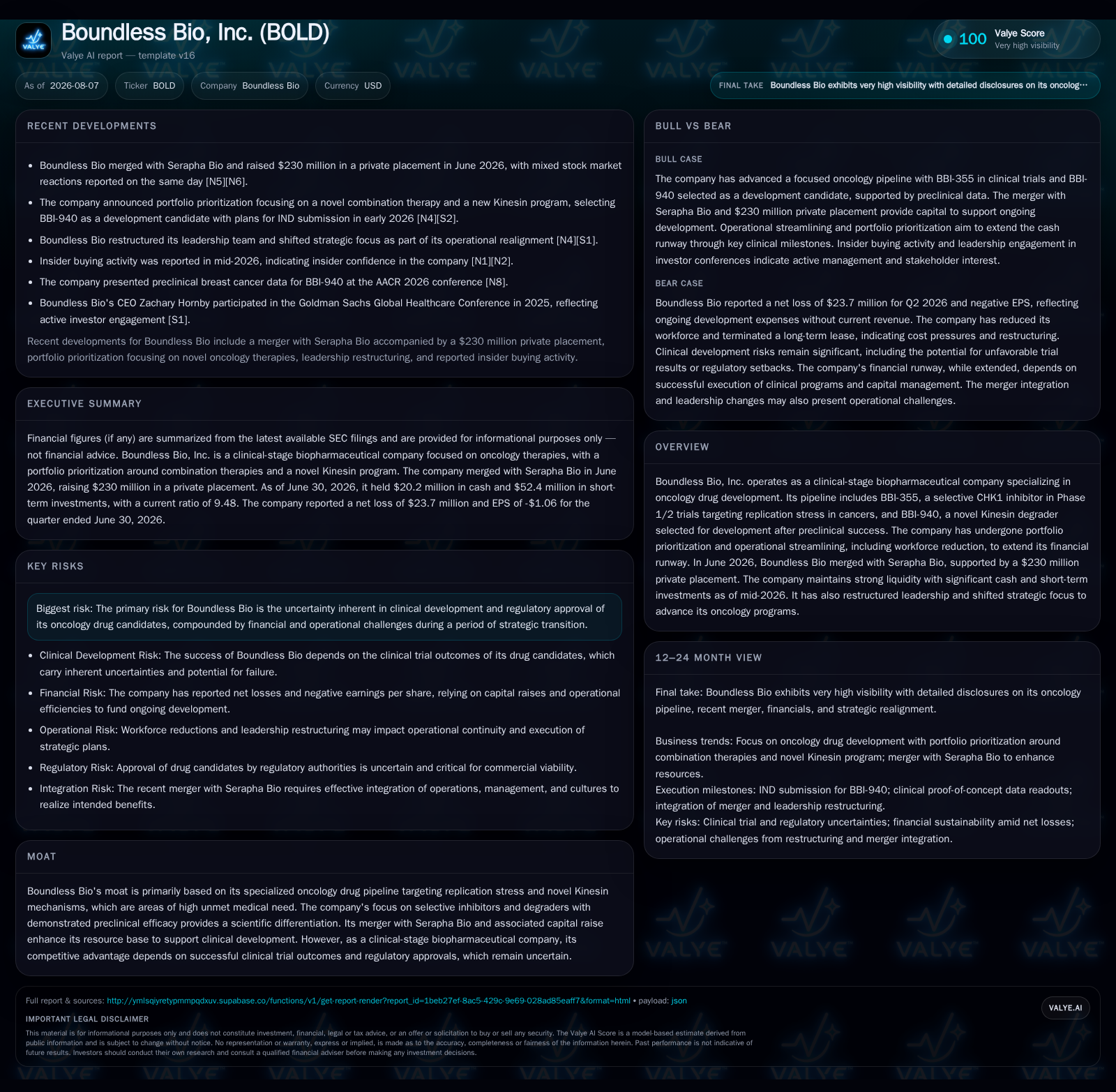
In mid-2026, Boundless Bio completed a merger with Serapha Bio alongside a $230 million private placement to bolster its oncology drug development pipeline. The company narrowed its focus to two key programs: BBI-355, a selective CHK1 inhibitor in Phase 1/2 trials, and BBI-940, a novel Kinesin degrader advancing toward clinical proof-of-concept after preclinical validation. Operational restructuring including workforce reductions was implemented to extend financial runway. However, early clinical data for BBI-940 revealed pharmacokinetic challenges, triggering development reevaluation. Boundless Bio has maintained strong liquidity with over $20 million cash on hand as of June 30, 2026, supporting ongoing trials and strategic initiatives.
Recent Operating Update
Boundless Bio’s latest quarterly filing dated August 7, 2026 highlights critical operational moves that have reshaped its near-term trajectory. The company announced completion of its merger agreement with Serapha Bio Inc., finalized in June 2026 along with a $230 million private placement that significantly replenished the company’s capital base [S3][N1]. This transaction positions Boundless Bio with enhanced financial resources to advance select oncology therapeutics.
The latest update confirms the company's strategy of portfolio prioritization concentrating on two main assets: BBI-355, an orally administered selective CHK1 inhibitor targeting replication stress pathways in oncogene-amplified cancers currently under investigation in a Phase 1/2 POTENTIATE trial; and BBI-940, a novel Kinesin degrader emerging from successful preclinical studies poised for clinical proof-of-concept evaluation [S1][N1]. Notably, initial clinical exposure data for BBI-940 indicated that oral bioavailability in humans was considerably lower than expected based on animal models, resulting in an immediate halt and reevaluation of this program’s ongoing clinical development [S12]. This setback introduces near-term risk but underscores the company's scientific rigor in decision-making.
Concurrently, Boundless Bio has been implementing ongoing workforce reductions initiated mid-2025 aimed at controlling operating expenses and extending cash runway well into early 2028 [S23][S27]. The streamlining reflects both portfolio refocusing and prudent capital management during the inherently capital-intensive and binary-risk nature of clinical-stage oncology drug development
Financially, as of June 30, 2026, Boundless Bio reported holding $20.2 million in cash and equivalents against current liabilities of just $7.8 million yielding a robust current ratio near 9.5x—indicative of significant liquidity buffer despite net losses accumulated during development phases [F1]. This liquidity profile supports expected clinical milestones and operational commitments over the midterm.
Business Model Analysis
Boundless Bio operates within the biotechnology sector primarily focused on developing novel oncology therapeutics through internally discovered candidates progressing from preclinical research into early-phase human trials. Since marketed products are absent at this stage, revenue generation is minimal or nonexistent. Funding depends predominantly on equity raises—evidenced by their recent private placements—strategic partnerships, or potential licensing agreements pending successful proof-of-concept results.
Their pipeline targets niche but high-unmet medical needs: drugs modulating replication stress via CHK1 inhibition or uniquely degrading Kinesin proteins involved in cancer cell division mechanics. Such mechanisms differentiate Boundless Bio’s assets within the early-stage oncology drug developer peer set by addressing pathways not widely targeted by incumbent therapies.
Revenues arise post-commercialization or from milestone payments upon partnering; currently, the company incurs substantial R&D expenditure supporting lengthy multi-year trials that require efficient burn management to reach data inflection points reflecting either safety/tolerability profiles or signs of anti-tumor efficacy.
Customer-wise, eventual revenue sources will be payers such as hospital systems and insurers purchasing approved therapies for cancer patients. The company must advance candidates through investigational new drug (IND) submissions, phased clinical trials (Phase 1–3), culminating regulatory approvals—a highly competitive process influenced by trial design rigor and differentiation versus standard-of-care or other pipeline therapies.
Industry Structure & Competitive Positioning
Within oncology-focused clinical-stage biotechnology firms, Boundless Bio faces intense competition not only from deep-pocketed pharmaceutical giants but also peer biotechs pursuing similar replication stress or mitotic machinery targets. While CHK1 inhibitors have been explored broadly across the industry landscape, Boundless Bio’s selective oral inhibitor attempts a differentiated safety/efficacy profile. The Kinesin degrader program represents a more novel mechanism potentially addressing tumors resistant to conventional modalities.
Competitors vary from large multinational corporations with marketed oncology franchises to emerging biotechs advancing antibody-drug conjugates or immunotherapies targeting solid tumors. Compared to peers relying heavily on licensing deals for no-longer-core assets or broader portfolios, Boundless Bio is relatively concentrated in proprietary small-molecule candidates progressing from IND through early phase testing.
Strategic merger activity—such as with Serapha Bio—and concurrent private funding placements typify consolidation trends aiding mid-sized biotechs in bolstering their pipelines amidst capital constraints. Nonetheless, operational efficiency remains critical; workforce reductions mirror broader sector cost-cutting measures seen during economic downturns or challenging clinical readouts elsewhere.
Growth Drivers
Key growth drivers hinge upon successful progression through clinical milestones that validate safety signals and preliminary efficacy (proof-of-concept). For BBI-355, ongoing Phase 1/2 dose escalation results provide insight into tolerability windows balanced against therapeutic index due to hematologic toxicity observed at certain regimens [S1].
For BBI-940’s kinesin degrader approach—though facing recent bioavailability hurdles—the ability to optimize delivery or reformulate could unlock promising pathways if pharmacokinetic challenges are mitigated.
Regulatory designations such as orphan status or breakthrough therapy could accelerate timelines or increase trial enrollment; meanwhile, strategic partnerships enabling out-license or co-development would supplement funding while validating technology platforms against competitors.
Operating measures such as controlled burn rate through ongoing portfolio prioritization enhance longevity to witness these inflection points without disruptive capital crunches.
Risks & Constraints
As a clinical-stage entity with no approved products or revenue streams beyond capital raises, Boundless Bio bears classic biotech risks: binary trial outcomes that may abruptly terminate programs; delays impacting cash consumption; regulatory setbacks; and technical risks specific to novel molecular modalities like Kinesin degradation.
The recent finding of suboptimal oral bioavailability causing a pause on BBI-940 highlights intrinsic risks embedded in translating preclinical successes into human pharmacology—a recurrent challenge for many peer oncology biotechs using pioneering mechanisms of action.
Further constraints include the competitive landscape where other companies may advance faster with superior compounds targeting overlapping pathways; evolving regulatory expectations; intellectual property challenges; reliance on external manufacturing capabilities; and potential setbacks arising from workforce transitions post-merger.
Financially inadequate capital for requisite trials could compel dilution or partnership terms skewed unfavorably if clinical progress stalls beyond expected horizons.
What to Watch Next
Upcoming milestones include additional dose-escalation data readouts from the ongoing POTENTIATE trial with BBI-355 which will clarify its therapeutic index boundaries impacting future trial design decisions [S1]. Watch also for announcements concerning any re-start or reformulation efforts related to BBI-940 following reconsideration triggered by bioavailability concerns [S12].
Regulatory interactions such as IND filings or FDA feedback remain crucial markers signaling forward movement toward pivotal studies.
Operationally, further disclosures regarding post-merger integration outcomes including leadership appointments following CEO departure effective July 1, 2026 warrant attention as management stability influences execution capability [S27]
Finally, monitoring burn rate against cash reserves will indicate whether additional financing rounds become necessary before reaching these critical inflection points.
Financial Profile Discussion
At quarter-end June 30, 2026, Boundless Bio reported cash and equivalents totaling approximately $20.2 million alongside current assets of $73.6 million compared with current liabilities of just $7.8 million—translating into a strong current ratio of about 9.48x indicative of substantial short-term liquidity cushion supportive of continuing operations through anticipated near-term spend cycles [F1]
Losses remain consistent with typical biotech profiles heavily weighted toward R&D expenditure preceding commercialization; latest reported operating income was negative $63.5 million as of end-2025 year-end reflecting ongoing investment levels required for candidate advancement [F1]
The recent $230 million equity infusion accompanying merger with Serapha materially extended liquidity horizon compared with prior projections allowing survival past anticipated Phase 1/2 data readouts without immediate dilution pressure [S3][N1]. Labour cost rationalizations contribute meaningfully to reducing fixed expense commitments incrementally enhancing runway extension prospects [S23][S27].
Notwithstanding operating losses inherent in this stage of the cycle, cautious expense control combined with acquired capital positions Boundless Bio adequately for executing defined strategy given current operating assumptions hold true over the next one-to-two years.
This analysis synthesizes publicly available SEC filings and market disclosures as of August 7, 2026 to provide an informed view on Boundless Bio's business operations within the biotechnology therapeutic development context. It does not constitute investment advice or offer research views regarding securities transactions.
Disclaimer: This is research-only, informational analysis and not investment advice. It may include AI-generated interpretation and general industry context. Always verify important details using primary sources.

Comments