
Republic Services Expands Recycling Footprint and Navigates Regulatory Costs with Strategic Debt Issuance
Q2 2026 highlights include a significant acquisition in recycling services alongside proactive capital market activity as environmental regulations reshape operational costs.
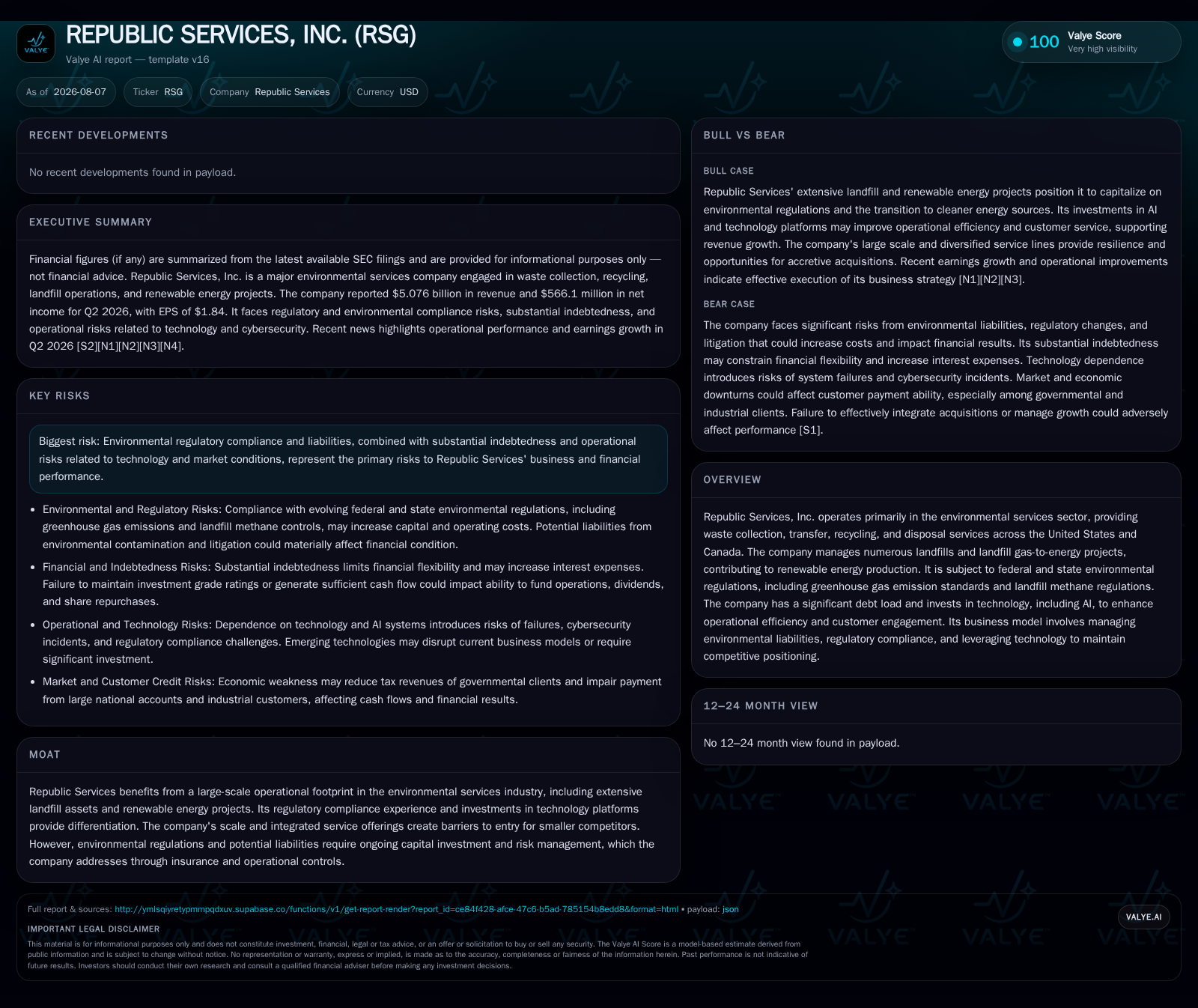
Republic Services reported progress in its strategic expansion with the acquisition of Robinson Waste Holdings Group, enhancing its integrated recycling and waste capabilities in Utah. The company continues to manage regulatory headwinds related to greenhouse gas emissions and landfill methane controls while leveraging pricing power to offset inflation. Recent debt issuances optimize capital structure for acquisitions and operational investments. Growth remains anchored in yield-led revenue improvement, sustainability initiatives, and technology integration.
Recent Operating Update
Republic Services’ latest quarterly filing from August 7, 2026 highlights strategic expansion through the acquisition of Robinson Waste Holdings Group in May 2026 [S2]. Robinson operates vertically integrated recycling and waste services primarily in Utah — a direct complement to Republic's existing core competencies in environmental services. This acquisition underscores Republic’s focus on broadening its recycling footprint—a growing priority given increased regulatory emphasis on sustainable waste management. The purchase price allocation remains preliminary, pending further valuation adjustments
Alongside this growth move, Republic issued $700 million of senior notes due 2031 at a fixed coupon of 4.75%, and $500 million of senior notes due 2036 at 5.00% in June 2026 [S2]. Proceeds were primarily used to repay borrowings under credit facilities and commercial paper programs. This debt issuance reflects active capital management designed to maintain liquidity and fund acquisitions while capitalizing on favorable interest rate conditions
The firm updated its full-year guidance upward with adjusted diluted earnings per share expected between $7.23–$7.28 for calendar year 2026, slightly above prior estimates. Revenue growth is anticipated mainly from average yield improvements in the range of 3.2% to 3.7%, partially offset by a volume decline near 1%. This dynamic indicates effective execution of pricing strategies amid inflationary cost pressures but also reveals challenges from softer demand or waste generation volumes given economic factors [S3], [S6], [S1].
Business Model
Republic Services operates as an end-to-end environmental services provider offering waste collection, transfer operations, recycling centers, landfill management—including both active landfills (207 sites) and post-closure care responsibilities (124 sites)—and renewable energy production leveraging landfill gas-to-energy projects (84 active sites). Its customers span residential, commercial, industrial sectors requiring fee-based service contracts that combine volume-based pricing with negotiated fixed-yield components.
Revenue primarily derives from collection fees based on contracted service volumes and pricing yields; disposal fees linked to landfill utilization; sales from recycled commodities; and energy revenues from methane capture converting landfill gas into renewable power sold under various agreements. Operating margins depend critically on optimizing route density for collections, controlling transport fuel costs, efficient landfill operations including environmental compliance costs, and maximizing landfill gas capture efficiency.
The company strategically invests in technology—such as AI-driven route optimization platforms and customer data analytics—to improve productivity while enhancing customer retention through more responsive service engagement [S1]. These investments are part of a broader industry trend where digital tools address operating complexities inherent in multi-site geographic networks with heterogeneous customer bases
Industry Structure and Competitive Position
Republic Services holds scale advantages through extensive infrastructure assets across North America relative to regional competitors. Its combined portfolio of collection routes, processing facilities, landfills, and renewable energy projects forms barriers to entry by capital intensity and complex regulatory compliance pathways.
Regulatory frameworks strongly shape competitive dynamics: Federal EPA rules plus state-level mandates impose methane capture requirements with associated capital investments in emissions monitoring technologies—necessary for compliance but expensive to implement across landfill portfolios. Canada’s output-based pricing system and newly finalized Landfill Methane Regulations signal intensifying regulatory cost pressures for operators like Republic involved in cross-border operations [S1]
The company faces competition from municipal providers who may receive political support or subsidies; regional waste firms focusing on niche geographic markets; specialized recyclers targeting particular materials; plus emerging renewable energy operators harnessing landfill gas outside traditional waste management players.
Growth Drivers
Key growth levers include:
- Yield increases via contractual price escalators designed to outpace cost inflation pressures.
- Strategic acquisitions like Robinson Waste Holdings that expand geographic reach or service integration capabilities.
- Expansion of renewable energy projects extracting value from landfill gas-to-energy outputs adds a diversified revenue stream aligned with sustainability trends.
- Urban population growth driving higher waste generation volumes over longer horizons.
- Technology advancements enhancing operational efficiency reduce costs per ton handled and deepen customer relationships.
- Rising corporate sustainability commitments amplifying demand for comprehensive recycling solutions beyond traditional waste disposal.
Risks and Watchpoints
Environmental regulations present persistent risks by driving incremental compliance expenditures affecting capex budgets and operating costs. Potential adverse rulings or new mandates could materially affect cost structures beyond current estimates.
Environmental liabilities remain sizable; the company reported $429 million in remediation liabilities at mid-2026, down modestly year-over-year but necessitating ongoing cash payments plus accretion expense accounting considerations [S2]
Operational risks also include exposure to fuel price volatility impacting fleet-related collection expenses—a key variable given transportation weighs heavily on overall cost of operations.
Technology deployment carries execution risk; failures or delays could impair expected productivity gains or customer experience improvements.
Market competition from municipal services or nimble regional operators could pressure yield gains or shrink potential contract wins in certain locales.
Public opposition—a well-documented challenge—can delay permitting for new landfills or required expansions limiting capacity growth options.
What to Watch Next
Investors should track:
- Integration progress of Robinson Waste Holdings Group reflecting scope synergy realization in recycling operations.
- Quarterly updates on volume trends versus yield changes revealing demand elasticity post inflationary environment adjustments.
- Regulatory developments in both U.S. federal/state arenas as well as Canada's evolving carbon pricing impacting capex planning.
- Progress in technology initiatives tied explicitly to measured productivity improvements or customer retention metrics if disclosed.
- Capital expenditure ramp-ups deploying methane capture systems per recent EPA guidelines or Canadian methane rules compliance schedules.
- Quarterly debt maturities covered versus new issuances assessing leverage flexibility amid sustained acquisition activity.
- Updates on environmental remediation liability trajectories including settlement outcomes impacting cash flow forecasts.
Financial Profile Discussion
As of June 30, 2026, Republic Services held approximately $107 million in cash equivalents against current assets totaling $2.56 billion versus current liabilities at $3.98 billion resulting in a current ratio near 0.64 indicating working capital constraints typical for asset-heavy sectors reliant on receivables velocity rather than liquid buffers [F1], [S2].
Total debt levels remain elevated but manageable given EBITDA-based covenants: recent senior notes issuance increased long-term fixed-rate debt providing stable amortization profiles maturing up to 2036 with coupons clustered around mid-single digits percent range [S2], [S13], [S18]. The company’s total debt-to-EBITDA ratio was comfortably below covenant ceilings (max 3.75x normal; up to 4.25x during acquisition-related elevated periods), ensuring covenant compliance while supporting capital spending for acquisitions and mandated infrastructure upgrades [S5], [S15], [S18].
This analysis is intended solely for informational purposes reflecting currently available public data as of August 2026 without any investment advice expressed or implied.
Disclaimer: This is research-only, informational analysis and not investment advice. It may include AI-generated interpretation and general industry context. Always verify important details using primary sources.

Comments