
Hecla Mining Navigates Metal Price Volatility and Asset Transition in Q2 2026
Hecla Mining's Q2 report highlights resilience through diversified metals exposure, hedging strategies, and portfolio realignment.
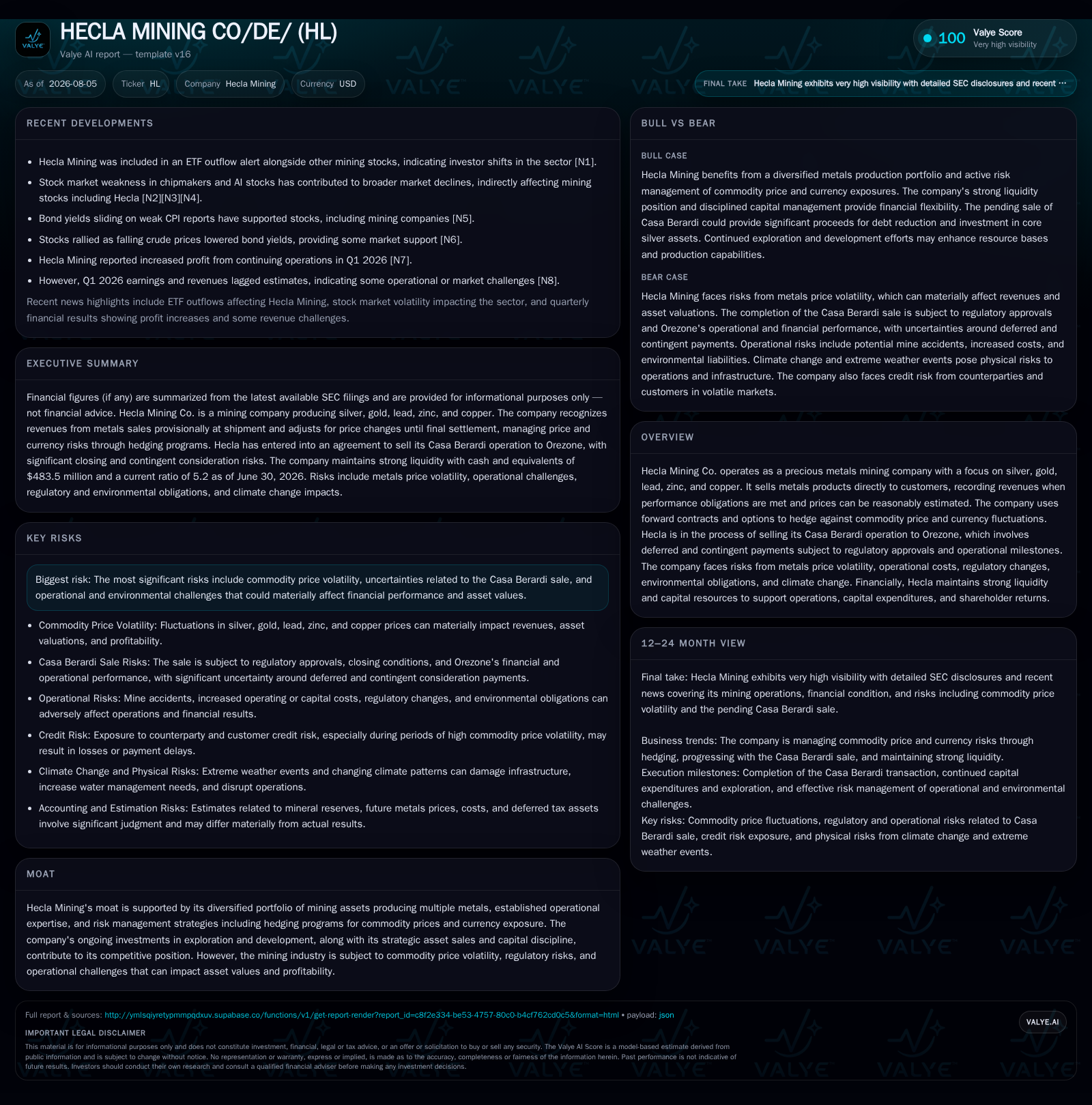
Hecla Mining's latest quarter shows stable operational performance supported by a diversified portfolio spanning silver, gold, lead, zinc, and copper. The company actively manages commodity price volatility through financially settled forward contracts and option hedges while progressing with the sale of its Casa Berardi asset to Orezone, subject to regulatory approvals. Key risks remain centered on metal price fluctuations and execution of asset dispositions. Hecla maintains a strong liquidity position with a current ratio over 5x, enabling continued capital investments and shareholder returns amid an uncertain macro environment.
Latest Operating Update Anchored by Strategic Portfolio Moves
Hecla Mining’s Q2 2026 results reaffirm its operational resilience within the challenging precious metals sector [S2]. The company continues to recognize revenue at shipment based on provisional metal prices subject to future settlement adjustments—a common industry practice given volatile commodity markets [S1]. This approach necessitates robust price estimation capabilities and underscores the financial impact ahead from metal price volatility realized between shipment and final settlement.
Key near-term developments include Hecla’s active use of financially settled forward contracts and put/call options to hedge silver, gold, zinc, and lead exposures [S1]. These instruments cover up to 75% of forecasted production up to five years out, aiming to stabilize realized prices. However, such hedging also exposes Hecla to counterparty credit risk if contract counterparties fail and risks limiting upside when spot prices exceed contracted levels.
Simultaneously, the company's portfolio realignment efforts focus on divesting the Casa Berardi mine to Orezone [S1,S3]. The transaction involves significant deferred consideration plus contingent payments tethered to regulatory approvals and operational milestones.
Business Model: Diversified Metals Production with Hedged Revenue Streams
Hecla generates revenue primarily through mining ore containing multiple metals—silver remains the dominant product complemented by gold, lead, zinc, and copper [S1]. Extracted ore undergoes processing into concentrates which are sold directly to smelters or refiners. Pricing follows concentrate shipment at estimated forward prices aligned with anticipated monthly settlement periods. Variability in treatment charges further influences net realizations.
Revenue mechanics hinge on volume produced (metal content), grade of ore mined (quality), recovery rates during processing (efficiency), and final metal prices set at settlement. Fluctuations in any variable impact cash flow timing and magnitude. Maintaining low all-in sustaining costs (AISC) per ounce or pound is crucial for margin preservation amid price volatility.
Strategically, Hecla manages commodity price risk via layered hedging programs employing forward sales commitments and option contracts [S1]. These limit downside but bring opportunity cost if market prices rally past locked-in levels. Currency exchange risks—especially USD/CAD exposure related to Canadian-based operations—are similarly mitigated through currency forward contracts.
The sale of Casa Berardi illustrates portfolio optimization aligning capital toward higher-margin assets or expansion projects while reducing operational complexity [S1,S3]. Deferred consideration components linked to Orezone’s equity injects potential upside but also valuation uncertainty given share price fluctuation risk.
Industry Structure and Competitive Positioning
Operating within the precious metals mining industry places Hecla among peer groups ranging from large diversified miners like Barrick Gold Corporation and Newmont Corporation to more focused silver producers such as Coeur Mining Inc. or Pan American Silver Corp.
This sector is characterized by high capital intensity mining fixed assets over extended life cycles with significant exposure to fluctuating spot metal prices that drive revenues. Operational metrics including ore grade, recovery rates, production volumes, AISC, exploration success for reserve replacement, mine safety records, environmental compliance costs, and capital expenditure discipline critically influence competitive standing.
Hecla’s diverse multi-metal production base coupled with active hedging provides resilience compared to single-metal producers vulnerable solely to one commodity cycle. Yet as a mid-tier player it lacks scale advantages of the largest producers whose lower per-ounce costs sometimes afford greater margin cushioning during downturns. Continuous investment in exploration targets serves as a competitive necessity for reserve replenishment in an industry where mineral reserves underpin long-term viability.
Growth Drivers: Exploration Success and Operational Excellence Amid Metal Demand Trends
Global industrial demand growth for precious metals driven by macroeconomic factors such as inflation protection narratives supports structural tailwinds for companies like Hecla Mining. Rising applications across electronics, renewable energy technologies (e.g., photovoltaic cells requiring silver), alongside steady bullion investment demand sustain interest in reliable producers.
Hecla aims growth via incremental expansion projects at existing mines alongside focused exploration targeting new reserves [S1,S20]. Success turning exploration targets into economically minable ore can extend asset lives or unlock new production streams—critical drivers given rising capital intensity in greenfield development.
Operational performance improvements measured by controlling or reducing AISC through process optimizations enhance profitability even in flat-to-lower metal price environments [S1]. Continued diligence over mine safety also avoids costly disruptions that can erode volumes or escalate expenses. Environmental compliance adherence minimizes regulatory penalties and reputational damage.
Capital allocation discipline seen in divesting non-core assets like Casa Berardi reflects prudent portfolio management ensuring capital is invested where return hurdles are highest [S3]. Moreover, structured commodity-price hedging improves earnings visibility supporting sustainable dividend policies despite inherent market cyclicality.
Risks, Watchpoints & Growth Constraints
The primary risk enveloping Hecla originates from metals price volatility—sharp declines reduce revenues directly while triggering asset write-downs if carrying values exceed recoverable cash flows [S1]. Metals prices additionally affect deferred tax asset realizability tied to taxable income projections.
Execution risks associated with timely closing of the Casa Berardi sale pose potential contingent liabilities or delayed cash inflows dependent on regulatory approvals [S1,S3]. Additionally, dependence on Orezone's stock valuation for equity consideration introduces pricing uncertainty impacting eventual proceeds realized by Hecla.
Operational hazards encompassing underground mine safety incidents or equipment failures can disrupt production volumes impacting unit cost metrics unfavorably. Increased environmental regulations potentially raise operating expenses affecting margin structures if not offset by productivity gains.
Counterparty credit risks linked with hedging counterparties pose financial exposure should counterparties default when contract mark-to-market positions are negative relative to spot prices [S1]. Currency exchange rate fluctuations remain a watchpoint especially relating to Canadian dollar denominated costs.
What To Watch Next
Investors should monitor progress towards completion of the Casa Berardi sale including milestones on regulatory clearance timelines and Orezone operational performance affecting contingent payments [S3]. Quarterly updates on realized metal prices versus hedged benchmarks will be illuminating regarding hedge program effectiveness.
Operational metrics such as quarterly shifts in production volumes by metal type, changes in ore grades mined reflecting deposit health, recovery efficiencies during milling processes, or trends in AISC provide direct insight into near-term cash flow sustainability [S20]. Exploration expenditure outcomes reported periodically offer signals on reserve pipeline evolution
Financially, upcoming quarterly reports detailing cash flow from operations relative to capex outlays alongside dividend declarations will reflect management’s confidence level amid metals market dynamics. Comparison against peer companies' performance on similar KPIs will contextualize Hecla's competitiveness particularly vis-à-vis larger players benefiting from scale economies or more concentrated single-commodity producers sensitive solely to silver prices.
Financial Profile Discussion
As of June 30, 2026, Hecla held $483 million in cash and equivalents against current liabilities of $149 million resulting in a robust current ratio of approximately 5.2x—indicative of strong short-term liquidity positioning amidst ongoing operational needs [F1][S2]
Cash flow generation benefits from rising revenue linked partly to favorable realized metal prices buffered by hedging gains/losses reflected within cost of sales adjustments impacting operating income stability.
In sum, Hecla Mining navigates a multifaceted operating environment balancing metallic commodity cyclicality with proactive financial risk management while spearheading strategic portfolio rationalization exercises reinforcing its position as a resilient mid-tier precious metals producer.
Disclaimer: This is research-only, informational analysis and not investment advice. It may include AI-generated interpretation and general industry context. Always verify important details using primary sources.

Comments