
Marqeta Strengthens Ecosystem Integration While Managing Customer Concentration Risks
Q2 2026 results reflect solid revenue growth and operational scale, underpinning Marqeta's strategic focus on platform innovation and capital deployment amid regulatory and customer concentration considerations.
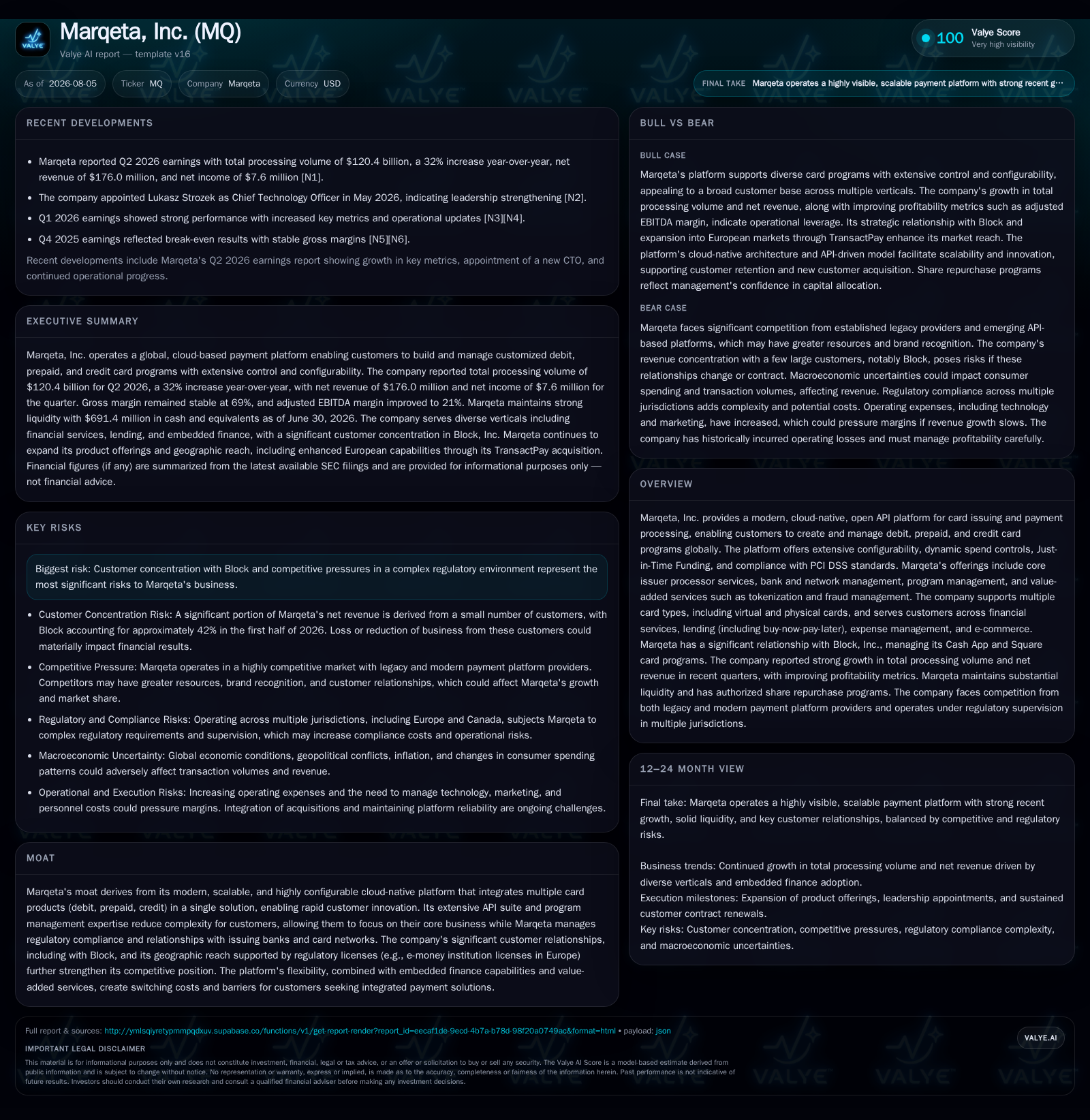
Marqeta reported robust second-quarter 2026 growth with net revenue rising approximately 17% year-over-year to $176 million, achieving positive net income and improved margins supported by scalable cloud-native technology. The company advanced its issuer processor platform leveraging open APIs, Just-in-Time Funding, and value-added program management services that cater to fintechs, merchants, and embedded finance clients globally. While growth is anchored by marquee customers like Block, customer concentration remains a risk alongside regulatory complexities. New share repurchase authorization signals confidence in capital allocation as Marqeta pursues geographical expansion and enhanced product offerings in prepaid, credit, and digital payment solutions.
Q2 Momentum Drives Confidence Amid Strategic Capital Deployment
Cloud-Native Technology Fuels Program Growth and Configurability Advantage
Marqeta’s foundational strength lies in its cloud-native issuer processor platform that enables customers to design and launch payment card programs spanning debit, prepaid, and credit products through an extensive open API suite [S1]. The platform integrates Just-in-Time (JIT) Funding technology allowing customers to minimize idle funds by provisioning transaction-level funding dynamically—materially enhancing capital efficiency compared to traditional prepaid processing models. Additionally, Marqeta provides comprehensive program management services such as chargeback handling, dispute resolution, reconciliation, and card fulfillment—streamlining complexity for clients who seek to embed payments into their digital ecosystems without building underlying infrastructure themselves.
This flexibility supports rapid deployment cycles for fintechs and e-commerce platforms alike. The configurable nature also differentiates Marqeta from more rigid legacy issuer processors by allowing tailored spend controls and real-time authorization customizations adaptable by client developers via APIs [S1]. The scalable cloud architecture underpins the growth in the number of active card programs—a key sector KPI driving transaction volume fees—and supports expanding TPV even as new verticals adopt embedded finance solutions.
Capturing Embedded Finance Opportunities While Managing Anchor Client Risk
Embedded finance remains a critical growth vector for Marqeta. Its close partnership with Block Inc., encompassing Cash App and Square’s card programs among others, contributes nearly half of net revenue—approximately 45% in recent periods—underscoring both opportunity and risk concentration [S1][S2]
While marquee clients fuel scaling TPV substantially due to their expansive user bases conducting billions in transaction volume annually through integrated payment cards, dependence on such anchors introduces volatility potential should contractual terms shift or customer needs evolve. Peer fintech issuer processors often face similar concentration dilemmas where large partners can dictate volume patterns that drive core processing fees. Balancing this relationship with broader customer diversification—including emerging BNPL providers, expense management platforms, and e-commerce merchants—is paramount to mitigate downside risks.
Regulatory Compliance Infrastructure Supporting Global Payment Integration
Marqeta’s business model is deeply intertwined with regulatory licenses and strategic alliances with issuing banks that act as BIN sponsors enabling compliant card issuance worldwide [S1]. These banking relationships facilitate adherence to PCI DSS standards and ensure conformance with card network rules (Visa, Mastercard), providing critical operational gating factors that elevate switching costs for clients.
The company holds e-money institution licenses in select European jurisdictions supporting cross-border prepaid cards—a significant competitive advantage given regulatory barriers for new entrants [S1]. This compliance infrastructure supports geographic expansion efforts while navigating complex local monetary policies and anti-money laundering requirements. Maintaining updated certifications safeguards uninterrupted access to global card networks pivotal for transaction clearing.
Revenue Mix Evolution: Expansion in Value-Added Services
Increasingly, Marqeta complements its base processing revenues—which primarily depend on per-transaction fees linked to TPV—with value-added offerings including tokenization services that replace sensitive card details with secure tokens for safer digital payments. Real-time fraud management solutions leveraging machine learning also contribute incremental revenue streams by reducing chargeback losses for clients [S1][S2]
This diversification enhances margin sustainability since value-added services command higher revenue per transaction than standard interchange fee shares typically earned on basic processing. Growth in digital banking modules accessible via the platform underlines evolution beyond pure issuer processing toward embedded banking capabilities fostering stickier client relationships.
Risks from Customer Concentration and Market Competition
Customer concentration is the foremost risk identified given Block’s outsized contribution approaching half of net revenue. The departure or contraction of such a client would materially impact financial results despite Marqeta’s efforts to develop additional enterprise accounts [S1][S2][S21]. Competitive pressures arise from established issuer processors like Galileo Financial Technologies which market similarly flexible API platforms as well as Stripe Issuing offering seamless developer experiences within their broader payment stacks.
Moreover, evolving regulatory landscapes introduce compliance costs that require continuous investment in platform security and governance frameworks to meet shifting Card Network mandates or consumer protection regulations. Payment reliability is crucial; any systemic downtime or security breach could damage credibility irreversibly in this trust-dependent industry.
Growth Catalysts: New Geographies, Product Innovations, and Embedded Use Cases
Looking forward, Marqeta aims to capitalize on rising adoption of embedded finance by targeting international market expansions where digital wallet penetration is accelerating alongside online commerce growth.
Higher penetration of prepaid virtual cards aligns well with remote work increase fueling expense management demand globally—key areas where Marqeta can scale active card counts effectively. These initiatives align closely with macro fintech trends favoring modular banking-as-a-service platforms enabling rapid go-to-market velocity for partners without traditional bank charter burdens.
Looking Ahead: Execution Milestones and Demand Signals to Monitor
Investors will keenly observe quarterly updates regarding TPV growth trajectory—especially any acceleration outside marquee clients—and onboarding metrics of new active card programs indicating diversification success. Net revenue retention rates will provide insight into upsell efficacy within existing accounts via value-added service adoption.
Progress against planned geographic rollouts supported by regulatory approvals will be a bellwether for scaling beyond North America dominance. Execution on share repurchase plans may also impact capital structure perceptions concerning return-of-capital discipline balanced with ongoing product/platform investments [S2][N1].
Financial Profile Discussion: Cash Flow Strength And Capital Actions Supporting Growth
As of June 30, 2026, Marqeta held $691 million in cash and equivalents supported by current assets totaling $1.102 billion against liabilities of $662 million yielding a current ratio of ~1.66—a position reflecting sufficient short-term liquidity to fund operational needs comfortably while investing in growth initiatives [F1][S2]. Positive net income reported this quarter at $7.567 million contrasts prior losses signaling improving cost discipline linked with operational leverage.
Adjusted EBITDA margins expanded modestly due to scale benefits despite continued investment in share-based compensation reflecting commitment to talent retention—a critical success factor in technology-driven fintech markets [S2]
This analysis is based exclusively on publicly available SEC filings as of August 2026 combined with sector-level expertise in financial technology payment platforms. It is intended solely for informational purposes without investment research views or price targets.
Disclaimer: This is research-only, informational analysis and not investment advice. It may include AI-generated interpretation and general industry context. Always verify important details using primary sources.

Comments