
PennyMac Mortgage Investment Trust Navigates Interest Rate Volatility and Leverage in Q2 2026
Recent quarterly results highlight PennyMac’s sensitivity to interest rates and leverage amid evolving mortgage market conditions.
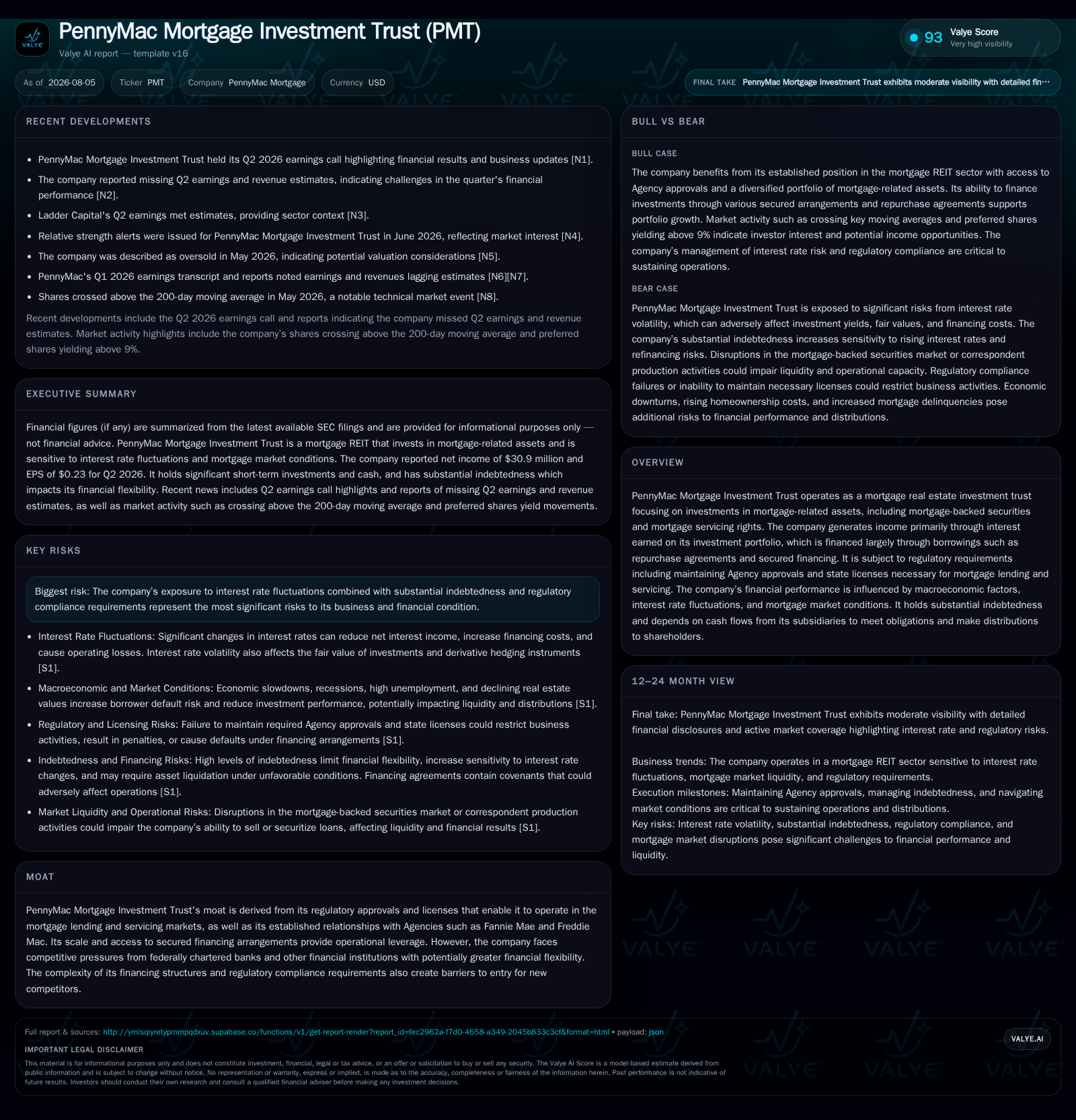
PennyMac Mortgage Investment Trust (PMT), a mortgage REIT specializing in mortgage-backed securities (MBS) and mortgage servicing rights (MSRs), reported Q2 2026 results reflecting challenges from interest rate fluctuations and refinancing activity downturns. The trust’s net interest income compression underscores inherent risks of funding costs rising faster than investment yields. PMT’s regulatory licenses and Agency approvals create a competitive moat, but its substantial leverage and dependence on secured financing expose it to margin calls and liquidity risks. The company’s growth hinges on stable or favorable interest rate spreads, expansion of servicing portfolios, and access to low-cost financing amidst heightened regulatory scrutiny.
Recent Operating Update: Q2 2026 Results Reflect Margin Pressures
Business Model: Spread-Driven Income Anchored by Agency-Backed Assets
PennyMac operates as a mortgage real estate investment trust focusing primarily on agency mortgage-backed securities (MBS) and mortgage servicing rights (MSRs). Its income stems predominantly from net interest income—the difference between interest earned on these assets and the cost of financing them [S1]. The company funds its investments primarily through repurchase agreements and secured debt facilities collateralized by its MBS or MSRs portfolios
This structure relies heavily on maintaining access to low-cost secured financing that typically carries shorter maturities than underlying asset durations. Consequently, PMT's return hinges on its ability to effectively manage the duration mismatch while controlling prepayment risk—the pace at which borrowers refinance or repay loans—which impacts cash flows and valuation of MSRs. Additionally, the servicing segment provides fee income linked to managing loan portfolios under strict contractual guidelines with government-sponsored entities like Fannie Mae and Freddie Mac.
Industry Structure and Competitive Position: Regulatory Approvals as Moat Amid Leverage Risks
Mortgage REITs like PennyMac occupy a niche between mortgage originators and capital markets investors. Unlike banks, they do not originate loans but invest in pools of mortgages or service them while leveraging debt extensively. PMT’s scale affords it significant access to secured borrowings via repurchase agreements—critical for efficient financing—and helps maintain relationships with federal Agencies essential for MSR retention [S1], [S5]. These Agency approvals effectively form a regulatory moat since maintaining them requires compliance with stringent financial covenants and operational standards enforced at multiple jurisdictional levels.
The company must maintain liquidity thresholds, tangible net worth levels, and profitability metrics not only for itself but for subsidiaries engaged in servicing operations; failure could trigger servicer termination events leading to loss of MSRs—valuable assets—and liquidity constraints via loss of funding access [S4], [S6], [S10]. Compared with peer Mortgage REITs such as Annaly Capital Management or AGNC Investment Corp., PMT’s integration with loan production affiliates enhances its ability to secure incremental assets but also concentrates operational risks tied to correspondent seller compliance.
Growth Drivers: Interest Rate Environments and Servicing Portfolio Expansion
Key drivers include a stable or positive environment for net interest spreads. Favorable Fed policies that contain financing costs while enabling MBS yields offer a pathway for expanding net interest income. PennyMac also benefits from growing its servicing portfolio—a segment delivering more predictable fee income—and increased issuance of MBS opportunities enhancing asset acquisition flexibility.
Improved credit conditions that reduce defaults enhance asset values and collections on MSRs while lowering provision expenses. Regulatory evolution enabling new investment avenues within mortgage finance can create diversification prospects beyond traditional agency securities. Lastly, housing market dynamics affect origination volumes indirectly feeding supply into the securitization pipeline from which PMT sources assets.
Risks and Watchpoints: Interest Rate Volatility, Leverage Complexity, Regulatory Compliance
PennyMac faces pronounced exposure to interest rate fluctuations that affect both asset valuations and funding costs; adverse moves have triggered operating losses historically when expense overtakes income [S1]. Prepayment risk arising from borrower refinancing activity can reduce expected cash flows abruptly by shortening asset durations.
Operationally, failure in servicing functions or loss of Agency approvals would cause termination risks translating into asset write-downs or lost future fee streams. Compliance failures among correspondent sellers may cascade penalties back onto PMT's portfolio quality affecting credit risk metrics.
What To Watch Next: Key Milestones And Demand Indicators
Upcoming quarters should be closely examined for stabilization or expansion in net interest margins—an operational bellwether demonstrating whether PMT can sustainably manage basis risk between asset yields and borrowing costs. Monitoring servicing portfolio growth rates will provide indications regarding fee diversification progress.
Margin call frequency serves as an early warning indicator about collateral value stress under secured borrowings. Maintaining compliance with financial covenants without breach is critical for uninterrupted funding access.
Dividend payouts relative to cash flow generation will reveal capital allocation discipline amid repayment schedules for senior notes due in late decade years [S3]. Changes in Agency approval statuses must also be tracked given their impact on operating license continuity.
This analysis synthesizes SEC filings up to Q2 2026 alongside industry knowledge relevant to Mortgage REIT operations without making investment research views.
Disclaimer: This is research-only, informational analysis and not investment advice. It may include AI-generated interpretation and general industry context. Always verify important details using primary sources.

Comments